


Requirements, best banks, documents, and step-by-step process for non-residents opening a savings account in the UAE
Non-residents can open a bank account in Dubai, but the process differs fundamentally from resident banking. Only savings and fixed deposit accounts are available: current accounts with chequebooks require a UAE residence visa and Emirates ID, with no exceptions. Minimum balance requirements typically range from AED 3,000 to AED 500,000 depending on the bank and account tier, and an in-person branch visit is required in nearly all cases. Since the UAE’s exit from the FATF Grey List in February 2024, banks enforce significantly stricter Know Your Customer (KYC) and source-of-funds checks on non-resident applicants.
This guide covers which banks accept non-resident applications, the exact documents you need to bring, how the account-opening process works in practice, minimum balance thresholds by bank, common rejection reasons, and what non-resident accounts can and cannot do compared to resident accounts. If you already hold a UAE residence visa, see our guide on how to open a bank account in Dubai as an expat instead.
Key Takeaways
- Account type: Non-residents are limited to savings accounts and fixed deposits. Current accounts (chequebook, overdraft) require a UAE residence visa.
- Physical presence required: You must enter the UAE on a tourist visa or visit visa and visit a bank branch in person. Fully remote opening is not available for standard personal accounts.
- Banks that accept non-residents: Emirates NBD, Mashreq, First Abu Dhabi Bank (FAB), ADCB, RAKBANK, HSBC UAE, and Dubai Islamic Bank.
- Minimum balance: Ranges from AED 3,000 (entry-level savings) to AED 100,000–500,000 (priority/premium banking), depending on the bank.
- Core documents: Passport with UAE entry stamp, 6 months of home-country bank statements, bank reference letter, proof of address, and income documentation.
- KYC strictness: Enhanced due diligence applies under Federal Decree-Law No. 10 of 2025 on AML/CFT. Expect detailed source-of-funds and source-of-wealth questions.
- Timeline: Plan a stay of 5–7 working days. Some banks activate accounts on the same day; others take 3–5 business days after the branch visit.
- What you get: Debit card, online banking, SWIFT transfers, multi-currency functionality. No chequebook, no personal loans, no credit cards (unless secured against a fixed deposit).
What Is a Non-Resident Bank Account in the UAE?
A non-resident bank account is a savings or fixed deposit account opened by someone without a UAE residence visa. These accounts are designed for foreign investors, property buyers, business owners, and individuals who receive payments from the UAE but do not live in the country. The Central Bank of the UAE (CBUAE) permits licensed banks to offer these accounts, though each bank sets its own eligibility criteria, minimum deposits, and service levels.
The key distinction is regulatory, not practical. Under CBUAE guidelines, only UAE residents may hold AED current accounts with full transactional features: chequebooks, overdraft access, salary transfers, and personal lending products. Non-residents receive savings accounts that provide debit card access, online banking, international SWIFT transfers, and multi-currency functionality in AED, USD, EUR, and GBP. For most non-residents who need a UAE banking footprint for property transactions, international transfers, or asset diversification, a savings account covers the core requirements.
Non-Resident vs Resident Account: Key Differences
| Feature | Non-Resident Account | Resident Account |
|---|---|---|
| Account type | Savings / Fixed deposit only | Current, savings, fixed deposit |
| Chequebook | Not available | Available with current accounts |
| Debit card | Yes (most banks) | Yes |
| Credit card | Only secured against fixed deposit | Standard and secured options |
| Personal loans | Not available | Available (salary-linked) |
| International transfers | Yes (SWIFT, online) | Yes (SWIFT, online, standing orders) |
| Multi-currency | AED, USD, EUR, GBP (varies by bank) | AED, USD, EUR, GBP + more options |
| Minimum balance | AED 3,000–500,000 (higher tiers) | AED 0–3,000 (salary accounts often zero) |
| KYC requirements | Enhanced due diligence | Standard CDD |
| Opening process | In-person branch visit required | Online via app or branch |
The absence of a chequebook matters more than it seems. In the UAE, post-dated cheques remain standard for rent payments, utility deposits, and various government transactions. Without a chequebook, you cannot sign a tenancy contract through standard channels. If you plan to rent property, you will need either a resident account or an arrangement with a property manager who accepts bank transfers.
Who Should Open a Non-Resident Bank Account in Dubai?
Not everyone needs one, and alternatives exist. A non-resident account makes practical sense in specific situations where holding funds directly in the UAE banking system provides a functional advantage over international transfers or third-party payment platforms.
- Property buyers and investors: If you are purchasing or already own property in Dubai, a local account simplifies DLD fee payments, developer instalments, and rental income collection. Some developers and the Dubai Land Department require payments from a UAE bank account.
- Business owners without UAE residency: Owners of UAE-registered companies who do not hold a residence visa may need a personal account to receive dividends or manage company-related personal transactions.
- Freelancers and remote workers with UAE clients: Receiving payments in AED directly avoids currency conversion losses and delays associated with international wire transfers.
- Wealth diversification: The UAE offers zero income tax, zero capital gains tax, and zero withholding tax on interest income. Multi-currency accounts provide a tax-efficient holding structure, though you remain subject to tax obligations in your country of residence.
- Future residents: Establishing a banking history before relocating can simplify the transition to a full resident account later.
Which Banks Accept Non-Resident Account Applications?
Only a limited number of UAE banks actively serve non-resident personal clients. The banks listed below have dedicated non-resident account products or routinely process non-resident applications. Each bank has different minimum balance thresholds, service levels, and tolerance for complex applicant profiles. Your choice should match your deposit capacity and intended account usage.
| Bank | Non-Resident Account Type | Indicative Minimum Balance | Best Suited For |
|---|---|---|---|
| Emirates NBD | Savings account (multiple tiers) | AED 3,000–50,000 | Property investors, clients wanting the largest branch/ATM network |
| Mashreq Bank | Savings (AED) / Current (foreign currency) | AED 10,000–100,000+ | Clients with larger deposits seeking premium digital banking |
| First Abu Dhabi Bank (FAB) | Savings account | AED 3,000–5,000 | Entry-level access, multi-currency flexibility |
| ADCB | Savings account (multi-currency) | AED 5,000–50,000 | Multi-currency needs, TouchPoints rewards program |
| RAKBANK | Elite savings account | AED 25,000+ (Elite tier) | Individuals wanting straightforward process and clear criteria |
| HSBC UAE | International banking / Premier | Varies (Premier relationship balance applies) | Existing HSBC global clients, expats moving to UAE soon |
| Dubai Islamic Bank (DIB) | Sharia-compliant savings account | AED 25,000+ | Clients requiring Islamic banking products |
Minimum balance thresholds are indicative and vary by account tier, applicant profile, and promotional periods. Confirm current requirements directly with each bank before your visit.
Emirates NBD: Largest Network, Widest Range of Tiers
Emirates NBD is the UAE’s largest bank by assets and the most frequently chosen option for non-resident personal accounts. The bank offers tiered savings accounts starting from AED 3,000 minimum balance for basic access, scaling up to AED 50,000 for premium packages with enhanced services. Their mobile banking app handles international transfers, currency conversion, and card management competently. The bank has over 200 branches and 900+ ATMs across the UAE, which provides practical convenience for account activation and cash management.
In practice, Emirates NBD’s compliance process for non-residents is thorough. The bank accepts online pre-applications through its website, but this does not replace the mandatory branch visit. Treat the digital form as a pre-screening step: complete it before arrival, then visit a central branch (DIFC, Downtown Dubai, or Business Bay) with your full document package. Account activation takes 1–5 business days after the branch visit, depending on compliance review.
Mashreq Bank: Non-Resident Savings and Foreign Currency Current Accounts
Mashreq Bank is one of the more accessible banks for non-residents. It explicitly offers non-residents both a savings account in AED and a current account in foreign currencies (USD, EUR, GBP). The documentation requirements are relatively straightforward: a valid passport, two months of bank statements from your home country, and proof of residential address abroad. The bank’s digital platform is advanced, with multilingual support and strong international transfer capabilities.
Mashreq positions itself at the premium end, with non-resident account minimums typically starting at AED 10,000 and climbing to AED 100,000 or more for priority banking services. This makes it better suited for clients with meaningful capital to deposit rather than those testing the waters with smaller amounts.
HSBC UAE: Best for Existing HSBC Global Clients
HSBC UAE operates differently from local banks. If you already hold an HSBC Premier or HSBC One account in another country, you can leverage the bank’s International Banking service to open an account in the UAE, sometimes with simplified documentation and the ability to begin the process remotely. For clients without an existing HSBC relationship, the process is closer to standard non-resident applications at local banks, and the bank typically requires UAE residency for full current account access.
Documents Required to Open a Non-Resident Bank Account
Incomplete documentation is the single most common reason for application rejection. Banks officially list only a passport as the primary requirement, but arriving with just a passport will not result in a successful application at any major UAE bank. The enhanced KYC requirements under Federal Decree-Law No. 10 of 2025 mean compliance teams now routinely request all of the following:
- Original valid passport: including the page with your UAE entry stamp or visit visa. The passport must have at least 6 months’ remaining validity.
- Last 6 months of personal bank statements: from your primary bank in your home country, in English. If your statements are in another language, bring certified translations. Statements must be official (not screenshots) and show your name, account number, and transaction history.
- Bank reference letter: a letter from your home-country bank confirming your account has been open for at least 12 months, is in good standing, and states your residential address. This letter should be dated within 30 days of your UAE visit.
- Proof of residential address: a recent utility bill (electricity, water, gas) or bank statement from your home country, dated within the last 3 months, showing your name and full address.
- Proof of income or employment: salary certificate, employment contract, tax return, or business registration documents. Self-employed applicants should bring 6 months of business bank statements and any relevant trade licenses.
- Curriculum vitae (CV): some banks request a CV or professional summary to understand your background, particularly for higher-value accounts or complex income profiles.
- Source of funds declaration: be prepared to explain in writing and verbally where the money you plan to deposit comes from. The bank’s compliance team will ask about the origin of funds (salary, business income, property sale, investment proceeds, inheritance, etc.).
All documents should be originals or certified copies. If any document is not in English or Arabic, bring a certified translation alongside the original.
Documents That Strengthen Your Application
Beyond the core requirements, the following optional documents can improve your chances of approval, particularly if your income sources are complex or your nationality falls in a higher-risk compliance category:
- Property purchase agreement or title deed (if opening the account for UAE real estate transactions)
- Company registration documents (if you own a UAE or international business)
- Investment portfolio statements
- Reference letter from a professional advisor (accountant, lawyer) confirming your business activities
Step-by-Step Process: Opening a Non-Resident Account in Dubai
The practical process takes between 1 and 7 working days from your first branch visit to full account activation. Planning your UAE trip around this timeline is essential: an account applied for on a Friday is unlikely to be active by Monday, because the UAE weekend falls on Saturday and Sunday. What the bank then sends abroad each year, and the exact fields it reports, is covered in what your UAE bank reports under FATCA and CRS.
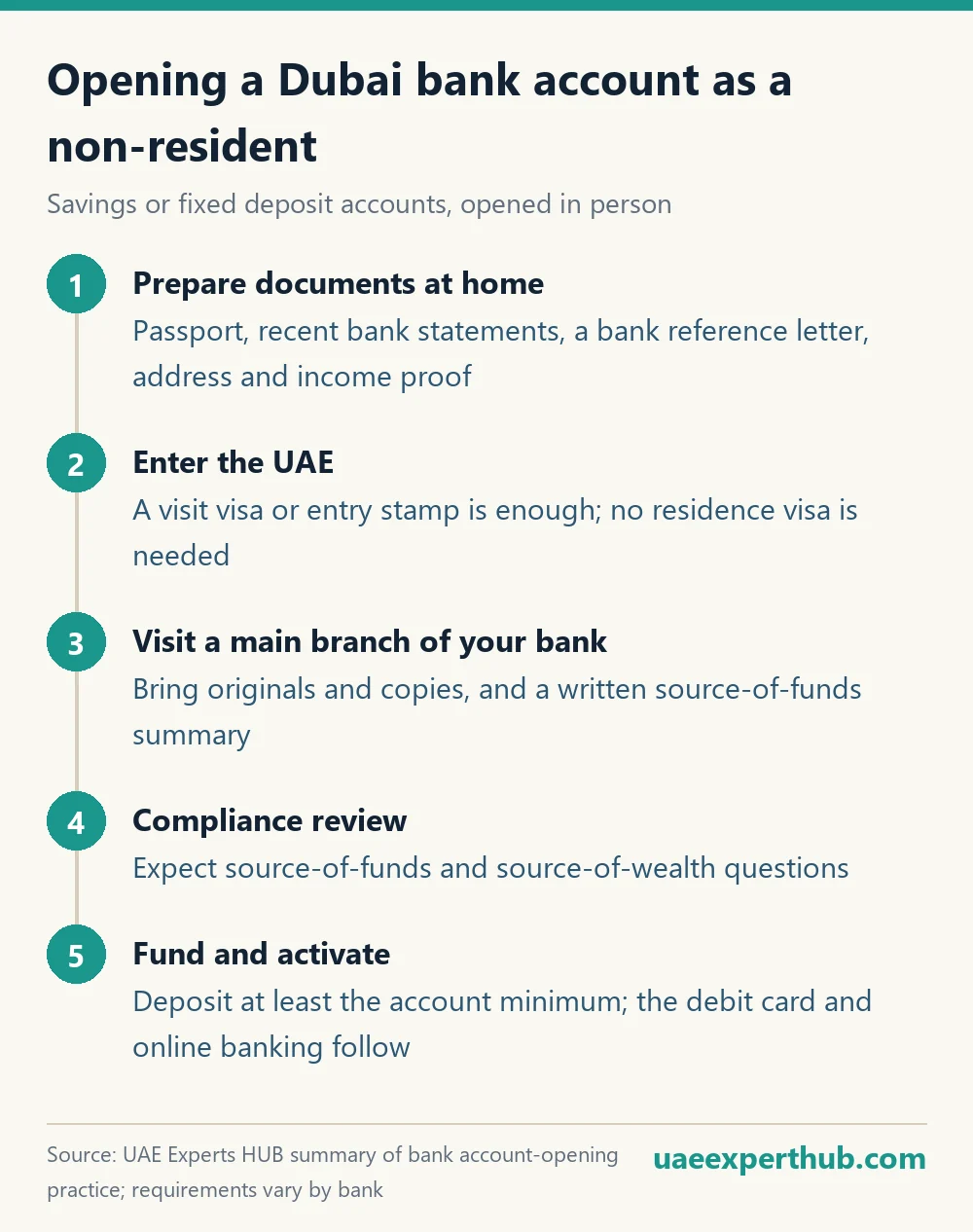
Step 1: Prepare Documents Before Traveling to the UAE
Where: Your home country
What to do: Gather all documents listed above. Request the bank reference letter at least 2–3 weeks before your trip, as some banks take time to issue one. Ensure bank statements are in English and cover the most recent 6 months. Prepare a clear, written summary of your source of funds and the purpose for opening a UAE account.
Timeline: 2–4 weeks before travel
Step 2: Enter the UAE and Obtain a Valid Entry Stamp
Where: Any UAE port of entry (Dubai airport, Abu Dhabi airport, land border)
What happens: Your passport must carry a valid UAE entry stamp or visit visa. A tourist visa on arrival (available to 70+ nationalities for 30 or 90 days) is sufficient. You do not need a residence visa or work visa for a savings account. If your nationality requires a pre-arranged visit visa, ensure it is valid before departure.
Timeline: Upon arrival
Step 3: Visit a Main Branch of Your Chosen Bank
Where: A main branch in a business district: DIFC, Downtown Dubai, Business Bay, or Sheikh Zayed Road. Avoid suburban or mall branches, which may not have compliance officers authorised to process non-resident applications.
What to bring: All original documents plus copies. Dress professionally. First impressions matter in UAE banking culture, particularly for non-resident applications.
What happens: A relationship manager or customer service officer will review your documents and conduct the KYC interview. Expect questions about: your occupation, the source of your income, the purpose of the account, expected transaction volumes and frequency, and your connection to the UAE (property ownership, business interests, family). Answer directly and specifically. Vague responses trigger additional scrutiny.
Timeline: The branch meeting takes 30–90 minutes
Step 4: Complete the Compliance Review
Where: Internal bank process (you wait for confirmation)
What happens: After the branch visit, the bank’s compliance department reviews your application and runs background checks. This includes verifying your identity, screening against sanctions lists, and assessing your risk profile under the bank’s customer acceptance policy. Some banks approve same-day; others take 3–5 business days.
Timeline: 1–5 business days
Step 5: Fund Your Account and Activate
Where: At the branch or via international wire transfer
What happens: Once approved, deposit the required minimum balance. Some banks require the initial deposit at the branch; others allow you to wire funds from your home-country account within 7 days. You receive your account number, IBAN, online banking credentials, and a debit card (card delivery may take 3–5 days). Set up the bank’s mobile app during your visit.
Timeline: Same day (deposit) + 3–5 days (card delivery)
Minimum Balance Requirements and Account Fees
Non-resident accounts carry higher minimum balance requirements than resident accounts. Falling below the minimum triggers monthly maintenance fees, typically AED 25–100 depending on the bank and account tier. Some banks frame this as a “fall-below fee” rather than a service charge. The practical consequence is the same: your balance erodes monthly if you deposit less than the threshold and leave the account dormant.
| Bank | Indicative Minimum Balance | Fall-Below Fee | Notes |
|---|---|---|---|
| Emirates NBD (basic savings) | AED 3,000 | AED 26.25/month | Higher tiers up to AED 50,000 |
| Mashreq (non-resident savings) | AED 10,000+ | Refer to Schedule of Charges | Priority tier: AED 100,000+ |
| FAB (basic savings) | AED 3,000–5,000 | Varies by account type | Entry-level option for non-residents |
| ADCB | AED 5,000–50,000 | Varies by package | Multi-currency accounts available |
| RAKBANK (Elite) | AED 25,000+ | Refer to Elite service guide | Dedicated relationship manager included |
Fees and minimum balances are subject to change. Confirm current figures on each bank’s official website or at the branch before opening your account.
Beyond minimum balance charges, watch for international transfer fees (typically AED 15–75 per outbound SWIFT transfer), currency conversion margins (0.25%–1.5% above mid-market rate), ATM withdrawal fees outside the UAE, and account closure fees if you close within the first 6 months (commonly AED 100–525 including VAT).
KYC and AML Compliance: What Non-Residents Should Expect
The compliance landscape has shifted significantly since the UAE was placed on the FATF Grey List in 2022 and subsequently removed in February 2024 after strengthening its AML policies. Non-resident account applications are now classified as enhanced due diligence (EDD) cases at most banks. This is not bureaucratic excess: it reflects the global standard for cross-border banking that UAE institutions now enforce at a level comparable to Swiss and Singaporean private banking.
The CBUAE’s CDD/KYC Guidance requires banks to identify and verify the source of funds (the specific money entering the account), source of wealth (how you accumulated your assets over time), the purpose and intended nature of the business relationship, and the expected pattern of transactions. For non-residents, banks must also assess country risk: your nationality and country of residence factor into the risk assessment under the bank’s customer acceptance policy.
Practical Tips for the KYC Interview
Prepare clear, specific answers before your branch visit. Vague statements like “I do consulting” or “various investments” will slow your application or trigger additional review rounds. Instead, prepare documentation showing exactly what you do, how much you earn, and where the deposit funds come from. If your income includes cryptocurrency, present other documented income sources first. Banks associate crypto income with elevated compliance complexity, and it may extend the review period.
Avoid stating that you are “looking for work” in the UAE. This is a red flag for non-resident applications, as it suggests you may need a resident account (with different regulatory requirements) rather than a non-resident savings account. Frame your purpose clearly: property investment, asset diversification, receiving UAE-sourced income, or managing existing UAE financial interests.
Can You Open a Non-Resident Bank Account Remotely?
For standard personal savings accounts at UAE-domiciled banks, the answer is no: physical presence in the UAE is required. While some banks offer online pre-application forms, these function as pre-screening tools rather than complete remote opening channels. The in-person branch visit is where identity verification, KYC interview, and document authentication take place.
There are limited exceptions. Existing HSBC Premier or HSBC One clients in other countries may be able to initiate the process through their International Banking Centre and complete account opening with reduced in-person requirements. Some private banking divisions at UAE banks offer video-based onboarding for ultra-high-net-worth clients, but these require relationship balances well above AED 500,000 and are arranged through invitation, not standard application channels.
If you need a multi-currency account with AED functionality but cannot travel to the UAE, consider alternatives like Wise Business or Revolut, which offer AED-denominated transactions through international fintech platforms. These are not UAE bank accounts and do not provide a local UAE IBAN, but they serve basic transfer and payment functions for clients who cannot make the trip.
Common Rejection Reasons and How to Avoid Them
Banks can refuse a non-resident application without providing a detailed explanation: the CBUAE permits banks to decline accounts as part of their risk-based customer acceptance policies. However, the most common reasons are identifiable and avoidable with proper preparation.
- Incomplete or outdated documents: Bank statements older than 3 months, address proof older than 3 months, or a bank reference letter dated more than 30 days before the visit. Always bring the freshest documents possible.
- Unclear source of funds: The compliance team cannot trace where the money comes from. Prepare a written explanation with supporting documentation (employment contracts, business income evidence, property sale proceeds, inheritance records).
- High-risk nationality or country of residence: Citizens or residents of countries on FATF monitoring lists face additional scrutiny. This does not mean automatic rejection, but it extends review times and requires more extensive documentation. If this applies to you, consider a bank introduction or advisory service to present your application professionally.
- No clear purpose for the account: “I just want a Dubai account” is insufficient. Link the account to a specific use case: property investment, business income, family support, or asset diversification.
- Visiting the wrong branch: Smaller branches in suburban areas may not have compliance officers authorised to process non-resident applications. Always visit a main branch in a central business district.
- Insufficient deposit capacity: Arriving with funds below the bank’s minimum threshold, or being unable to demonstrate that you can maintain the required balance. Know the minimum before you visit.
Non-Resident Accounts and UAE Property Investment
For non-residents purchasing property in Dubai, a local bank account simplifies the transaction process but is not always strictly required. Some developers accept international wire transfers directly, and the Dubai Land Department processes payments through registered property transfer procedures that can involve escrow arrangements. However, having a UAE account provides practical advantages: faster fund transfers to developers, easier management of ongoing service charges, direct receipt of rental income if you plan to let the property, and a banking relationship that becomes necessary if you later apply for a mortgage as a non-resident.
If your primary reason for opening an account is a property purchase, bring your sale and purchase agreement (SPA) or reservation form to the bank branch. This provides a documented purpose for the account and strengthens your application by demonstrating a legitimate UAE financial interest. Some banks, particularly ADCB and Emirates NBD, have dedicated non-resident property buyer programs that streamline the process when you can show an active transaction.
Tax Implications for Non-Resident Account Holders
The UAE imposes no income tax, capital gains tax, or withholding tax on interest income earned in bank accounts. This applies equally to residents and non-residents. However, holding a UAE bank account does not make you a UAE tax resident: tax residency in the UAE requires a separate application through the Federal Tax Authority and is linked to your residency visa and physical presence.
Under the Common Reporting Standard (CRS), UAE banks automatically report account information (including account holder identity, balance, and interest income) to tax authorities in your country of residence. The UAE has signed CRS agreements with over 100 jurisdictions. This means your home-country tax authority will receive information about your UAE bank account. You are responsible for reporting income and assets held in UAE accounts according to the tax laws of your country of residence.
What Happens if You Later Become a UAE Resident?
If you obtain a UAE residence visa after opening a non-resident account, contact your bank to upgrade your account status. Most banks will convert your savings account to a full current account once you provide your Emirates ID and residence visa. This upgrade unlocks chequebook access, personal lending products, credit cards, and salary transfer functionality. The process is straightforward: you do not need to close and reopen the account.
Banks typically require the updated documents within 30 days of your residence visa issuance. Failing to update your status can result in account restrictions, as the bank’s compliance obligations differ for residents and non-residents. If you anticipate obtaining residency soon, mention this during the account opening process. It may influence which account tier or product the bank recommends.
FAQ
Can a Non-Resident Open a Bank Account in Dubai Without a Visa?
You need a valid UAE entry stamp in your passport, which you receive automatically upon arrival as a tourist. A tourist visa on arrival (available to 70+ nationalities) or a pre-arranged visit visa is sufficient. You do not need a residence visa or work visa. The entry stamp serves as proof of legal presence, which banks require to process non-resident applications under CBUAE regulations.
What Is the Minimum Deposit to Open a Non-Resident Account in Dubai?
Minimum deposits vary by bank and account tier. FAB and Emirates NBD offer entry-level savings accounts starting from AED 3,000–5,000. Mid-range options at ADCB and Mashreq require AED 5,000–50,000. Premium and priority banking tiers at any bank can require AED 100,000–500,000. Always confirm current minimums directly with the bank, as these thresholds change with product updates and promotional periods.
How Long Does It Take to Open a Non-Resident Account in Dubai?
Plan 5–7 working days in the UAE. The branch visit takes 30–90 minutes. Account approval can happen on the same day at some banks, while others take 3–5 business days for compliance review. Debit card delivery adds another 3–5 days. If your profile is complex or your nationality requires additional screening, the process can extend to 2–3 weeks in rare cases.
Can I Open a Dubai Bank Account Entirely Online as a Non-Resident?
Not for standard personal accounts at UAE-domiciled banks. Some banks accept online pre-applications, but the in-person branch visit remains mandatory for identity verification and KYC interview. HSBC Premier clients with an existing global relationship may have a partially remote process. Fully remote options are limited to international fintech platforms (Wise, Revolut) that offer AED transactions but are not UAE bank accounts.
Do UAE Banks Report My Account to My Home Country’s Tax Authority?
Yes. Under the Common Reporting Standard (CRS), UAE banks automatically share account holder information (including identity, balance, and interest income) with tax authorities in participating countries. Over 100 jurisdictions have CRS agreements with the UAE. You are required to report your UAE account and any income it generates under the tax laws of your country of residence.
What Documents Do I Need to Open a Non-Resident Account?
At minimum: valid passport with UAE entry stamp, 6 months of home-country bank statements in English, a bank reference letter (dated within 30 days), proof of residential address (utility bill or bank statement, within 3 months), and proof of income. Some banks also request a CV and written source-of-funds declaration. Missing any of these documents is the most common cause of rejection.
Can I Get a Credit Card With a Non-Resident Bank Account?
Standard unsecured credit cards are not available to non-residents. Some banks issue secured credit cards backed by a fixed deposit: you place a sum (typically AED 10,000–50,000 or more) in a fixed deposit, and the bank issues a credit card with a limit matching or slightly below that deposit. The deposit is locked for the duration of the card’s validity.
Which Branch Should I Visit to Open a Non-Resident Account?
Visit a main branch in a central business district: DIFC, Downtown Dubai, Business Bay, or Sheikh Zayed Road. These locations have compliance officers authorised to process non-resident applications and are accustomed to serving international clients. Avoid suburban branches, mall kiosks, or smaller neighbourhood locations, which may redirect you to a main branch anyway.
Can I Receive Rental Income in a Non-Resident Bank Account?
Yes. If you own rental property in Dubai, tenants or property management companies can transfer rental payments directly to your non-resident savings account. This is one of the most common use cases. You can then transfer funds internationally from your UAE account to your home-country bank. Ensure your tenancy contract specifies bank transfer as the payment method, since non-resident accounts do not include chequebooks.
What Happens to My Account if I Don’t Use It for a Long Period?
UAE banks classify accounts as dormant after 12–24 months of inactivity (no customer-initiated transactions). A dormant account may be restricted: you cannot make withdrawals or transfers until you reactivate it by contacting the bank, which may require updated KYC documents. After extended dormancy, the CBUAE requires banks to transfer unclaimed balances to the central bank’s unclaimed deposits register. To avoid dormancy, execute at least one small transaction every 6 months.
Official Sources
- Central Bank of the UAE, AML/CFT Regulations and Supervision
- CBUAE Rulebook, AML/CFT Guidance for Licensed Financial Institutions
- CBUAE, CDD/KYC Guidance for Licensed Financial Institutions
- Emirates NBD, Account Opening and Products
- Mashreq Bank, Non-Resident Account Information
- RAKBANK, Non-Resident Elite Banking
- HSBC UAE, International Banking Services
Regulations and fees are subject to change. Verify requirements with official authorities before proceeding.
This guide is for informational purposes only. UAE regulations and fees are subject to change. Always verify current requirements with the relevant official authority before proceeding with any application or transaction.