

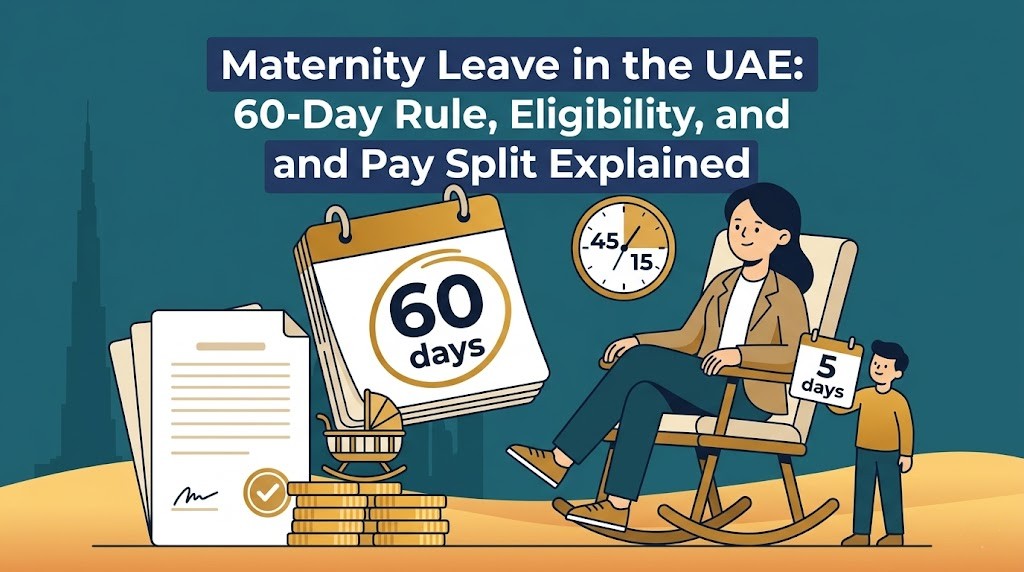
Under UAE labour law (Article 30 of Federal Decree-Law No. 33 of 2021), female employees in the private sector are entitled to 60 calendar days of maternity leave — 45 days at full pay followed by 15 days at half pay. No minimum service period is required; the entitlement applies from day one of employment. This article covers the complete pay structure, eligibility conditions, extensions for medical complications, government sector differences, DIFC and ADGM rules, and the additional 5-day parental leave available to both parents.
This guide covers only the legal framework under federal labour law and free zone employment regulations. Company-specific policies may offer more generous terms, but they cannot fall below the statutory minimums described here. The responsible authority for the private sector is the Ministry of Human Resources and Emiratisation (MOHRE).
Key Takeaways: Maternity Leave in the UAE (2026)
- Private sector employees receive 60 calendar days of maternity leave: 45 days at full pay, 15 days at half pay.
- No minimum service requirement — eligible from day one of employment.
- Leave can start up to 30 days before the expected delivery date.
- An additional 45 days of unpaid leave is available for pregnancy- or childbirth-related illness (medical certificate required).
- If the newborn is sick or has a disability: 30 extra days at full pay, extendable by another 30 days unpaid.
- Both parents are entitled to 5 working days of paid parental leave within 6 months of the child’s birth.
- Nursing breaks of up to 1 hour per day (fully paid) for 6 months after returning to work.
- Termination during maternity leave is prohibited under UAE law.
How Maternity Leave Works in the UAE Private Sector
Maternity leave in the UAE private sector is governed by Article 30 of Federal Decree-Law No. 33 of 2021, which applies to all mainland companies and most free zones (except DIFC and ADGM, which have their own employment frameworks). The law replaced the older Federal Law No. 8 of 1980 and came into effect on 2 February 2022, extending the previous 45-day entitlement to 60 days.
The 60-day period consists of calendar days, not working days. Weekends and public holidays falling within the maternity leave period count toward the 60-day total. The leave is structured in two tiers: the first 45 days at full wage (basic salary plus regular allowances such as housing and transport), and the remaining 15 days at half of that wage. Performance bonuses, commissions, and variable incentives are typically excluded from the maternity pay calculation.
Who Is Eligible
Every female employee working under a valid UAE employment contract is entitled to maternity leave, regardless of length of service. The law does not impose a probation period exclusion — an employee who becomes pregnant during her first month of employment has the same statutory right. This applies equally to UAE nationals and expatriates, full-time and part-time workers, and employees on limited-term contracts.
Some HR sources reference a half-pay rule for employees with less than one year of service. This originates from certain interpretations and company-level policies rather than from the text of Article 30 itself, which makes no distinction based on service length. If your employer applies reduced maternity pay citing short tenure, it is worth checking the contract terms and, if needed, raising the matter with MOHRE.
When the Leave Can Start
Under Article 30(5), the employer must grant maternity leave at any time from the last day of the month preceding the expected delivery month. In practice, this means a woman expecting delivery in August can begin her leave from 31 July at the earliest. Many employees choose to start leave closer to the due date to preserve more post-delivery recovery time, but this is a personal decision — the law does not mandate a specific split between pre-birth and post-birth leave.
The 60-Day Pay Structure Explained
The pay split is the most common source of confusion. Here is how it works in practice:
| Period | Duration | Pay Rate | Pay Basis |
|---|---|---|---|
| Days 1–45 | 45 calendar days | 100% (full pay) | Basic salary + regular allowances |
| Days 46–60 | 15 calendar days | 50% (half pay) | Basic salary + regular allowances |
| Extension (illness) | Up to 45 calendar days | Unpaid | Medical certificate required |
| Extension (sick/disabled child) | 30 days + 30 days | Full pay + unpaid | Medical certificate required |
Pay Calculation Example
A female employee earning AED 12,000 per month (AED 8,000 basic + AED 4,000 regular allowances) would receive:
| Period | Calculation | Total |
|---|---|---|
| Days 1–45 (full pay) | (AED 12,000 ÷ 30) × 45 = AED 400/day × 45 | AED 18,000 |
| Days 46–60 (half pay) | (AED 6,000 ÷ 30) × 15 = AED 200/day × 15 | AED 3,000 |
| Total maternity pay | AED 21,000 |
The daily rate follows the standard UAE payroll convention of dividing the monthly salary by 30, regardless of the actual number of days in the month.
Extended Leave: Medical Complications and Special Cases
The law provides three distinct extension pathways beyond the standard 60 days, each with specific conditions.
Pregnancy- or Childbirth-Related Illness (Up to 45 Days Unpaid)
If the mother is unable to return to work due to illness related to the pregnancy or delivery, she may take up to 45 additional calendar days of unpaid leave. These days can be taken consecutively or intermittently. A medical certificate from a licensed medical authority is mandatory — employer-approved documentation from any UAE-licensed facility typically suffices. Without the medical certificate, the employer is not obliged to grant this extension.
Sick or Disabled Newborn (30 Days Paid + 30 Days Unpaid)
If the child is born with an illness or disability requiring the mother’s constant presence, the law grants an additional 30 days at full pay immediately following the initial 60-day maternity leave. If the condition persists, the mother may take a further 30 days of unpaid leave. Both extensions require a medical report from a licensed medical authority confirming the child’s health condition.
Stillbirth or Miscarriage After 6 Months of Pregnancy
Under Article 30(3), the full 60-day maternity leave applies if delivery occurs after six or more months of pregnancy, whether the child is born alive or stillborn. This means a miscarriage or stillbirth in the third trimester triggers the same leave entitlement as a live birth. Miscarriages earlier than six months of pregnancy are typically treated under the sick leave provisions rather than maternity leave.
Parental Leave: The Additional 5-Day Entitlement
Separately from maternity leave, Article 32(1)(b) of Federal Decree-Law No. 33 of 2021 grants both mothers and fathers 5 working days of paid parental leave to care for a newborn. The leave must be taken within 6 months of the child’s birth, either continuously or split across multiple periods.
For mothers, parental leave is in addition to the 60-day maternity leave. A mother can therefore combine her maternity leave with the 5-day parental leave, plus accrued annual leave, to extend her total time off. No minimum service requirement applies — parental leave is available from day one of employment.
A birth certificate must be provided to the employer to claim parental leave, as specified in Article 21(4) of Cabinet Resolution No. 1 of 2022.
Nursing Breaks After Returning to Work
After the mother returns from maternity leave, she is entitled to one or two additional breaks per day for nursing, with the total break time not exceeding one hour. These breaks continue for 6 months from the date of delivery and are fully paid — the employer cannot deduct them from salary or classify them as unpaid time.
What this looks like in practice: the employee and employer typically agree on whether the break is taken as a single hour (for example, leaving one hour early) or split into two 30-minute breaks during the workday. The law does not prescribe the exact scheduling, leaving this to workplace arrangement. However, during Ramadan, nursing breaks are generally not applicable for employees observing the fast, as government guidelines have historically excluded nursing breaks during the fasting month.
Job Protection During Maternity Leave
UAE labour law explicitly prohibits terminating or issuing notice to a female employee because of pregnancy or while she is on maternity leave. This protection extends to the unpaid extension periods for illness and to the nursing break period. An employer who terminates an employee during maternity leave risks an arbitrary dismissal claim, which can result in compensation of up to three months’ wages on top of other end-of-service entitlements.
Maternity leave does not reduce the employee’s entitlement to annual leave or end-of-service gratuity. The leave period counts as continuous service for gratuity calculation purposes. Annual leave continues to accrue during maternity leave.
Government Sector: Longer Leave, Different Rules
Government employees in the UAE are covered by separate legislation with generally more generous maternity provisions. The rules vary between the federal government and each emirate’s local government.
| Sector / Emirate | Maternity Leave | Pay | Nursing Breaks | Legal Basis |
|---|---|---|---|---|
| Federal government | 90 days | Full pay | 2 hours/day for 6 months | FDL No. 49/2022, Art. 19 |
| Dubai government | 90 days (extendable to 120 with annual/unpaid leave) | Full pay for 90 days | 2 hours/day for 1 year | Decree No. 14 of 2017 |
| Sharjah government | 120 days (90 paid + 30 unpaid) | Full pay for 90 days | 2 hours/day for 6 months | Local decree (2016) |
| Ras Al Khaimah government | 90 days | Full pay | Until child turns 1 year | Local decision (Nov 2016) |
| Private sector (mainland) | 60 days | 45 days full + 15 days half | 1 hour/day for 6 months | FDL No. 33/2021, Art. 30 |
Federal government employees who give birth to a child with special needs receive childcare leave from the end of maternity leave until the child turns one year old. Dubai government employees have the same provision under Decree No. 14 of 2017.
FNC Recommendation: 98 Days (Not Yet Enacted)
In January 2026, the Federal National Council (FNC) recommended extending maternity leave in the federal government sector to 98 fully paid days, aligning with international labour standards. This remains a recommendation — it has not been enacted into law as of May 2026. The FNC also discussed mandating flexible work arrangements for mothers of children under 10–12 years old, and allowing maternity leave to be divided in cases involving premature births. These proposals are currently under review.
DIFC and ADGM: Separate Employment Laws
The Dubai International Financial Centre (DIFC) and Abu Dhabi Global Market (ADGM) operate under their own employment legislation, which differs from the federal labour law in several material ways.
| Element | Federal Law (Mainland + Most Free Zones) | DIFC | ADGM |
|---|---|---|---|
| Total maternity leave | 60 calendar days | 65 working days | 65 working days |
| Pay structure | 45 days full + 15 days half | 33 days full + 32 days half | 33 days full + 32 days half |
| Day type | Calendar days (includes weekends) | Working days (excludes weekends/holidays) | Working days (excludes weekends/holidays) |
| Minimum service for paid leave | None (from day 1) | 12 months continuous employment | 12 months continuous employment |
| Paternity leave | 5 working days (within 6 months) | 5 working days (within 1 month) | 5 working days (within 2 months) |
| Adoption | Not explicitly covered | Covered (child under 5 years) | Covered (child under 3 months) |
The most significant practical difference is that DIFC and ADGM maternity leave is counted in working days, which effectively extends the actual calendar time off. Sixty-five working days in a standard five-day work week translates to approximately 13 calendar weeks (about 91 calendar days), compared to roughly 8.5 calendar weeks under the federal law’s 60 calendar days. However, the DIFC and ADGM require 12 months of continuous employment before the employee qualifies for paid maternity leave — employees with less than a year of service are entitled to unpaid leave only.
Maximising Your Leave: Combining Entitlements
UAE law allows employees to combine maternity leave with other leave types. Cabinet Resolution No. 1 of 2022 (Article 21(5)) explicitly permits combining parental leave, annual leave, and unpaid leave.
A practical combination for a private sector employee might look like this:
| Leave Type | Duration | Pay Status |
|---|---|---|
| Maternity leave | 60 calendar days | 45 days full + 15 days half pay |
| Parental leave | 5 working days | Full pay |
| Accrued annual leave | Up to 30 calendar days | Full pay |
| Unpaid extension (if needed) | Up to 45 calendar days | Unpaid |
| Maximum possible total | ~140 calendar days |
This approach is especially common in Dubai government roles, where Decree No. 14 of 2017 explicitly allows combining annual leave and unpaid leave with maternity leave for a total of up to 120 days. In the private sector, combining leave types requires employer agreement on scheduling, but the law does not restrict it.
Common Issues and What to Watch For
Employer Refuses to Grant Full Pay for 45 Days
If your employer pays only basic salary during maternity leave (excluding regular allowances), this may not comply with the law. The “full wage” referenced in Article 30 includes the basic salary and fixed contractual allowances. If your contract includes a housing allowance or transport allowance as a regular monthly payment, these should continue during the paid maternity period. File a complaint with MOHRE if your employer withholds statutory maternity pay.
Maternity Leave Deducted from Annual Leave
Maternity leave is a separate statutory entitlement. An employer cannot deduct maternity leave days from annual leave. If you discover maternity days were counted against your annual leave balance, raise this with HR and escalate to MOHRE if unresolved.
Termination Shortly After Return
While the law prohibits termination during maternity leave, some employees report being let go shortly after returning. If the termination appears linked to the pregnancy or maternity absence, this may constitute arbitrary dismissal. Document all communications and file a MOHRE complaint within the statutory timeline.
Part-Time and Temporary Workers
Federal Decree-Law No. 33 of 2021 applies to all private sector employment categories, including part-time, temporary, and flexible work arrangements. Part-time employees are entitled to maternity leave, though pay is calculated based on their contracted wage and working pattern.
Documents Required for Maternity Leave
| Document | When Required | Issued By |
|---|---|---|
| Medical certificate confirming pregnancy and expected delivery date | Before maternity leave starts (if starting pre-delivery) | Licensed UAE medical facility |
| Birth certificate of the child | After delivery (for employer records and parental leave claim) | UAE Health Authority / Hospital |
| Medical certificate for illness extension | To claim additional 45 days unpaid leave | Licensed UAE medical authority |
| Medical report for sick/disabled child | To claim additional 30 days paid + 30 days unpaid | Licensed UAE medical authority |
There is no standardised MOHRE form for maternity leave applications. Most employers have internal HR processes — submit your request in writing (email is sufficient) with the supporting medical documentation. Keep copies of all submissions.
Impact on Health Insurance and Visa
Your employer-provided health insurance must remain active during maternity leave, as the employment relationship continues throughout the leave period. The insurer covers maternity-related medical expenses according to the policy terms. Dubai Health Authority (DHA) mandates that all Dubai-based health insurance plans include maternity coverage, though the specifics (co-pays, coverage caps, waiting periods for maternity benefits) vary between insurance providers and plan tiers.
Your residence visa and Emirates ID are unaffected by maternity leave because you remain an employed, sponsored individual. There is no need to take any visa-related action during or after maternity leave.
FAQ
How many days of maternity leave does UAE labour law provide?
Private sector employees receive 60 calendar days: 45 at full pay and 15 at half pay, under Article 30 of Federal Decree-Law No. 33 of 2021. Government employees receive 90 days at full pay under federal rules, though specific emirate-level provisions may differ.
Is there a minimum service requirement for maternity leave in the UAE?
No. Under the current federal labour law, maternity leave is available from the first day of employment. There is no probation exclusion or minimum tenure requirement for private sector employees. DIFC and ADGM require 12 months of continuous service to qualify for paid maternity leave.
Can I take maternity leave before giving birth?
Yes. The law allows maternity leave to begin up to 30 days before the expected delivery date. The leave can be requested from the last day of the month preceding the expected delivery month. Any pre-birth days count toward the total 60-day entitlement.
Does maternity leave include weekends and public holidays?
In the private sector (federal law), maternity leave is counted in calendar days — weekends and public holidays within the leave period are included. In DIFC and ADGM, maternity leave is counted in working days, so weekends and public holidays are excluded, effectively extending the calendar duration.
Can my employer terminate me during maternity leave?
No. Termination or serving notice during maternity leave is explicitly prohibited under UAE labour law. This protection applies throughout the maternity leave period, including any unpaid extensions for medical reasons. Violation may constitute arbitrary dismissal, entitling the employee to compensation.
What happens to my annual leave and gratuity during maternity leave?
Annual leave continues to accrue during maternity leave. The maternity leave period counts as continuous service for end-of-service gratuity calculations. Maternity leave cannot be deducted from annual leave — they are separate entitlements.
Can my husband take leave when our baby is born?
Yes. Both parents are entitled to 5 working days of paid parental leave under Article 32(1)(b) of Federal Decree-Law No. 33 of 2021. This must be taken within 6 months of the child’s birth and can be used continuously or in intervals. In DIFC, paternity leave must be taken within 1 month of birth; in ADGM, within 2 months.
Does maternity leave apply to miscarriage or stillbirth?
If delivery occurs after 6 or more months of pregnancy, the full 60-day maternity leave applies regardless of whether the child is born alive or stillborn. A miscarriage before the sixth month of pregnancy is generally handled under sick leave provisions, not maternity leave.
What if my baby is born with a disability or health condition?
The mother receives 30 additional days at full pay after the standard maternity leave, provided a medical report from a licensed authority confirms the child’s condition requires the mother’s constant presence. If needed, this can be extended by a further 30 days without pay.
Are nursing breaks paid?
Yes. After returning to work, the mother is entitled to up to 1 hour of paid nursing breaks per day for 6 months from the date of delivery. The timing of the breaks (start, end, or mid-day) is arranged with the employer but cannot be denied or deducted from salary.
Official Sources
- UAE Government Portal (u.ae) — Maternity Leave (Private Sector)
- UAE Government Portal (u.ae) — Maternity and Paternity Leave (Government Sector)
- MOHRE — Federal Decree-Law No. 33 of 2021 (Full Text PDF)
- Federal Decree-Law No. 33 of 2021 — Article 30 (Maternity Leave) and Article 32 (Other Leaves)
- Gulf News — FNC Recommendation on 98-Day Maternity Leave (January 2026)
- Khaleej Times — UAE Officials Call for Changes in Family Protection Laws (January 2026)
Maternity leave rules, pay structures, and government sector provisions can change through new decrees or ministerial resolutions. Confirm current entitlements with your employer, MOHRE, or the relevant free zone authority before making decisions based on this information.