

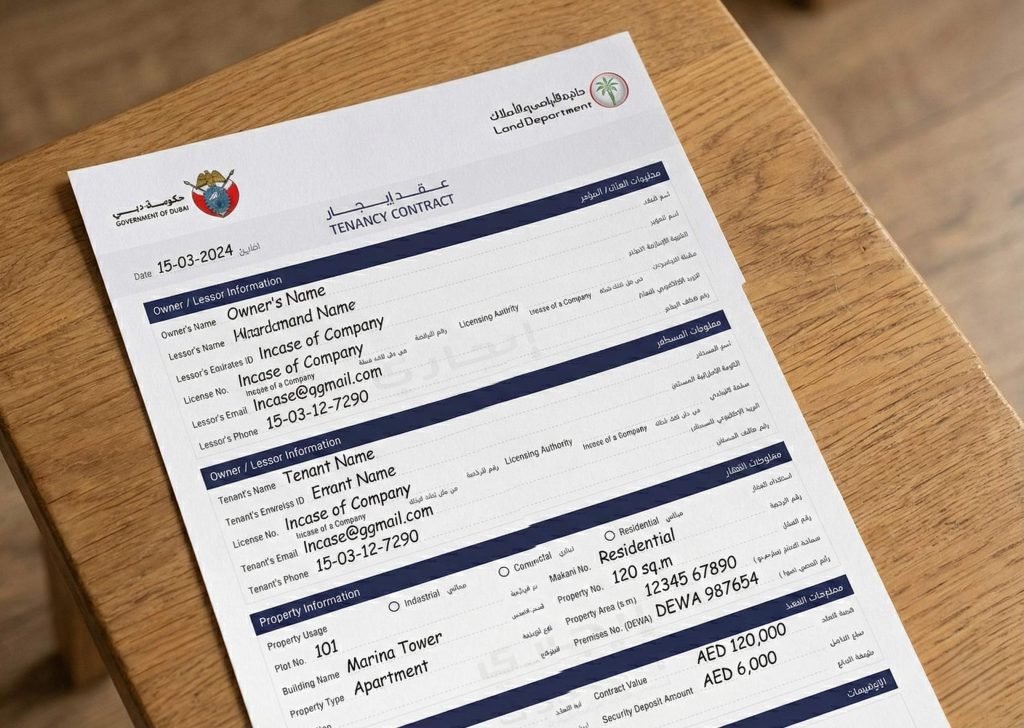
Essential guide to rental agreements, Ejari registration procedures, legal requirements, and landlord-tenant obligations under Dubai tenancy law.
Renting property in Dubai requires more than signing a lease agreement. Every tenancy contract must be registered through the Ejari system—Dubai’s official rental registration platform operated by the Dubai Land Department (DLD) under the Real Estate Regulatory Agency (RERA). Without Ejari registration, tenants cannot activate utilities, apply for residence visas, or access legal protection in rental disputes. This guide covers everything tenants, landlords, and property managers need to understand about tenancy contracts and Ejari registration in 2026.
This article explains what Ejari is, who should register, the complete registration process, current fees, required documents, landlord obligations, and how Ejari connects to essential services like DEWA. Whether you are a first-time renter or a property investor, understanding these requirements ensures compliance with Dubai’s rental regulations and protects your legal rights throughout the tenancy.
What Is Ejari in Dubai?
Ejari—Arabic for “my rent”—is Dubai’s official tenancy contract registration system introduced by RERA in 2010 under Law No. 26 of 2007. The system creates a legally binding record of every rental agreement in the emirate, storing contract details in a centralised government database maintained by the Dubai Land Department. When you register your tenancy contract through Ejari, you receive an Ejari certificate with a unique reference number that serves as official proof of your tenancy.
The Ejari system was designed to bring transparency and standardisation to Dubai’s rental market. Before its introduction, tenancy contracts varied widely in format, making verification difficult and legal enforcement inconsistent. Today, Ejari ensures every rental agreement follows a unified structure, records the agreed rental price, documents the lease duration, and captures the rights and obligations of both parties. This standardisation significantly reduces fraud, prevents properties from being rented to multiple tenants simultaneously, and provides a clear framework for resolving disputes.
Beyond its regulatory function, Ejari serves as the gateway to essential services in Dubai. The system integrates directly with other government platforms, including DEWA for utility connections and immigration authorities for visa processing. Without a valid Ejari certificate, tenants face significant barriers to establishing their life in Dubai—from connecting electricity and water to enrolling children in schools or sponsoring family members on their residence visa.
Is Ejari Compulsory in Dubai?
Yes. Ejari registration is mandatory for all residential and commercial tenancy contracts in Dubai. The rules that work differently for business premises are set out in our guide to leasing an office, shop or warehouse in Dubai. Article 4 of Law No. 33 of 2008 explicitly requires that all lease contracts subject to Dubai tenancy law must be registered with RERA. Government departments, courts, and official entities will not consider any dispute, claim, or action relating to a tenancy contract unless that contract is registered in accordance with RERA’s rules and regulations.
The legal consequences of failing to register extend beyond administrative inconvenience. An unregistered tenancy contract has no legal standing in Dubai’s Rental Dispute Settlement Centre (RDSC). If a dispute arises—whether over rent payments, maintenance responsibilities, or eviction—neither the landlord nor tenant can seek official resolution without a valid Ejari registration. Additionally, authorities have begun enforcing compliance more strictly, with potential penalties for landlords who allow unlicensed occupants or fail to ensure proper registration.
Who Should Apply for Ejari?
While Dubai tenancy law places the primary responsibility for Ejari registration on the landlord, either party to the tenancy agreement can complete the registration. In practice, the registration process varies depending on how the property is managed and who initiates the application.
Landlords bear the legal obligation to ensure their rental properties are properly registered. When a landlord manages their own property directly, they should register the tenancy contract through the Ejari system using their DLD credentials. Property owners who manage multiple units can access the Ejari portal directly after registering as system users. Licensed property management companies typically handle Ejari registration as part of their service offering, managing the entire process on behalf of property owners.
Tenants often complete the registration themselves to expedite the process, particularly when they need to activate utilities quickly after moving in. The Dubai REST app allows tenants to initiate registration directly, though landlord approval is required through the app before the certificate is issued. This flexibility ensures tenants are not dependent solely on landlord responsiveness for a process that affects their ability to access essential services.
Documents Required for Ejari Registration
The documentation requirements differ slightly depending on whether you register online through the Dubai REST app or visit a Real Estate Services Trustee Centre in person. Preparing all documents in advance prevents delays and rejection of applications.
Documents for Online Registration via Dubai REST App
When registering through the Dubai REST app or DLD website, you need a copy of the unified tenancy contract signed by both parties. The system verifies property ownership and tenant identity through integrated government databases, requiring minimal additional documentation for straightforward applications involving individual landlords and tenants.
Documents for Trustee Centre Registration
In-person registration at Real Estate Services Trustee Centres requires more comprehensive documentation:
- Original unified tenancy contract – The signed lease agreement between landlord and tenant using RERA’s standard contract format
- Tenant’s Emirates ID – Must be valid and presented in person for verification
- Landlord’s passport copy – With visible signature page
- Title deed copy – Proof of property ownership provided by the landlord
- Power of Attorney – If applying on behalf of the landlord or tenant, with the POA number (for Dubai-issued) or attached document (for other emirates)
For Ejari renewal, you also need a recent DEWA bill (the “green bill”) showing the property’s utility account status. Ensuring all documents match precisely—names spelled identically across all documents, property details consistent with the title deed—prevents the most common cause of application rejection.
What Documents Must a Landlord Give to a Tenant?
Dubai tenancy law establishes clear obligations for landlords regarding documentation. Under the rental regulations governed by Law No. 26 of 2007 and its amendments, landlords must provide tenants with specific documents to enable proper registration and ensure the tenant can exercise their rights under the lease.
The landlord must provide the tenant with a copy of the signed tenancy contract using RERA’s unified format. This standardised contract includes all essential terms: property address and description, rental amount, payment schedule, lease duration, security deposit terms, and the responsibilities of each party. The landlord must also provide a copy of the title deed or proof of their authority to lease the property, which tenants need for Ejari registration. A change of owner does not disturb any of this, and the position when the property is sold mid-tenancy is covered separately.
Once the tenancy contract is registered, the landlord is required to provide the tenant with a copy of the Ejari certificate. This certificate serves as the tenant’s official proof of tenancy for all government services. If the landlord handles the registration process, they must ensure the tenant receives the certificate promptly. When tenants complete registration themselves, the system sends the certificate directly to the email address provided during registration.
Additionally, landlords must provide any permits or approvals required for the tenant to carry out authorised modifications to the property, as specified in Article 18 of the tenancy law. This includes documentation needed for interior fit-out works in commercial properties or approved renovations in residential units.
How to Register Ejari: Step-by-Step Process
Dubai offers multiple channels for Ejari registration, allowing applicants to choose the method that best suits their situation. The process has been significantly streamlined through digital platforms, with most straightforward applications processed immediately or within one to two business days.
Online Registration via Dubai REST App
The Dubai REST app provides the fastest and most convenient registration method for eligible applicants. This channel works when both the landlord and tenant are individuals (not companies) and the property owner’s data is up to date in the DLD system.
- Download the Dubai REST app from the App Store or Google Play Store
- Create an account or log in using UAE Pass for secure authentication
- Navigate to Services and select RERA, then choose “Register Ejari Contract”
- Enter the property details and upload the unified tenancy contract
- Submit the application and complete the fee payment via card or Noqodi
- The landlord receives a notification to approve the registration through the app
- Once approved, the Ejari certificate is issued immediately and sent via email
Registration at Real Estate Services Trustee Centres
In-person registration remains available for applications that cannot be processed online, including those involving corporate landlords, properties managed by real estate companies, or situations where the owner’s system data requires updating.
- Visit any Real Estate Services Trustee Centre during operating hours (no appointment required)
- Present all required original documents to the service representative
- The representative verifies documents and enters contract details into the Ejari system
- Pay the applicable fees at the counter (cash, card, or Noqodi accepted)
- Receive the Ejari certificate upon successful registration
Processing time at service centres averages seven minutes excluding waiting time, though this varies based on centre traffic and application complexity.
Registration via Ejari Portal for Property Managers
Licensed property management companies and individual owners who manage their own properties can register contracts directly through the Ejari online system. Companies must hold appropriate property management licences as per DLD regulations, while individual owners must be registered as system users with valid credentials linked to their owned properties.
How Much Does Ejari Cost?
Ejari registration fees vary depending on the channel used for registration. The Dubai Land Department publishes official fee structures that include government charges and service partner fees.
| Fee Component | Dubai REST App / DLD Website | Trustee Centre |
|---|---|---|
| Contract Registration Fee | AED 100 | AED 100 |
| Knowledge Fee | AED 10 | AED 10 |
| Innovation Fee | AED 10 | AED 10 |
| Service Partner Fee | AED 55 | AED 95 |
| VAT on Service Partner Fee | AED 2.75 | AED 4.75 (approx.) |
| Total | AED 177.75 | AED 219.75–220 |
The same fee structure applies to both new registrations and renewals. Some third-party typing centres may charge additional service fees ranging from AED 35 to AED 100 on top of the official charges, so tenants should verify they are using an authorised Real Estate Services Trustee Centre or the official Dubai REST app to avoid unnecessary costs.
Who Pays for Ejari in Dubai?
Dubai tenancy law does not explicitly assign the Ejari registration fee to either party. In practice, payment responsibility depends on what is agreed in the tenancy contract and local market customs. Most standard tenancy contracts in Dubai treat Ejari registration as a tenant expense, similar to other move-in costs like the security deposit and DEWA connection fees.
Some landlords, particularly those using property management services or seeking to attract tenants in competitive market conditions, may absorb the Ejari cost as part of their service offering. Corporate tenancies and commercial leases often negotiate fee allocation differently based on the overall lease terms. Regardless of who pays, both parties share an interest in ensuring registration is completed promptly—the landlord to maintain legal compliance and protect their property rights, and the tenant to access utilities and establish their legal tenancy status.
Is Ejari Linked to DEWA?
Yes. Ejari registration is directly linked to DEWA (Dubai Electricity and Water Authority) and serves as a mandatory prerequisite for activating utility services in rented properties. The integration between these systems means tenants cannot connect electricity and water without first obtaining a valid Ejari certificate.
The connection process works as follows: Once Ejari registration is complete and the certificate is issued, DEWA’s system can verify the tenancy. Some property transactions now benefit from DEWA’s One Step Move-in service, which automatically transfers tenant data from Ejari to DEWA, creates a corresponding utility account, and initiates the activation process. For manual registration, tenants use their Ejari certificate number when applying for DEWA services through the DEWA website or app.
DEWA activation requires additional fees beyond Ejari registration. Tenants pay a refundable security deposit of AED 2,000 for apartments or AED 4,000 for villas, plus a non-refundable activation fee of approximately AED 130 (for standard meters). The Ejari certificate includes the DEWA Premise Number, which identifies the specific unit’s utility connection point and must be entered during the DEWA application. Without matching Ejari and premise number data, DEWA applications are rejected.
Beyond DEWA, Ejari connects to other essential services. Internet and telecommunications providers typically require Ejari certificates for home service installations. Building management companies use Ejari to verify residency before providing access cards, parking permits, and community services. Immigration authorities require valid Ejari for residence visa applications, renewals, and family sponsorship documentation.
Ejari Renewal Requirements
Ejari does not renew automatically when a tenancy contract is extended. Every time a lease is renewed—whether with the same terms or amended conditions—a new Ejari registration must be completed. This requirement applies even when the rental amount and other terms remain unchanged.
Under Law No. 26 of 2007, as amended by Law No. 33 of 2008, if either the landlord or tenant wishes to amend any lease terms—including rental amount—for renewal, they must notify the other party at least 90 days before the contract expiration date. If no objection is raised and the tenant continues occupying the property, the lease automatically renews under the same terms for the original contract period or one year, whichever is shorter.
The renewal process mirrors the initial registration procedure. Applicants must submit the updated tenancy contract reflecting the new lease period, pay the standard registration fees, and receive a new Ejari certificate with updated validity dates. Additional documentation for renewal includes a recent DEWA green bill, which confirms the property’s current utility status and the existing tenant’s account.
Failure to renew Ejari creates practical difficulties. Without current registration, tenants may face issues updating DEWA accounts, renewing residence visas linked to the property address, or accessing services that verify tenancy status. The previous Ejari record becomes inactive once the original contract period expires, leaving the tenant without valid proof of tenancy until renewal is completed.
Co-Occupant Registration Requirements
Since 2022, RERA requires all co-occupants living in a rented property to be registered in the Ejari system. This requirement applies to family members, flatmates, domestic workers, and any other individuals residing in the unit for more than one month. The registration must be completed within seven days of the co-occupant moving in.
The main tenant—whose name appears on the Ejari contract—is responsible for adding co-occupant details through the Dubai REST app. The process involves selecting the registered property, accessing the “Manage Co-Occupants” feature, and entering each co-occupant’s Emirates ID number and date of birth for verification. For co-occupants without Emirates ID, a valid passport number can be used. There is no fee for registering co-occupants.
Co-occupant registration serves multiple regulatory purposes. It prevents unauthorised subletting, enhances community safety through accurate resident records, and ensures compliance with housing regulations regarding occupancy limits. Failure to register co-occupants can result in fines of up to AED 50,000 and complications during property inspections or visa renewals. The registration also benefits co-occupants themselves, who can use the updated Ejari record as proof of residence for various official purposes.
Understanding Dubai’s Tenancy Contract
The tenancy contract—also called the lease agreement—forms the legal foundation of the landlord-tenant relationship in Dubai. RERA requires all rental agreements to use the unified tenancy contract format, which standardises terms and ensures compliance with Dubai’s rental laws.
Key Elements of the Unified Tenancy Contract
The standard contract template includes specific fields that must be completed accurately:
- Property details – Full address, unit number, property type, size, and the DEWA Premise Number
- Party information – Full names, Emirates ID numbers, passport details, and contact information for both landlord and tenant
- Rental terms – Annual rent amount, number of payment cheques, payment dates, and cheque details
- Lease duration – Start date, end date, and whether the contract allows for renewal
- Security deposit – Amount held (typically 5% of annual rent for unfurnished or 10% for furnished properties), conditions for deductions, and refund procedures
- Maintenance responsibilities – Allocation of repair and maintenance duties between parties
- Special conditions – Any additional terms agreed by both parties, such as pet policies, parking allocation, or furniture inventory
Landlord Rights and Obligations
Dubai tenancy law establishes clear obligations for landlords throughout the lease term. Under Articles 15-18 of Law No. 26 of 2007, landlords must:
- Deliver the property in good, habitable condition that allows full use as specified in the contract
- Maintain and repair any faults, defects, or wear and tear affecting the property (unless the contract specifies otherwise)
- Refrain from making changes that interfere with the tenant’s intended use of the property
- Provide permits and approvals needed for authorised tenant modifications
- Register the tenancy contract with Ejari and provide the certificate to the tenant
- Refund the security deposit (in full or remaining balance after justified deductions) at lease end
Landlords have corresponding rights including receiving rent payments on due dates, collecting security deposits, inspecting the property with reasonable notice, and receiving the property in its original condition (allowing for normal wear and tear) at lease termination.
Tenant Rights and Obligations
Tenants enjoy significant protections under Dubai rental law, including:
- The right to occupy and use the property fully for the contracted purpose
- Protection against unlawful eviction—landlords need valid legal grounds and must provide 12 months’ written notice via notary public or registered mail
- The right to automatic lease renewal if the landlord does not object and the tenant continues occupying the property
- Protection against arbitrary rent increases through RERA’s rental index calculator
- The right to challenge unfair deductions from security deposits through the Rental Dispute Settlement Centre
Tenant obligations include paying rent on agreed dates, maintaining the property in good condition, not making modifications without landlord permission, not subletting without written consent, and returning the property in its original condition at lease end.
Rental Disputes and Legal Protection
Dubai’s Rental Dispute Settlement Centre (RDSC), established under Decree No. 26 of 2013, handles all tenancy-related disputes. Access to the centre requires a valid Ejari registration—without it, neither party can file a case or seek official resolution.
Common dispute categories include non-payment of rent, unlawful rent increases, maintenance disagreements, security deposit deductions, and eviction challenges. The RDSC offers a structured resolution process beginning with attempted mediation and proceeding to formal hearings if necessary. Parties dissatisfied with RDSC decisions can escalate to higher courts, though this involves additional time and legal costs.
Article 25 of Law No. 26 of 2007 specifies the only grounds for early lease termination by landlords: tenant failure to pay rent within 30 days of written notice, subletting without permission, using the property for illegal activities, causing structural damage, using the property contrary to its intended purpose, or if the property is condemned. For eviction at lease end, landlords need specific reasons such as property sale, personal use, or major renovation, and must provide 12 months’ notice through proper legal channels.
FAQ
Can I Do Ejari Myself?
Yes. Tenants can register Ejari independently through the Dubai REST app without relying on the landlord to complete the process. Download the app, log in with UAE Pass, submit the unified tenancy contract, and pay the fees. The landlord must approve the registration through their app, but tenants can initiate and manage the entire process themselves. This option works when both parties are individuals and the property owner’s data is current in the DLD system.
How Long Does Ejari Registration Take?
Online registration through the Dubai REST app is typically instant once the landlord approves the application and payment is processed. Trustee centre registration averages seven minutes of processing time after document submission, excluding any queue waiting time. Applications with document discrepancies or requiring manual verification may take one to two business days.
What Happens If My Landlord Refuses to Register Ejari?
Tenants can register Ejari themselves through the Dubai REST app if the landlord fails to do so. If the landlord actively obstructs registration or refuses to provide necessary documents like the title deed copy, the tenant can file a complaint with the Rental Dispute Settlement Centre. An unregistered tenancy contract leaves both parties without legal protection, so landlords have a vested interest in ensuring compliance.
Can I Renew My Residence Visa Without Ejari?
No. Immigration authorities require a valid Ejari certificate when processing residence visa renewals for tenants and their sponsored family members. The certificate proves your residential address and must be current—an expired Ejari from a previous lease period will not be accepted. Ensure your Ejari is renewed whenever your tenancy contract is extended.
Is There a Penalty for Late Ejari Registration?
Dubai regulations do not specify a fixed penalty for delayed registration, but the practical consequences are significant. Without Ejari, tenants cannot activate DEWA services, process visa applications, or access legal remedies for rental disputes. Landlords allowing unregistered tenancies may face fines and restrictions on future leasing activities as authorities increase enforcement of rental compliance.
Do I Need to Cancel My Old Ejari When Moving?
Yes. When vacating a property, the existing Ejari should be cancelled to formally close the tenancy record. This protects both parties—landlords can register new tenants without complications, and outgoing tenants avoid any liability associated with the property after departure. Cancellation can be completed through the Dubai REST app or at a Trustee Centre with documentation confirming the tenancy termination.
Can I Have Multiple Ejari Certificates?
Each individual can be the registered tenant for one residential Ejari at a time for visa purposes, though you can be listed as a co-occupant on another property. Investors and business owners may have commercial Ejari registrations in addition to their residential tenancy. Each Ejari certificate is linked to a specific property and cannot cover multiple units.
What Is the DEWA Housing Fee and How Does It Relate to Ejari?
The Dubai Housing Fee is a 5% charge on annual rent, calculated by DEWA and included in monthly electricity bills. DEWA uses Ejari data to determine the applicable housing fee based on your registered rental amount. When you register or renew Ejari with a different rent amount, DEWA adjusts the housing fee accordingly. This fee funds municipal services and is payable by the tenant as part of regular utility bills.
Official Sources
This article references information from the following UAE government authorities:
- Dubai Land Department – Register / Renew Ejari Contract
- Dubai Legislation Portal – Law No. 26 of 2007 Regulating Landlords and Tenants
- Dubai Legislation Portal – Law No. 33 of 2008 Amending Tenancy Law
- Dubai Land Department – Co-Occupant Registration
- DEWA – Activation of Electricity/Water (Move-in)
Information is current as of January 2026. Regulations, fees, and procedures are subject to change. Verify requirements with official authorities before proceeding with any registration or application.