
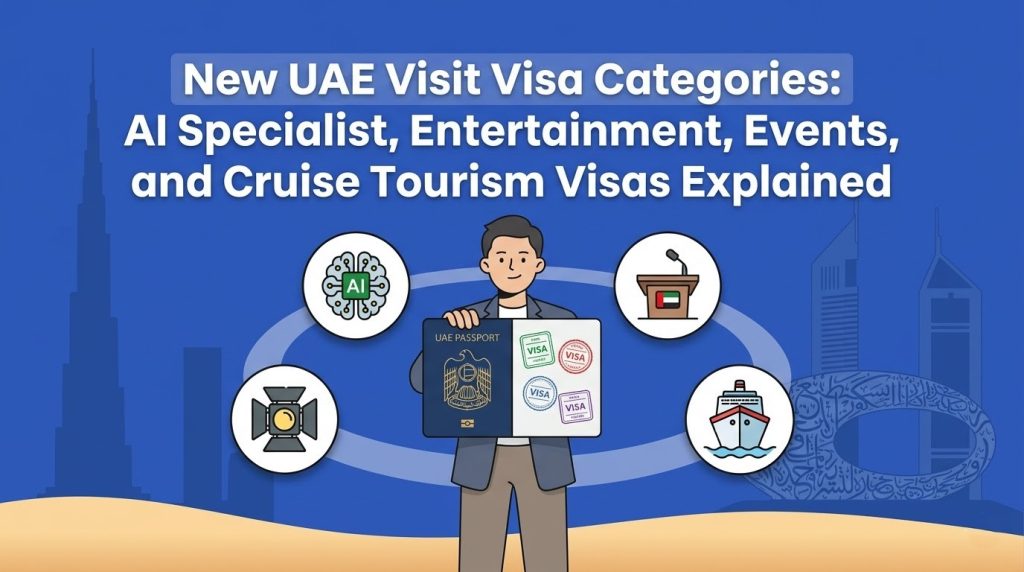
What AI specialists, entertainers, event delegates, and cruise tourists need to know about the four purpose-driven visit visas introduced by ICP in late 2025
The UAE’s Federal Authority for Identity, Citizenship, Customs & Port Security (ICP) added four entirely new visit visa categories in September 2025 — covering artificial intelligence specialists, entertainment professionals, event attendees, and cruise/leisure boat tourists. These are not tweaks to existing visa types. They are purpose-built entry permits with their own eligibility rules, sponsorship structures, and documentation requirements, and they mark the first time the UAE has created sector-specific visit visas outside the standard tourist and business framework.
This guide breaks down each new category: who qualifies, what documents you need, how sponsorship works, where to apply, what the visa costs, and how long you can stay. It also covers the related changes ICP announced alongside these new categories — including updated salary thresholds for sponsoring visit visas for friends and relatives — that affect anyone applying for or sponsoring a visit visa from late 2025 onward.
What Changed: Four New Visit Visa Purposes
On 29 September 2025, ICP announced the addition of four new entry visa purposes under a broader overhaul of the visit visa framework. The official ICP announcement confirmed the new categories as: (1) AI Specialist Visit Visa, (2) Entertainment Visit Visa, (3) Events Visit Visa, and (4) Cruise Ship & Leisure Boat Tourism Visa. Each category requires a UAE-based sponsor or host entity licensed in the relevant sector — you cannot apply for these visas as a self-sponsored tourist.
Before this reform, foreign professionals arriving for AI projects, performers coming for concerts, delegates attending conferences, and cruise passengers all entered on generic tourist or mission visas. The new framework creates a direct match between the visitor’s purpose and the visa category, which ICP has stated is designed to strengthen compliance, reduce processing friction, and support the UAE’s economic diversification goals. In practice, the key shift is that your sponsor must now hold a sector-relevant licence — a technology company for the AI visa, an entertainment entity for the entertainment visa, and so on.
| New Visa Category | Who It Targets | Required Sponsor Type | Entry Type |
|---|---|---|---|
| AI Specialist Visit Visa | AI, machine learning, data science professionals | Licensed technology-focused establishment | Single or multiple entry |
| Entertainment Visit Visa | Performers, artists, production crews, cultural creatives | Licensed entertainment entity (public or private sector) | Single or multiple entry |
| Events Visit Visa | Conference delegates, exhibition attendees, speakers, sports participants | Public or private sector event host/organiser | Single or multiple entry |
| Cruise & Leisure Boat Tourism Visa | Cruise ship passengers, yacht tourists | Licensed cruise or leisure-boat tourism operator | Multiple entry |
AI Specialist Visit Visa: Eligibility and Requirements
The AI Specialist Visit Visa targets foreign professionals working in artificial intelligence, machine learning, data science, algorithm development, and related technology fields. ICP’s announcement specifies that the visa can be issued for a single visit or multiple visits within a defined period. This makes it suitable for short-term project assignments, collaborative research, technical workshops, and exploratory visits — not ongoing employment, which requires a standard work visa through MOHRE.
The core requirement is a formal letter from a UAE-based sponsor or host that is a technology-focused establishment. The host entity must hold a valid UAE trade licence in a technology-related activity. The letter needs to specify the visitor’s role, purpose of visit, scope of activities, and duration. Generic invitation letters will not suffice — ICP expects the letter to clearly define what the specialist will be doing and for how long.
Who Qualifies as an AI Specialist
ICP does not publish a closed list of eligible job titles. Based on the official announcement and secondary sources, qualifying professionals include AI engineers, machine learning specialists, data scientists, algorithm developers, robotics researchers, NLP specialists, and related roles. The determining factor is the alignment between your professional profile, the host entity’s technology licence, and the stated purpose of your visit. A marketing consultant visiting a technology company would not qualify; a machine learning engineer invited for a model deployment project would.
Documents Required for the AI Specialist Visa
- Valid passport — minimum 6 months validity from date of entry
- Recent passport-size photograph — white background, as per ICP specifications
- Copy of passport cover page — now mandatory for all entry permit applications following the 2025 reforms
- Sponsor/host letter — from a UAE-licensed technology establishment, detailing role, purpose, activities, and visit duration
- Professional credentials — qualifications, employment history, or portfolio demonstrating AI/technology expertise
- Proof of accommodation — hotel booking or host-arranged accommodation
- Return ticket or onward travel booking
Note: Specific document requirements may vary based on nationality and the issuing authority (ICP or GDRFA Dubai). The sponsor typically handles the application and document submission on behalf of the visitor.
Entertainment Visit Visa: For Performers, Artists, and Production Crews
The Entertainment Visit Visa covers foreign visitors entering the UAE temporarily for leisure and entertainment-related engagements. ICP’s wording describes it as a visa for “temporary stay for leisure purposes” under a licensed entertainment sponsor. In practical terms, this category serves performers, musicians, artists, technical production crews, cultural contributors, and supporting personnel travelling for short-term entertainment engagements in the UAE.
The sponsor must be a licensed public or private sector entity engaged in entertainment activities — event management companies, concert venues, production houses, theatres, and similar establishments. This is a departure from previous practice, where performers typically entered on generic tourist or mission visas arranged through travel agencies. The dedicated category creates clearer accountability: the sponsor confirms the visitor’s activity and visit period in an official letter, and the visitor’s activities must align with what the sponsor’s entertainment licence covers.
Practical Implications for Promoters and Venues
For entertainment companies bringing in international talent, the new visa streamlines what was previously a workaround-heavy process. Production companies no longer need to shoehorn touring artists into ad-hoc visit permits. The trade-off is documentation discipline — the sponsor letter must accurately describe the engagement, and the licensed activity of the sponsoring entity must cover the type of entertainment involved. A company licensed for concert production sponsoring a circus performer may face compliance questions if the activities do not match the licence scope.
Events Visit Visa: Conferences, Exhibitions, Sports, and Cultural Activities
The Events Visit Visa is issued to foreign nationals attending a festival, exhibition, conference, seminar, or any economic, cultural, sports, religious, community, or educational activity — the official ICP text covers a deliberately broad range of event types. The sponsor or host must be a public or private sector entity organising or hosting the event, and must provide a letter specifying the event details and duration.
This category is particularly relevant for the UAE’s growing events sector — from the Dubai Expo legacy programme and GITEX Global to religious gatherings, sports tournaments, and academic conferences. Previously, delegates at large international events entered on standard tourist visas, which created a mismatch between the visitor’s actual purpose and their visa category. The Events Visit Visa eliminates that gap.
What Counts as a Qualifying Event
ICP’s language is broad: festivals, exhibitions, conferences, seminars, and economic, cultural, sports, religious, community, or educational activities. The limiting factor is not the event type but the sponsor structure — the hosting entity must be the one applying for the visa and providing the invitation letter with complete event details (dates, agenda, venue, and the visitor’s role). Individual attendees cannot self-sponsor under this category; they need the event organiser to act as their host.
Documents for the Events Visa
- Valid passport — minimum 6 months validity
- Passport-size photograph — white background
- Copy of passport cover page
- Invitation letter from the event host — specifying event name, dates, venue, and the visitor’s role (attendee, speaker, exhibitor, participant)
- Event confirmation details — ticket or registration confirmation where applicable
- Proof of accommodation and return travel
Cruise Ship and Leisure Boat Tourism Visa
The fourth new category is a multiple-entry tourism visa specifically for passengers arriving via cruise ships or leisure boats. Unlike the other three categories, which can be single or multiple entry, ICP specifies this visa as multiple-entry by design — reflecting the nature of cruise itineraries that may dock at multiple UAE ports (Dubai, Abu Dhabi, Fujairah) during a single voyage.
The requirement is straightforward: the visitor must submit a tourism itinerary that includes UAE port stops, and the sponsor/host must be an establishment licensed for cruise or leisure-boat tourism activities. In practice, the cruise line or tour operator acts as the sponsor, submitting bulk visa applications for passengers along with the ship’s itinerary and passenger manifest. Individual cruise passengers do not apply separately — the operator handles the entire process.
How the Cruise Visa Works in Practice
The licensed cruise operator submits a bulk application to ICP or GDRFA, including the ship’s itinerary and passenger list. Applications are typically processed 5–10 days before the ship arrives. Upon docking, immigration officials board the vessel for passenger clearance. Passengers with approved visas can then disembark for shore excursions and re-board before departure. The multiple-entry structure means that if your cruise calls at both Dubai’s Port Rashid and Abu Dhabi’s Zayed Port, you use the same visa for both port entries without needing a separate application.
Duration, Extension, and Fees
ICP’s September 2025 announcement does not publish a single standardised fee or duration for the four new categories. Based on the official text and the existing fee structure for UAE visit visas, here is what is confirmed and what requires checking at the time of application.
| Parameter | What Is Known |
|---|---|
| Duration | Visas are issued for 30, 60, or 90 days depending on category and eligibility. AI Specialist visas reportedly allow 60 or 90 days. Cruise visas align with the ship’s itinerary. |
| Extension | Select categories (AI Specialist and Events visas) can be extended through ICP e-services. Standard extension is 30 days per renewal, processed online. |
| Fees | ICP has not published category-specific fees for these new visas. Standard UAE visit visa fees range from AED 200–300 for 30–60 day single-entry visas (via GDRFA Dubai), plus 5% VAT and applicable surcharges. Some sources report approximately AED 600 plus VAT for the new categories. Confirm the exact fee on the ICP Smart Services portal or GDRFA at the time of application. |
| Extension fees | ICP publishes AED 100 application fee + AED 500 extension fee for standard visit visa extensions. GDRFA Dubai charges AED 600 plus VAT and applicable surcharges. |
| Overstay fine | AED 50 per day, standardised across all visit, tourist, and residence visas according to the UAE Government Portal. |
| Processing time | Standard visa processing takes 3–5 business days via ICP; reports suggest the new specialist categories may be processed within 48–72 hours. Urgent processing is available for an additional AED 100. |
Fees and durations displayed on the ICP Smart Services portal or GDRFA Dubai platform at checkout are authoritative. Third-party sources may reflect outdated or approximate figures.
How to Apply: Step-by-Step Process
The application process for all four new categories follows the sponsor-led model used for most UAE visit visas. The visitor does not apply independently — the UAE-based sponsor or host entity initiates and manages the application.
Step 1: Identify the Correct Visa Category
Where: Before any application is filed
What happens: The sponsor determines which of the four categories matches the visitor’s purpose. The visitor’s actual activities must align with the visa category selected — mismatches are a common compliance risk and can result in refusal.
Step 2: Prepare the Sponsor Letter and Supporting Documents
Who: The UAE-based sponsor entity
What you need: The sponsor prepares a formal letter on company letterhead specifying the visitor’s identity, purpose, scope of activities, and duration. The visitor provides their passport copy, photograph, passport cover page copy, and any category-specific documents (professional credentials for AI, event details for Events visa, itinerary for cruise visa).
Step 3: Submit the Application
Where: ICP Smart Services portal (for most emirates), GDRFA Dubai portal (for Dubai-issued visas), or through an authorised Amer Centre or typing centre
Who: The sponsor submits on behalf of the visitor
What happens: The sponsor logs in, selects the appropriate visa category, fills in the application details, uploads documents, and pays the applicable fee. For cruise visas, the operator typically submits bulk applications.
Step 4: Receive the E-Visa
Timeline: 3–5 business days for standard processing; 48–72 hours reported for some specialist categories; urgent processing available for additional fee
What happens: The approved visa is issued electronically (PDF) and sent to the sponsor, who forwards it to the visitor. The visitor must enter the UAE within the visa’s validity period (typically 60 days from issue).
Step 5: Enter the UAE and Comply with Visa Conditions
What happens: Present the e-visa, passport, and supporting documents at the port of entry. Immigration may verify that your stated purpose matches the visa category. Ensure your passport has the required minimum 6 months validity. Track your visa expiry date and apply for an extension before it expires if needed — overstay fines of AED 50 per day begin immediately upon expiry.
Related Changes Announced Alongside the New Categories
ICP’s September 2025 decision was not limited to the four new categories. Several related amendments affect anyone applying for or sponsoring a visit visa. The most significant changes concern sponsoring visit visas for friends and relatives and the business opportunity exploration visa.
Revised Salary Thresholds for Sponsoring Relatives and Friends
UAE residents sponsoring a visit visa for relatives or friends now face tiered minimum salary requirements based on the relationship:
| Visitor’s Relationship to Sponsor | Minimum Monthly Salary | Who This Covers |
|---|---|---|
| First-degree relative | AED 4,000 | Father, mother, spouse, son, daughter |
| Second-degree relative | AED 8,000 | Siblings, grandparents, grandchildren |
| Third-degree relative | AED 8,000 | Uncles, aunts, cousins |
| Friend (non-relative) | AED 15,000 | Any non-relative |
Sponsors must provide proof of kinship for relative applications. These thresholds represent a significant formalisation of requirements that were previously less transparently enforced.
Business Opportunity Exploration Visa Update
The same ICP decision added a requirement for the Business Opportunity Exploration Visa: applicants must now demonstrate financial capability appropriate to the intended activity, be engaged in a relevant activity through an existing business outside the UAE, or be a practising professional in that field. This tightens eligibility beyond the previous requirements and is designed to ensure the visa is used for genuine business exploration rather than as an alternative tourist entry route.
How These Visas Differ from Existing Visit Visa Options
The four new categories sit alongside — not in place of — the UAE’s existing visit visa framework. Standard tourist visas, multiple-entry and long-term tourist visas, business visit visas, and mission visas continue to operate as before. The new categories are additional purpose-driven options for visitors whose travel fits a specific sector.
| Criteria | Standard Tourist Visa | New Sector-Specific Visit Visas |
|---|---|---|
| Purpose | General tourism, sightseeing, visiting | Specific: AI work, entertainment engagement, event attendance, cruise tourism |
| Sponsor type | Tourism agency, hotel, airline, or self-sponsored (5-year visa) | Sector-licensed entity (tech company, event organiser, entertainment firm, cruise operator) |
| Activity matching | No strict activity requirements | Activities must match the visa category and sponsor’s licensed activity |
| Self-sponsorship possible? | Yes (5-year tourist visa requires USD 4,000 bank balance) | No — all four categories require a UAE-based host/sponsor |
| Best for | Leisure travellers, general visitors | Professionals on short-term assignments, event delegates, touring artists, cruise passengers |
If you are visiting the UAE purely for tourism and do not have a sector-specific sponsor, the standard tourist visa remains the correct choice. The new categories are designed for visitors whose travel purpose aligns with one of the four defined sectors.
Common Compliance Risks and How to Avoid Them
The purpose-matching requirement in these new categories introduces compliance risks that did not exist with generic tourist visas. ICP’s framework explicitly ties the visa category to the visitor’s activities and the sponsor’s licensed activity. Getting this alignment wrong can result in visa refusal, entry denial, or post-entry compliance issues.
Purpose Mismatch Between Visa and Activities
The most common risk is applying for a category that does not match what the visitor actually does in the UAE. If a software developer arrives on an AI Specialist Visa but spends their time conducting sales meetings, that is a purpose mismatch. The visa category, the sponsor letter, and the visitor’s actual activities must all align.
Vague or Incomplete Sponsor Letters
Generic invitation letters missing dates, unclear host details, or boilerplate text that does not reflect the visitor’s actual itinerary are a significant risk factor. ICP expects the letter to specify the visitor’s role, purpose, activities, and duration. Recycled templates from previous visitors are particularly problematic.
Sponsor Licence Mismatch
The sponsor must hold a valid UAE trade licence in the relevant sector. A general trading company cannot sponsor an AI Specialist Visa — the sponsor must be a technology-focused establishment. Similarly, a restaurant cannot sponsor an Entertainment Visa; the sponsor must be licensed for entertainment activities. Verify the sponsor’s licence scope before filing the application.
Converting a Visit Visa to Residency
One of the broader changes announced alongside the four new categories is the ability to convert a visit or tourist visa to residence status without leaving the UAE. If you enter on one of the new specialist visit visas and subsequently receive a job offer from a registered UAE company, your employer can apply for a MOHRE work permit and submit an in-country Change Status request through ICP or GDRFA while your current visit visa remains valid. This saves the time and cost of exiting the country to activate a new entry permit.
The in-country conversion is not automatic — it requires a valid job offer, employer application through MOHRE, and approval from ICP or GDRFA. But for AI specialists on short-term project assignments who receive permanent offers, or event professionals who are subsequently hired by UAE companies, this pathway eliminates weeks of mobilisation delays.
FAQ
What are the four new UAE visit visa categories introduced in 2025?
ICP announced four new purpose-driven visit visa categories on 29 September 2025: (1) AI Specialist Visit Visa for technology professionals, (2) Entertainment Visit Visa for performers and cultural creatives, (3) Events Visit Visa for conference delegates, exhibition attendees, and sports participants, and (4) Cruise Ship & Leisure Boat Tourism Visa for maritime tourists. All four require a sector-licensed UAE sponsor — none allow self-sponsorship.
Can I apply for the AI Specialist Visa without a UAE sponsor?
No. All four new visa categories require a UAE-based host or sponsor entity licensed in the relevant sector. For the AI Specialist Visa, the sponsor must be a technology-focused establishment. The sponsor initiates and manages the visa application on your behalf through ICP or GDRFA.
How long can I stay in the UAE on the new specialist visit visas?
Duration varies by category and eligibility — visas are issued for 30, 60, or 90 days. The AI Specialist Visa reportedly allows 60 or 90 days with extension options. Cruise visas align with the ship’s itinerary. Extensions of 30 days are available for select categories through ICP e-services, subject to fees and eligibility.
How much does the new visit visa cost?
ICP has not published separate fee schedules for the four new categories. Standard UAE visit visa fees range from AED 200 for a 30-day single-entry to AED 300 for 60 days (via GDRFA Dubai), plus 5% VAT and applicable surcharges. Some third-party sources report approximately AED 600 plus VAT for the new specialist categories. Check the exact fee on the ICP Smart Services portal or GDRFA platform when applying.
What happens if I overstay my visit visa?
Overstay fines are standardised at AED 50 per day across all visit, tourist, and residence visas in the UAE. Fines begin accruing upon visa expiry — grace periods are no longer guaranteed for visit visas. Apply for an extension through ICP or GDRFA before your visa expires to avoid penalties.
Can I convert a specialist visit visa to a residency visa without leaving the UAE?
Yes, in-country conversion from a visit visa to employment residency is possible under the 2025 reforms. You need a formal job offer from a registered UAE company. Your employer applies for a MOHRE work permit and submits a Change Status request through ICP or GDRFA while your visit visa is still valid. Approval grants a 60-day employment entry permit to complete medicals, biometrics, and residence stamping without exiting the country.
Do cruise passengers need to apply for the new visa individually?
No. The licensed cruise operator acts as the sponsor and submits bulk visa applications for all passengers, including the ship’s itinerary and passenger manifest. Passengers provide their passport copy and photo to the cruise line in advance (typically 30–45 days before departure). The operator handles all immigration paperwork with UAE authorities.
What is the minimum salary to sponsor a visit visa for a friend or relative?
Under the revised ICP rules, UAE residents must earn a minimum of AED 4,000 per month to sponsor first-degree relatives (parents, spouse, children), AED 8,000 for second- or third-degree relatives (siblings, grandparents, uncles, aunts, cousins), and AED 15,000 to sponsor a friend. Proof of kinship is required for relative applications.
Where do I apply for the new visit visa categories?
Applications are submitted through ICP Smart Services (for most emirates), GDRFA Dubai (for Dubai-issued visas), or through authorised Amer Centres and typing centres. The sponsor — not the visitor — initiates the application. Dubai-issued visas go through GDRFA; visas for other emirates go through ICP.
Are the new visit visa categories available for all nationalities?
ICP’s announcement does not restrict the new categories by nationality. However, standard UAE visa eligibility rules still apply — citizens of countries eligible for visa-on-arrival or visa-free entry may not need a pre-approved visit visa. Check your nationality’s eligibility through the official UAE visa checker before applying.
Official Sources
This article references information from the following UAE government authorities and official platforms:
- ICP — Official Announcement: Four New Visit Visa Categories (29 September 2025)
- ICP — Issuance of a Visa (Service Details and Requirements)
- ICP Smart Services Portal — Online Visa Applications
- UAE Government Portal — Visit Visas
- UAE Government Portal — Entry Permits
- UAE Government Portal — Visa Fees and Overstay Fines
- GDRFA Dubai — General Directorate of Residency and Foreigners Affairs
UAE regulations change frequently. Always verify current requirements directly with ICP or GDRFA before proceeding with any application.
This guide is for informational purposes only. UAE regulations and fees are subject to change. Always verify current requirements with the relevant official authority before proceeding with any application or transaction.