
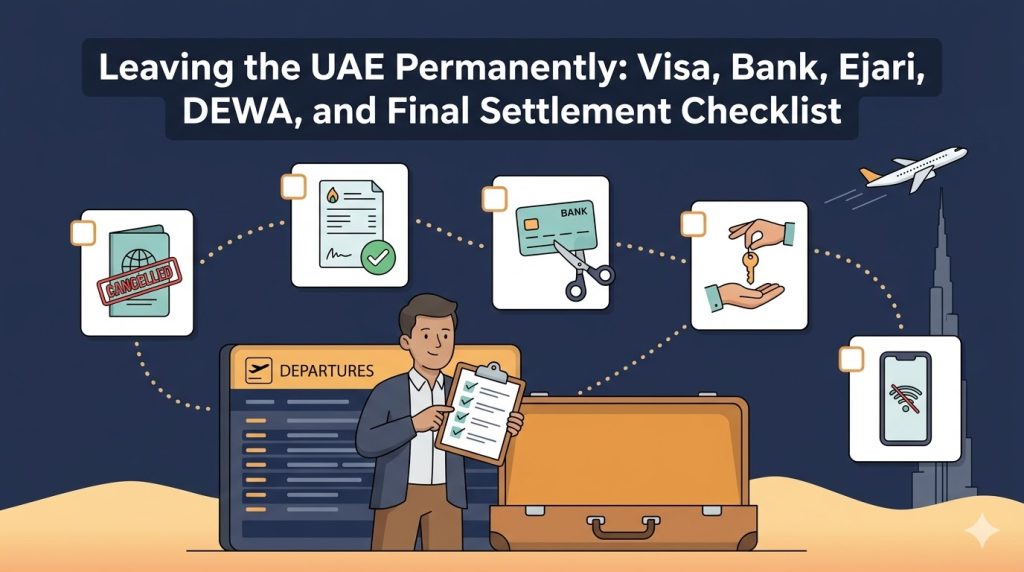
Complete departure checklist for expats cancelling visas, closing bank accounts, and settling all obligations before leaving the UAE for good
Leaving the UAE permanently involves at least seven separate cancellation procedures — each with its own authority, portal, timeline, and documents. Missing any single step can lead to overstay fines (AED 50 per day), frozen bank accounts, continued utility billing, or even a travel ban triggered by unpaid debts. This guide maps the full sequence, from final settlement with your employer through to airport departure.
This guide covers: the correct cancellation order and why sequence matters, employer final settlement and end-of-service gratuity collection, residence visa cancellation via GDRFA or ICP, Ejari and DEWA disconnection, bank account closure and clearance letters, telecom contract termination, and commonly overlooked items that catch departing expats off guard.
Why the Cancellation Sequence Matters
Several departure procedures depend on earlier steps being completed first. Cancelling your visa before closing your bank account, for instance, can lock you out of online banking that requires an active Emirates ID for authentication. Cancelling Ejari before DEWA disconnection can cause the disconnection request to fail, since DEWA cross-references Ejari records. Starting DEWA disconnection before your actual move-out date means losing electricity and water prematurely.
The table below shows the recommended sequence. Procedures marked with the same phase number can often run in parallel, but should not be started before earlier phases are complete.
| Phase | Action | Authority / Provider | Typical Timeline |
|---|---|---|---|
| 1 | Serve notice period & receive final settlement | Employer / MOHRE | 30–90 days (per contract) |
| 2 | Cancel dependent/family visas (if sponsor) | GDRFA Dubai / ICP | 1–3 working days each |
| 3 | Cancel employer-sponsored residence visa | MOHRE + GDRFA / ICP | 1–3 working days |
| 4a | Deactivate DEWA (on move-out date) | DEWA | 24–36 hours for final bill |
| 4b | Cancel Ejari | DLD / RERA | Same day (minutes to hours) |
| 4c | Cancel telecom contracts | e& / du / Virgin | Instant to 72 hours |
| 5 | Close bank account(s) & obtain clearance letter | Your bank(s) | 3–7 working days |
| 6 | Clear traffic fines, cancel Salik, sell vehicle | RTA / Dubai Police | Varies |
| 7 | Exit the UAE within grace period | Immigration (airport) | 30 days standard grace |
Note: If you are self-sponsored (investor visa, Golden Visa, Green Visa, freelance visa), you initiate your own visa cancellation — the employer steps do not apply. The rest of the sequence remains the same.
Step 1: Final Settlement and End-of-Service Gratuity
If you are leaving an employer, your final settlement is the first financial matter to resolve. Under Federal Decree-Law No. 33 of 2021 (UAE Labour Law), employers must pay all outstanding wages, unused leave encashment, and end-of-service gratuity within 14 days of the contract end date. The final settlement includes every dirham owed — not just gratuity.
What Your Final Settlement Should Include
- End-of-service gratuity — calculated on basic salary only (excludes housing, transport, and other allowances). Employees with 1–5 years of service receive 21 calendar days’ basic salary per year. Those with more than 5 years receive 30 days’ basic salary for each year beyond five. The total gratuity is capped at two years’ total salary.
- Unused annual leave balance — paid at the basic salary rate for any accrued but unused leave days.
- Outstanding salary — any unpaid wages up to and including the last working day.
- Repatriation flight — the employer must cover the cost of a one-way ticket to the employee’s home country (or country of hire), unless the employee has already secured new employment in the UAE.
Under the current labour law, employees who resign after completing one year of service receive their full gratuity entitlement. The previous sliding-scale reductions for resignation from unlimited contracts no longer apply — all employment contracts are now fixed-term.
If Your Employer Delays Payment
If the employer fails to pay within 14 days, you can file a labour complaint with MOHRE (Ministry of Human Resources and Emiratisation). MOHRE will attempt to mediate an amicable settlement. If mediation fails within 14 days, the dispute is referred to the labour court. For claims under AED 50,000, MOHRE can adjudicate directly without court referral.
Keep your bank account open until the final settlement is received — you will need an active UAE bank account for the employer to transfer the funds.
Step 2: Residence Visa Cancellation
Visa cancellation is the central procedure around which everything else revolves. The grace period after cancellation sets your hard deadline for leaving the country, so every other task must fit within that window.
Who Cancels the Visa
For employment visas, the employer (sponsor) initiates cancellation. The process involves two linked steps: the employer first cancels the labour card/work permit with MOHRE, then GDRFA (Dubai) or ICP (other emirates) processes the residence permit cancellation. In Dubai, this is handled through GDRFA Dubai’s smart services or at an Amer centre. For other emirates, the ICP Smart Services portal is the primary channel.
For self-sponsored visas (investor, Green Visa, freelance), you initiate the cancellation yourself through the relevant portal or typing centre.
Documents Required
- Original passport of the visa holder
- Original Emirates ID
- Sponsor’s passport and Emirates ID (for employer/family-sponsored visas)
- MOHRE cancellation confirmation (for employment visas — the employer handles this)
- Trade licence cancellation certificate (for investor visas linked to a business)
Fees (Dubai — GDRFA)
| Fee Component | Amount |
|---|---|
| Residence permit cancellation (inside UAE) | AED 100 |
| Service fee | AED 50 |
| Knowledge Dirham | AED 10 |
| Innovation Dirham | AED 10 |
| Amer centre fees (if applicable) | AED 20–30 (varies) |
| Total (approximate) | AED 190–225 |
Cancellation from outside the UAE costs approximately AED 290 plus Amer centre fees, according to GDRFA Dubai.
Grace Period After Cancellation
After the visa is officially cancelled, a grace period begins. Follow the step-by-step visa cancellation process to do it correctly. For most standard residence visas (employment, family), the grace period is 30 days. Certain categories may receive longer periods — Golden Visa holders, investors, and some skilled workers may qualify for up to 90 or 180 days. The exact duration appears on your cancellation confirmation document. Overstaying beyond the grace period incurs a fine of AED 50 per day.
If you are losing a job rather than resigning, different rules apply — employees terminated by their employer may receive an extended job-search period.
Cancel Dependants First
If you sponsor family members (spouse, children, parents), their visas must be cancelled before yours — or transferred to a new sponsor. Your own visa cannot be cancelled while active dependant visas remain under your sponsorship.
Step 3: Cancel Ejari (Tenancy Registration)
If you rent in Dubai, your Ejari registration must be cancelled once your tenancy ends. Ejari does not expire automatically — failing to cancel it blocks the landlord from registering a new tenant and can cause complications with your own DEWA account closure.
Before You Cancel Ejari
Give your landlord written notice of non-renewal at least 90 days before the contract expiry date, as required under Dubai tenancy law. If you are leaving before the contract expires, you will need to negotiate early termination terms — most contracts include a penalty clause (commonly two months’ rent, though this varies).
How to Cancel
Online (free): Log in to the Dubai REST app or the DLD Ejari website using UAE Pass. Navigate to tenant services, select cancellation, upload the required documents, and submit. Approval typically arrives by email once DLD reviews the application.
In person (AED 40 excl. VAT): Visit any authorised Real Estate Services Trustee Centre with the original tenancy contract (if still valid), Emirates ID of the tenant and landlord (or authorised representative), and a landlord NOC if applicable.
Documents Required
- Emirates ID of tenant (and landlord or representative)
- Original tenancy contract or Ejari certificate
- Final DEWA bill — marked as paid. This is a critical requirement; Ejari cancellation will not complete without a settled DEWA final bill.
- Landlord NOC (No Objection Certificate) — some cancellations require explicit landlord consent
Processing time at Trustee Centres is typically under one hour. Online submissions may take slightly longer depending on DLD verification.
Step 4: DEWA Disconnection and Security Deposit Refund
DEWA (Dubai Electricity and Water Authority) disconnection should be timed to coincide with your actual move-out date — submit the request on or just before the day you vacate the property. Disconnecting too early leaves you without electricity and water; disconnecting too late means paying for usage you did not consume.
How to Disconnect DEWA
Online: Log in to the DEWA website or DEWA Smart App using your DEWA User ID or UAE Pass. Navigate to Consumer > Deactivation of Electricity/Water (Move-out). Enter your 10-digit contract account number, select your move-out date and time, and choose your preferred security deposit refund method.
Without login: On the DEWA website, select “Apply Online (without login)” under the deactivation service. Enter your DEWA contract account number and premises number. DEWA sends an OTP to your registered mobile or email for verification.
In person: Visit any DEWA Customer Happiness Centre with your Emirates ID and contract account details.
DEWA Disconnection Fees
| Fee Component | Small Meter | Large Meter |
|---|---|---|
| Deactivation fee | AED 100 | AED 300 |
| Knowledge fee | AED 10 | AED 10 |
| Innovation fee | AED 10 | AED 10 |
Thukher and Sanad cardholders may receive a 50% discount on DEWA disconnection fees.
Security Deposit Refund
DEWA holds a refundable security deposit for each account: AED 2,000 for apartments and AED 4,000 for villas. After your final bill is generated (typically within 24 hours of your move-out date), any outstanding charges are deducted from the deposit, and the balance is refunded. Three refund methods are available: bank transfer (via IBAN — fastest, no fees), Western Union (generates a Money Transfer Control Number valid for 30 days, usable at any branch worldwide), or cheque.
DEWA now processes most deposit refunds (up to AED 4,000) within 30 minutes through their automated system. Larger deposits may take 3–5 working days. Ensure your registered phone number and email are current, as DEWA sends the final bill and refund instructions to these contacts.
Step 5: Close Your Bank Accounts
Leaving a UAE bank account open after departure is a common mistake that leads to dormancy fees, minimum balance charges, and complications on future return visits. Close all accounts before leaving, but keep at least one account active until your employer’s final settlement and any deposit refunds (DEWA, landlord) have been received.
Standard Closure Process
Most banks require an in-person branch visit to initiate closure. Bring your Emirates ID, passport, and debit card. The process involves filling out an account closure form, settling any outstanding balances (including credit card dues, loan repayments, and minimum balance fees), and returning unused cheque books and debit cards. If you have credit cards, begin the settlement process two to three months before departure — the paperwork for loan and credit card clearance can take considerable time.
The bank can only close an account with a zero balance. Transfer remaining funds to an international account or withdraw as cash before submitting the closure request. Typical processing takes 3–5 working days, after which you receive a closure confirmation by email or SMS.
Request a Clearance Letter
Ask every bank where you hold accounts for a “no liabilities” or clearance letter confirming zero outstanding debts. This document is essential — it protects you against any future claims and may be required if you return to the UAE and apply for new financial products. Some banks charge a fee for issuing this letter; Emirates NBD, for example, requires the fee amount to remain in the account until the letter is produced. Unresolved debts can also surface as a court-ordered travel ban discovered at the airport, and the routes to clear one are set out in our guide to lifting a UAE travel ban for debt.
If You Have Already Left the UAE
Some banks allow account closure from abroad by email. You will typically need to send a completed closure form (downloaded from the bank’s website), a self-attested passport copy, and a copy of your visa cancellation document, all sent from your registered email address. Processing from abroad is slower — allow 7–10 working days. Not all banks accept this; some require a power of attorney for a representative to visit the branch on your behalf.
What Happens If You Do Not Close Your Account
Accounts inactive for six months are typically frozen (marked dormant). Dormancy fees and minimum balance charges may continue accruing against the account. If charges accumulate into a negative balance, the bank may pursue the debt — potentially resulting in a legal case or travel ban, particularly for amounts exceeding AED 10,000. If you opened a bank account when you first arrived, close it properly when you leave.
Step 6: Cancel Telecom Contracts
Whether you use e& (Etisalat), du, or Virgin Mobile, you need to formally cancel your mobile plan and any home internet/TV packages before departure.
e& (Etisalat)
Call 101 (from an e& line) or visit any e& store at least 48 hours before departure. Clear all outstanding balances first. If you are within a commitment period, an early exit fee applies — capped at one month’s rental charge or AED 1,000, whichever is lower (per TDRA regulations). For eLife home packages (internet/TV), call 800 6665 or visit an e& Business Centre. Return any equipment (router, set-top box) to avoid additional charges.
e& also offers “Homebound Packs” that let you keep your UAE number active for 30–60 days after departure if you need to finalise outstanding tasks. This is a prepaid option and does not require maintaining a postpaid contract.
du
Call 155 or visit any du store. Clear outstanding dues. du typically issues cancellation confirmation within 72 hours. The same one-month early termination cap applies if you are within a contract commitment period.
Virgin Mobile
Contact Virgin Mobile customer support. For postpaid plans, your account stays active until the next renewal date, after which it terminates automatically. Clear any outstanding charges before departure.
Home Internet
If you have a separate home internet package (from e& or du), this must be cancelled independently of your mobile plan. Return all equipment — routers, mesh devices, set-top boxes. Failure to return equipment can result in charges of AED 500–1,000 depending on the device.
Step 7: Additional Cancellations and Clearances
Beyond the main cancellations, several smaller obligations are easy to overlook but can cause problems if left unresolved.
Traffic Fines and Salik
Check and pay all outstanding traffic fines through the RTA Dubai app, Dubai Police app, or the respective authority in your emirate. Unpaid fines can block visa cancellation processing. If you have a Salik (toll) account, clear any outstanding balance and deregister your tag through the RTA website or app. If you are selling your vehicle, the Salik account transfers with the car’s registration — but verify this is completed properly.
Selling a Vehicle
If you own a car registered in the UAE, you must either sell it, export it, or deregister it before departure. Selling requires all fines to be cleared and the registration (Mulkiya) to be valid. The buyer and seller complete the transfer at an RTA service centre. If you cannot sell the vehicle before leaving, you can authorise a representative via a notarised power of attorney to complete the sale on your behalf.
Emirates ID
According to the official UAE Government portal, residents leaving the UAE permanently must hand over their Emirates ID card to GDRFA during the visa cancellation process. In practice, the Emirates ID is cancelled automatically when the residence visa is cancelled — the ID’s validity is linked to the visa. Keep a photocopy of both sides of your Emirates ID for your records before handing it over.
Health Insurance
Employer-provided health insurance is typically cancelled by the employer as part of the exit process. If you have a private policy or are self-insured, contact your insurance provider to cancel the policy and request any applicable refund for unused premium.
PO Box
If you have an Emirates Post PO Box, visit a post office to close it or let it lapse at renewal. Return the PO Box key to avoid being charged.
Driving Licence Experience Letter
If your home country accepts driving experience letters for licence conversion, request one from the RTA before leaving. Some countries require this document to transfer your UAE driving experience and avoid retaking tests.
Money left behind is the most common one of all. An account with no forwarding address goes dormant after three years and the balance transfers to the Central Bank after five, though it stays your property throughout, as explained in our guide to dormant accounts and unclaimed funds. Qualifications and civil status documents are far harder to legalize once you have gone, so see our guide to attesting UAE documents for use abroad before you leave. Canadians have a second checklist to run on the way out, because Canada charges a departure tax on assets you have not sold: see Canadian departure tax and CRA residency.
Common Mistakes When Leaving the UAE
Departing expats frequently encounter problems that are entirely avoidable with forward planning. The issues below are drawn from the most common complaints on community forums and advisory platforms.
- Leaving debts unresolved. Credit card balances, personal loans, and bounced cheques above AED 10,000 can result in a travel ban or civil case. Creditors can pursue collection even years after departure, and a judgment in absentia can trigger detention if you transit through a UAE airport in the future.
- Closing the bank account before receiving the final settlement. Employers have 14 days to pay gratuity and wages. If your account is already closed, there is no way to receive the transfer. Keep at least one account open until all payments are confirmed.
- Not cancelling Ejari. An active Ejari blocks new tenancy registrations on the same property and can cause disputes with landlords over security deposit returns.
- Ignoring the DEWA security deposit. If you do not submit a disconnection request and claim your deposit, the AED 2,000–4,000 remains with DEWA indefinitely. The refund process is straightforward — do not forfeit it.
- Leaving telecom contracts active. Unpaid postpaid bills accumulate monthly charges and late fees. These can be forwarded to collection agencies.
- Not requesting clearance letters. Bank clearance and employer settlement letters are your proof of zero liabilities. Without them, you have no documentation if a dispute arises later.
- Forgetting about the overstay fine clock. Once your grace period ends, the AED 50/day overstay fine starts accruing silently. There is no reminder or warning notification from immigration.
Master Checklist: Leaving the UAE Permanently
Use this checklist to track each cancellation. The items are listed in recommended completion order.
| ✓ | Task | Notes |
|---|---|---|
| ☐ | Submit resignation and serve notice period | 30–90 days per contract terms |
| ☐ | Receive final settlement (gratuity + leave + wages) | Employer must pay within 14 days of contract end |
| ☐ | Notify landlord of non-renewal (90 days) | Written notice required |
| ☐ | Cancel dependant visas | Before sponsor’s own visa cancellation |
| ☐ | Cancel your residence visa | Grace period starts from cancellation date |
| ☐ | Settle all credit card and loan balances | Start 2–3 months before departure |
| ☐ | Pay all outstanding traffic fines | Fines can block visa cancellation |
| ☐ | Sell or transfer vehicle / cancel Salik | Clear fines first; deregister Salik tag |
| ☐ | Deactivate DEWA on move-out date | Claim security deposit refund |
| ☐ | Cancel Ejari | Requires paid DEWA final bill |
| ☐ | Cancel telecom contracts (mobile + internet) | Return equipment; clear dues |
| ☐ | Close bank account(s) | After final settlement + deposit refunds received |
| ☐ | Obtain bank clearance letter(s) | One from each bank where you held accounts |
| ☐ | Cancel health insurance (if self-insured) | Employer usually handles if company-sponsored |
| ☐ | Close PO Box (if applicable) | Return key to Emirates Post |
| ☐ | Request RTA driving experience letter | If needed for home country licence transfer |
| ☐ | Keep copies of all cancellation confirmations | PDFs of visa, DEWA, Ejari, bank, telecom |
| ☐ | Declare cash above AED 60,000 at airport | Customs declaration required by law |
| ☐ | Exit the UAE within grace period | AED 50/day overstay fine after expiry |
FAQ
How long do I have to leave the UAE after visa cancellation?
The standard grace period for most employment and family residence visas is 30 days from the cancellation date. Some categories (Golden Visa holders, certain skilled workers) may receive 90 or 180 days. The exact period is specified on your cancellation confirmation document. Overstaying incurs a fine of AED 50 per day.
Can I cancel my own residence visa without my employer?
Only if you hold a self-sponsored visa (investor, Golden Visa, Green Visa, or freelance permit). Employment visas must be cancelled by the employer/sponsor. If your employer refuses to cancel or is unresponsive, file a complaint with MOHRE — they can intervene and process the cancellation.
What happens if I leave the UAE without cancelling my visa?
If you stay outside the UAE for more than 180 consecutive days, your visa is automatically nullified. If that happens, our re-entry permit process for returning after 6 months abroad explains how to get back in. However, leaving without formal cancellation can cause complications — the visa remains on your immigration record until it lapses, which can create issues if you attempt to return or transit through a UAE airport. Formal cancellation produces a clean record and an official cancellation document.
Do I have to close my UAE bank account before leaving?
There is no legal obligation, but failing to close it is risky. Inactive accounts are typically frozen after six months, and dormancy fees or minimum balance charges may accumulate into a negative balance. For amounts above AED 10,000, the bank can pursue legal action including a travel ban. Close accounts properly and obtain a clearance letter.
How do I get my DEWA security deposit refund if I have already left Dubai?
If you submitted a disconnection request before leaving and selected Western Union as your refund method, you receive a Money Transfer Control Number (MTCN) valid for 30 days — collect the refund at any Western Union branch worldwide. If you forgot to request deactivation before departure, contact DEWA customer care (+971 4 601 9999 or [email protected]) to initiate the process remotely.
Is there an early exit fee for cancelling my telecom contract?
If you are within a contract commitment period, the early termination fee is capped at one month’s rental charge or AED 1,000, whichever is lower — per TDRA (Telecommunications and Digital Government Regulatory Authority) regulations that took effect in 2020. If your initial commitment period has ended, there is no exit fee.
What should I do about my Ejari if my landlord is uncooperative?
If your landlord refuses to cooperate with Ejari cancellation, visit a Real Estate Services Trustee Centre with your tenancy contract, paid DEWA final bill, and Emirates ID. RERA can process cancellations in some cases without landlord consent. If there is a tenancy dispute, file a complaint with the Dubai Rental Disputes Centre (part of RERA).
Can I transfer money internationally from my UAE bank account before closing it?
Yes. Use your bank’s international transfer service or a licensed exchange house to send funds to your home country bank account before initiating closure. Some banks offer wire transfers as part of the closure process — ask at the branch when you submit the closure form. Ensure you retain enough balance to cover any pending fees or charges until closure is confirmed.
What documents should I keep after leaving the UAE?
Retain digital or physical copies of all cancellation confirmations (visa cancellation paper, DEWA final bill clearance, Ejari cancellation certificate, bank closure letter, telecom closure confirmation), your final employer settlement statement, bank clearance letters, and a copy of your cancelled Emirates ID. These documents serve as evidence of a clean departure and protect against any future disputes.
Do I need to pay the Dubai Municipality housing fee before leaving?
The housing fee (5% of annual rent) is billed monthly through DEWA. When DEWA generates your final bill, it includes any outstanding housing fee charges. You do not need to settle this separately — it is covered as part of your DEWA final bill payment.
Official Sources
- GDRFA Dubai — Cancellation of All Types of Residence Permits
- GDRFA Dubai — Residence Cancellation Procedures and Fees
- ICP — Cancellation of Residency Permits (Federal)
- UAE Government Portal — General Provisions for Residence Visas
- UAE Government Portal — Cancelling Emirates ID
- UAE Government Portal — End-of-Service Benefits for Private Sector Workers
- UAE Legislation Portal — Federal Decree-Law No. 33 of 2021 (Labour Law)
- Dubai Land Department — Cancel Tenancy Contract (Ejari)
- DEWA — Deactivation of Electricity/Water (Move-Out)
- MOHRE — Labour Law FAQ
- e& (Etisalat) — Leaving UAE Guide
Information current as of March 2026. UAE regulations change frequently. Verify current requirements directly with the relevant authority before proceeding with any cancellation.
Disclaimer: This guide is informational and does not constitute legal advice. Requirements, fees, and procedures may change without notice. Always confirm with official authorities before taking action.