
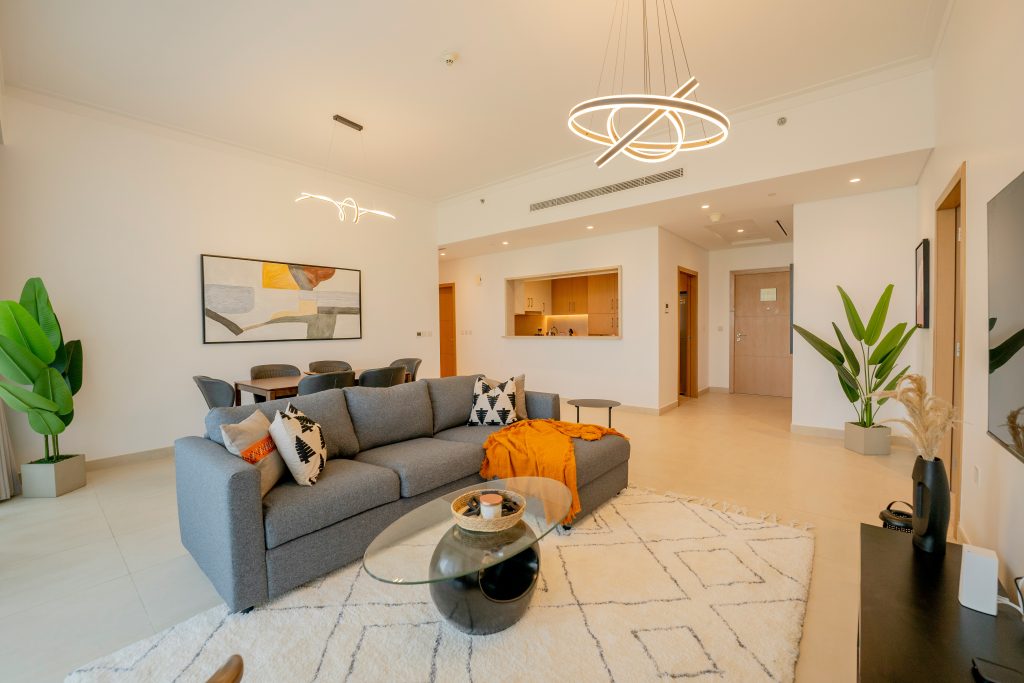
For a Dubai property owner who wants to list a unit on Airbnb, Booking.com, or Vrbo: what the DET Holiday Home permit actually is, what it costs per year, and the compliance rules (Tourism Dirham, guest registration, insurance) you take on the moment you accept your first short-stay booking.
Any residential unit in Dubai rented out for less than six months at a time is a holiday home, and it legally requires a permit from the Department of Economy and Tourism (DET), the authority formerly known as Dubai Tourism or DTCM. A one-bedroom apartment costs roughly AED 370 to AED 670 per year for the unit permit, on top of a one-time DET registration fee that most sources put at AED 1,520, and the permit caps out at about AED 1,270 a year for the largest homes. Listing without that permit is not a grey area: DET removes unlicensed listings and issues fines that start around AED 5,000 and escalate for repeat operators. This guide covers the two operator models, the full cost stack, the exact registration steps, and the ongoing obligations that catch first-time hosts off guard.
This is written for the individual owner self-managing one or a few units through platforms or direct bookings, not for a company running dozens of properties for other people. That distinction changes what you need to register, so we cover both models and the point at which a hobby becomes a licensed business. If you are still deciding whether short lets are worth the compliance load at all, first compare short-term and long-term rental returns before you register anything. Every fee below should be confirmed on the live DET portal at the point you apply, because DET adjusts the schedule from time to time.
What a DET Holiday Home Permit Is and Who Needs One
A holiday home permit is DET’s authorization to let a furnished residential unit to guests on a short-stay basis. The regime is built on Dubai Decree No. 41 of 2013, which brought all short-term residential letting under DET supervision. The rule is defined by duration, not by platform: if guests stay for less than six months at a time, the unit is a holiday home, whether the booking comes through Airbnb, Booking.com, Vrbo, a direct enquiry, or a social media message. There is no exemption for occasional or word-of-mouth letting.
The practical trigger most owners miss is that a standard Ejari residential tenancy does not cover short stays. A long-term lease and a holiday home permit are two different legal channels for the same apartment. If you list a unit that is only registered for annual tenancy, you are operating outside the permit system even if you own the property outright. This is why the first compliance question is never “which platform” but “is this unit permitted for short stays at all.” For the long-let alternative and how its paperwork differs, see our Dubai tenancy contract guide.
Do I Need a Permit to List My Dubai Apartment on Airbnb?
Yes. Any Dubai residential unit rented for less than six months at a time is a holiday home and legally requires a permit from the Department of Economy and Tourism (DET), formerly DTCM. This applies to Airbnb, Booking.com, Vrbo, and direct or social-media bookings alike. Listing without a valid DET permit leads to listing removal and fines that start around AED 5,000.
The Two Operator Models: Owner Permit vs Operator Licence
DET recognizes two distinct ways to run a holiday home, and picking the wrong one is the most common structural mistake new hosts make. The first is the individual homeowner who self-manages their own unit or units. The second is a licensed Holiday Homes Operator, a company that manages units on behalf of other owners. The paperwork, the cost, and the regulatory weight are very different.
An individual owner needs only the holiday home permit itself. Dubai allows a private individual to hold permits for a modest number of self-managed units, commonly cited as up to eight, without forming a company. Beyond that scale, or if you are managing other people’s properties for a fee, DET treats the activity as a commercial business. That requires a trade licence listing holiday homes rental or vacation homes rental as the activity, issued through DET’s economic licensing arm, in addition to a permit for every unit under management.
| Factor | Individual owner (self-managing) | Holiday Homes Operator (company) |
|---|---|---|
| Who it is for | Owner letting their own unit(s) | Business managing other owners’ units |
| Trade licence needed | No, permit only | Yes, DET trade licence for holiday homes rental |
| Typical unit ceiling | Commonly up to 8 self-managed units | No practical ceiling; scaled business |
| Per-unit permit | Required for each unit | Required for each unit under management |
| Tourism Dirham duty | Collect and file monthly | Collect and file monthly across portfolio |
| Setup cost weight | Low: registration plus per-unit fee | Higher: trade licence plus per-unit fees |
Decision point: permit or company? If you own one to a few apartments and manage them yourself, register as an individual and take the permit-only route. Do not form a company you do not need, since a trade licence adds several thousand dirhams a year in setup and renewal. Only step up to an operator trade licence when you cross into managing units you do not own, or your self-managed count grows past what DET allows for individuals. If you are heading toward the company route, our Dubai business setup guide explains the licensing mechanics.
What It Costs Per Year: The Full Fee Stack
The headline permit fee is small, but it is only one line in the real annual cost of running a compliant holiday home. The DET charges a one-time registration fee, then a per-unit permit fee scaled to bedroom count, and separately you are responsible for collecting and remitting Tourism Dirham on every occupied bedroom-night. Furnishing to the required standard and adequate insurance are additional costs the permit assumes you carry.
How Much Does a Dubai Holiday Home Permit Cost?
The DET unit permit runs from about AED 370 for a studio or one-bedroom up to a cap of around AED 1,270 per year for larger homes, with roughly AED 300 added per extra bedroom. A one-time DET registration fee, widely reported at AED 1,520, applies when you first join the system. Confirm the live figures on the DET holiday homes portal before you apply.
| Cost item | Illustrative annual amount (AED) | Notes |
|---|---|---|
| DET registration fee (one-time) | ~1,520 | Paid once on joining, not per unit, not annual. Confirm on the portal. |
| Unit permit, studio / 1 bedroom | ~370 to 670 | Per unit, per year. Standard vs Deluxe classification can affect it. |
| Unit permit, 2 to 3 bedrooms | ~970 to 1,270 | Roughly +300 per additional bedroom, capped near 1,270. |
| Tourism Dirham (Standard) | 10 per bedroom / night | Collected from guests, first 30 nights of a stay. Variable, not fixed. |
| Tourism Dirham (Deluxe) | 15 per bedroom / night | Higher classification. Collected and remitted monthly. |
| Insurance (contents + liability) | ~1,500 to 4,000 | Recommended, varies by unit and cover. Not a DET-fixed fee. |
| DED / DET trade licence (operators only) | ~10,000 to 15,000 | Only if you manage other owners’ units as a business. |
Read the table as a planning tool, not a quote. The two fixed DET charges are the registration fee and the per-unit permit; those are what the portal bills you directly. Tourism Dirham is not your cost at all in principle, since you collect it from the guest, but it becomes your liability if you fail to file it. Insurance and furnishing are market costs the permit presumes rather than charges. An individual owner with one two-bedroom apartment should budget roughly AED 1,520 registration in year one, then around AED 970 to 1,270 for the permit annually, plus whatever Tourism Dirham the occupancy generates.
Documents You Need Before You Start
DET will not issue a permit until it can confirm two things: that you have the right to let the unit, and that the unit exists as a real, furnished residential address in your control. That means the document set centers on proof of ownership or tenancy plus a live utility account. Assemble these before you open the portal, because the application stalls the moment a document is missing.
- Title deed for the unit, if you own it, or a valid tenancy contract plus a written landlord NOC if you are a tenant subletting as a holiday home.
- DEWA bill for the unit, generally expected to be recent and in the owner’s or licensee’s name, confirming the address and an active utility account.
- Emirates ID of the owner or applicant.
- Passport copy of the owner or applicant.
- Unit photographs showing the furnished condition, used for classification.
- Developer or owners association NOC where the building or community rules require one for short-stay use.
Decision point: are you the owner or a tenant? This single fact changes your document set. An owner submits the title deed and applies directly. A tenant cannot register a holiday home on a whim: you need the landlord’s written NOC permitting short-stay use, because subletting a unit as a holiday home without the owner’s consent breaches your lease and can trigger eviction. If you have a mortgage on the property, also confirm your lender permits short-term letting before you list, as some do not. Our guide to renting out a mortgaged property in Dubai covers that consent step.
How to Register a Holiday Home With DET: Step by Step
Registration is done entirely online through DET’s Holiday Homes portal. The flow is create an account, add the unit and upload documents, pay the fees, then receive the permit and classification before you take your first booking. Expect the review to take a few business days once documents are clean, longer if anything needs re-uploading.
What actually happens: after you submit, the unit sits in a pending or under-review state on your dashboard. DET checks the documents and the unit against Decree 41 requirements. If the DEWA name, the title deed, and the applicant identity all line up, the status flips to approved and the system generates your unit permit and a Standard or Deluxe classification. You download the permit certificate, and only then are you legally clear to accept guests. If a document is rejected, you get a notification to correct and resubmit, which resets the clock.
- Create your DET Holiday Homes account. Register on the DET Holiday Homes online system (hhpermits.det.gov.ae) as an individual owner, and pay the one-time DET registration fee to activate the account.
- Add the unit and upload documents. Enter the property details and attach the title deed or tenancy plus landlord NOC, the DEWA bill, your Emirates ID and passport, unit photographs, and any developer or community NOC.
- Pay the per-unit permit fee. Settle the annual permit fee for the unit, which is scaled to bedroom count, through the portal’s payment step.
- Receive the permit and classification. Once DET approves, download the unit permit certificate and note whether the unit is classified Standard or Deluxe, since that sets your Tourism Dirham rate.
- Register guests and collect Tourism Dirham. For each stay, register the guest as required and collect the Tourism Dirham of AED 10 (Standard) or AED 15 (Deluxe) per occupied bedroom per night.
- File and remit monthly. Submit your Tourism Dirham return and payment to DET by the 15th of the following month, every month you host.
Tourism Dirham: Collecting and Filing It Correctly
Tourism Dirham is the single ongoing obligation that trips up new hosts, because it is a tax you collect on DET’s behalf rather than a fee you pay. You add it to the guest’s charge, hold it, and remit it monthly. Getting the classification, the per-bedroom logic, and the filing date right keeps you clean.
How Much Is Tourism Dirham on a Dubai Holiday Home?
Tourism Dirham is AED 10 per occupied bedroom per night for a Standard holiday home and AED 15 per occupied bedroom per night for a Deluxe unit. The operator collects it from the guest and remits it to DET monthly, filing by the 15th of the following month. It applies to the first 30 consecutive nights of any stay.
The charge is per occupied bedroom, not per unit, so a two-bedroom apartment let to one group still accrues Tourism Dirham on the bedrooms actually used under the booking. It applies to the first 30 consecutive nights of a stay, after which longer stays stop accruing it. Your classification, Standard or Deluxe, is set by DET at permit issue and fixes your rate. Miss the monthly filing and the unpaid Tourism Dirham becomes a compliance liability that sits against your permit, so treat the 15th as a hard deadline the way a VAT-registered business treats its return.
Ongoing Compliance Obligations Beyond the Fee
The permit is a licence to operate under conditions, not a one-time clearance. Several duties run for as long as you host, and DET inspections and guest complaints are the usual way breaches surface. The recurring obligations are furnishing standards, utility setup, guest registration, insurance, and respecting the building’s own rules.
- Furnished to standard. The unit must be fully furnished and equipped to the level DET expects for its Standard or Deluxe classification, and maintained at that level.
- DEWA in the owner’s name. The utility account should sit with the owner or licensee, matching the permit, with utilities active throughout.
- Guest registration. Guest details are registered with DET’s system; major platforms handle this automatically, but for direct bookings the operator is responsible, generally within a short window of check-in.
- Adequate insurance. DET expects appropriate cover, and running short lets without contents and public-liability insurance exposes you personally to any guest claim.
- Building and community rules. Freehold ownership does not override an owners association or developer that restricts or bans short lets. Check your building’s rules, since some Dubai communities prohibit holiday homes outright.
Occupancy and yield vary sharply by location, and short-stay demand does not track long-let demand. Before you commit to the furnishing spend, sanity-check the numbers for your building against our data on Dubai rental yields by area. If you also hold a long-let unit and want to confirm its registration status while you plan, you can check your Ejari online status in parallel.
Penalties for Operating Without a Permit
DET actively enforces the permit regime, and the enforcement is not theoretical. Listings are monitored, and an unpermitted unit that surfaces in an inspection or a guest complaint faces removal and a fine. The exposure scales with how serious and how repeated the breach is.
What Happens If I Rent Out My Dubai Property Without a Permit?
DET removes the unlicensed listing and issues a fine. First offenses are commonly reported around AED 5,000 alongside listing takedown, with fines escalating for repeat or severe violations, up toward AED 50,000 to AED 100,000 and blacklisting in the most serious cases. Related breaches, such as failing to register guests, carry their own separate fines.
Beyond the headline fine for unlicensed operation, DET issues separate penalties for specific breaches by permitted operators, such as failing to register guests, exceeding permitted guest numbers, or misleading listings. The practical risk is compounding: an unpermitted host who also fails to collect Tourism Dirham and does not register guests is exposed on several fronts at once. The reason to register is not only to avoid the first fine but to move the whole operation inside a framework where a single inspection cannot unravel it.
FAQ
Do I Need a Permit to List My Dubai Apartment on Airbnb?
Yes. Any Dubai residential unit let for less than six months at a time is a holiday home and requires a permit from the Department of Economy and Tourism (DET), formerly DTCM. The rule is about duration, not platform, so it applies to Airbnb, Booking.com, Vrbo, and direct or social bookings equally. A standard annual Ejari tenancy does not cover short stays, so a long-let unit is not automatically permitted for them.
How Much Does a Holiday Home Permit Cost in Dubai?
The DET unit permit ranges from about AED 370 for a studio or one-bedroom up to roughly AED 1,270 a year for larger homes, adding around AED 300 per extra bedroom. On top of that, a one-time DET registration fee, widely reported at AED 1,520, applies when you first join the system. These figures move, so confirm the current amounts on the DET holiday homes portal before you apply.
What Is the Difference Between a Holiday Home Permit and an Operator Licence?
A holiday home permit authorizes a specific unit for short stays and is what an individual owner self-managing their own property needs. A Holiday Homes Operator licence is a DET trade licence a company holds to manage units on behalf of other owners, which costs several thousand dirhams a year in addition to a permit for each unit. Individuals can typically self-manage up to eight units without a trade licence.
Can a Tenant Register a Rented Apartment as a Holiday Home?
Only with the landlord’s written consent. A tenant needs a written NOC from the owner permitting short-stay use, submitted alongside the tenancy contract, because subletting a unit as a holiday home without the owner’s permission breaches the lease and is a ground for eviction. Even with the owner’s consent, the building’s owners association or developer rules may still prohibit short lets.
How Much Is Tourism Dirham and Who Pays It?
Tourism Dirham is AED 10 per occupied bedroom per night for a Standard holiday home and AED 15 for a Deluxe unit. The guest effectively pays it, but the operator collects it, holds it, and remits it to DET monthly, filing by the 15th of the following month. It applies to the first 30 consecutive nights of a stay, so very long stays stop accruing it after a month.
What Documents Do I Need to Register a Holiday Home?
The core set is the title deed if you own the unit, or a tenancy contract plus a landlord NOC if you rent it, together with a recent DEWA bill in the owner’s or licensee’s name, your Emirates ID, a passport copy, and photographs of the furnished unit. Some buildings also require a developer or owners association NOC for short-stay use. Assemble everything before opening the portal, since a missing document pauses the application.
How Long Does It Take to Get a DET Holiday Home Permit?
Once your account is set up and documents are clean, DET review commonly takes a few business days, after which the unit permit and Standard or Deluxe classification are issued and downloadable. The main cause of delay is a document mismatch, such as a DEWA account or title deed name that does not match the applicant, which triggers a resubmission and restarts the review. Do not accept bookings until the permit shows approved.
Does Freehold Ownership Let Me Run a Holiday Home Freely?
No. Owning the property outright does not exempt you from the DET permit, and it does not override the rules of your building or community. Some Dubai owners associations and developers restrict or ban short-term letting regardless of ownership, so a freehold owner must still hold a valid permit and comply with any community restriction. Check both DET and your building rules before listing.
Do I Need Insurance for a Dubai Holiday Home?
DET expects appropriate cover, and it is a practical necessity rather than an optional extra. Running short lets without contents and public-liability insurance leaves you personally exposed to any guest injury or property claim. Annual premiums vary widely by unit and level of cover, and building insurance may be separate. Treat adequate insurance as part of the real cost of operating, not a line you can skip.
What Happens If I Operate Without a Permit?
DET removes the unlicensed listing and fines the operator. First offenses are commonly reported around AED 5,000 with listing takedown, and penalties escalate for repeat or severe cases toward AED 50,000 to AED 100,000 and blacklisting. Separate fines apply for related breaches such as failing to register guests. Registering first is far cheaper than being caught operating outside the system.
Official Sources
This article references information from the following official sources:
- Department of Economy and Tourism (DET) – Issue a new Holiday Homes permit
- Department of Economy and Tourism (DET) – Apply for a holiday home permit
- DET Holiday Homes online system – registration and permit portal
- DET Holiday Homes Guide – rules, classification, and Tourism Dirham
- DET Holiday Homes FAQ – permit requirements and obligations
- Department of Economy and Tourism – official portal
- Government of Dubai – official portal
This guide is for informational purposes only. DET permit fees, Tourism Dirham rates, classification criteria, and penalties are subject to change, and the official Arabic text of any decree prevails in a conflict of interpretation. Confirm the current unit permit fee, registration fee, and Tourism Dirham amounts directly on the DET Holiday Homes portal before you apply, and check your building or community rules and any mortgage or landlord consent before listing a unit for short stays.