
SData-backed analysis of rental returns across Dubai’s residential communities, including calculation methods, service charge impact, and emerging vs established areas for 2026.
Dubai’s rental market continues to outperform global benchmarks, with average gross yields ranging from 5% to 9% depending on location and property type. For property investors evaluating buy-to-let opportunities, understanding how rental yields vary across Dubai’s diverse neighborhoods is essential for making informed decisions. The difference between a 6% and 8% yield over a 10-year holding period can translate to hundreds of thousands of dirhams in additional income—making area selection one of the most consequential investment decisions.
This guide provides a comprehensive breakdown of Dubai rental yields by area, covering gross versus net yield calculations, top-performing neighborhoods by property type, the impact of service charges and cooling costs on net returns, and how emerging areas compare to established communities. All figures are based on 2025 market data from Dubai Land Department transaction records, property portal research, and current rental market analysis.
Understanding Gross vs Net Rental Yield
Before comparing neighborhoods, investors must understand the distinction between gross and net rental yields—a difference that can swing your actual returns by 1.5 to 2.5 percentage points. Gross yield is a quick comparison metric, while net yield reflects your true cash-flow reality after all ownership costs are deducted. Making investment decisions based solely on gross yield is one of the most common mistakes among first-time Dubai property investors.
Gross Rental Yield Calculation
Gross rental yield measures annual rental income as a percentage of the property’s purchase price. The formula is straightforward: divide annual rent by purchase price, then multiply by 100. For example, an apartment purchased for AED 1,000,000 that generates AED 70,000 in annual rent delivers a 7% gross yield. This metric is useful for initial screening and comparing properties across different price points, but it tells only part of the story. Gross yield does not account for the operating costs that reduce your actual income, which is why professional investors focus primarily on net yield when making final decisions.
Net Rental Yield Calculation
Net rental yield provides a more accurate picture by subtracting annual ownership expenses from rental income before calculating the percentage. The formula is: (Annual Rent minus Annual Expenses) divided by Total Investment Cost, multiplied by 100. Total investment cost should include the purchase price plus acquisition fees such as the 4% Dubai Land Department registration fee, agency commission, and any initial fit-out costs.
Primary expenses that reduce net yield include service charges (AED 10-70 per square foot annually depending on community), district cooling or chiller fees (AED 3,000-15,000 per year), property management fees (5-10% of annual rent if using a management company), maintenance and repairs (AED 2,000-8,000 annually), landlord insurance (AED 1,000-3,000 annually), and vacancy periods (typically one month of lost rent between tenancies). In most Dubai communities, net yields run 1.5 to 2 percentage points below gross yields, though this gap widens significantly in luxury towers with high service charges.
Practical Calculation Example
Consider a one-bedroom apartment in Business Bay purchased for AED 1,500,000. Annual rent is AED 105,000, producing a 7% gross yield. After deducting service charges (AED 7,000 based on AED 20 per square foot for a 350 sq ft unit), chiller fees (AED 4,500), insurance (AED 1,500), maintenance (AED 3,000), and one month vacancy (AED 8,750), total annual expenses reach AED 24,750. Net annual income is AED 80,250, producing a net yield of 5.35%. This remains competitive compared to global markets, but represents a significant reduction from the headline gross figure that many property advertisements emphasize.
Top Dubai Areas for Apartment Rental Yields
Dubai’s apartment market delivers average gross yields of approximately 6.7-7.3% citywide, with considerable variation between affordable, mid-tier, and luxury segments. The highest yields concentrate in affordable and mid-market communities where purchase prices remain moderate relative to rental demand. Understanding which neighborhoods consistently deliver strong returns—and why—helps investors allocate capital effectively.
Highest Yield Apartment Communities (7-11% Gross)
International City leads Dubai’s yield rankings with gross returns of 8-9% on apartments, driven by very low purchase prices per square foot combined with steady rental demand from budget-conscious tenants. Studios and compact one-bedroom units perform best, with purchase prices starting around AED 250,000-350,000. Service charges remain among the lowest in Dubai at AED 8-12 per square foot, and most buildings operate chiller-free systems, meaning landlords avoid district cooling fees. Net yields typically range from 6.5-8% after expenses.
Dubai Investments Park (DIP) combines affordability with accessibility, offering typical one-bedroom units at AED 550,000-800,000 with annual rents of AED 50,000-70,000. With mixed cooling systems and moderate service charges of AED 10-14 per square foot, investors achieve 7-10% gross yields and 6-8.5% net yields. Proximity to Jebel Ali Free Zone and Al Maktoum International Airport supports consistent tenant demand from professionals working in the logistics and manufacturing sectors.
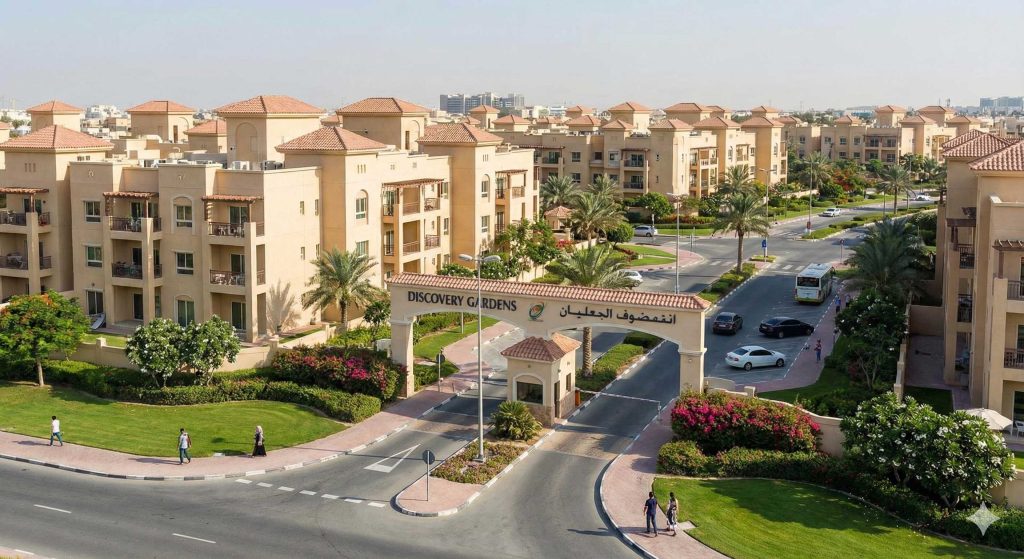
Discovery Gardens offers one-bedroom apartments priced at AED 600,000-850,000 with annual rents of AED 55,000-75,000. Low service charges (AED 10-16 per square foot) and no district cooling make it a stable option, with net yields averaging 6-8.5%. The community’s older building stock means higher maintenance requirements, but the price-to-rent ratio remains attractive for yield-focused investors.
Strong Yield Communities (6-8% Gross)
Jumeirah Village Circle (JVC) remains one of Dubai’s most consistent high-yield communities, recording over 13,600 apartment sales in 2025—more than any other district. Properties range from AED 750,000-1,100,000 for one-bedroom units, renting for AED 65,000-90,000 annually. With service charges of AED 12-16 per square foot and predominantly chiller-free buildings, gross yields reach 7-9% with net yields of 5.8-8%. JVC’s central location, expanding retail infrastructure, and family-friendly environment ensure low vacancy rates and broad tenant appeal.
Dubai Silicon Oasis (DSO) attracts tech professionals with stable rental demand, yielding 7-8% gross returns. Prices range from AED 650,000-950,000 for one-bedroom units, with annual rents of AED 55,000-80,000. Service charges of AED 10-14 per square foot and no central chiller help investors achieve net yields between 5.5% and 7.8%. The technology free zone anchor provides employment-driven tenant demand less susceptible to tourism fluctuations.
Arjan delivers gross yields approaching 8.5% for studio apartments, with larger units in the 7-7.5% range. This emerging area offers affordable entry points with proximity to Miracle Garden and Dubai Hills connectivity. Al Furjan, neighboring Jebel Ali Village, produces gross yields up to 8.51% for studios, with one-bedroom units around 7%. Average purchase prices of AED 160,000-300,000 for studios make it accessible for first-time investors seeking cash-flow positive properties.
Balanced Yield and Appreciation Communities (5-7% Gross)
Jumeirah Lakes Towers (JLT) offers a mature business-residential environment with units averaging AED 1,200,000-1,700,000, renting for AED 95,000-130,000 annually. Due to central chiller systems and higher service charges (AED 14-22 per square foot), yields average 6-8% gross and 4.8-6.8% net. Studios generate the strongest returns at over 7%, while larger units compress toward 5-6%. JLT’s proximity to Dubai Marina and Media City ensures reliable professional tenant demand.
Business Bay commands strong interest from professionals due to its proximity to Downtown Dubai and DIFC. Studios achieve approximately 6.7% gross yield with purchase prices from AED 1,200,000, while one-bedroom units deliver 6-6.5%. High service charges (AED 14-22 per square foot) and central cooling reduce net yields to 4.2-6.2%, but the area benefits from superior capital appreciation potential and excellent resale liquidity.
Dubai Marina remains a favorite among expats and tourists, with gross yields of 5-7% depending on unit size. One-bedroom apartments lead at approximately 6.5%, while studios achieve around 6%. Purchase prices exceed AED 1,500,000 for typical one-bedroom units, with annual rents of AED 110,000-165,000. Central chiller systems and service charges of AED 12-20 per square foot compress net yields to 3.8-5.8%, but Marina offers strong capital appreciation and consistent demand for both long-term and short-term rentals.
Prime Districts (4-6% Gross)
Downtown Dubai delivers gross yields of 4-6% for apartments, with studios performing best at around 7.9% and larger units closer to 4%. Apartments average AED 2,200,000-3,500,000 for one-bedroom units, renting for AED 155,000-230,000 annually. With service charges of AED 16-24 per square foot and central cooling, net yields compress to 3.2-4.8%. Investors in Downtown prioritize capital appreciation and Burj Khalifa proximity over immediate cash flow.
Palm Jumeirah apartments show gross yields of 4-5.5%, though studios can reach 6%. High-end finishes and service charges of AED 18-30 per square foot result in 3-4.3% net yields. The iconic location commands premium pricing, with investors accepting lower yields for prestige, limited supply, and long-term value appreciation. One-bedroom units cost AED 3,000,000-5,500,000 with annual rents of AED 210,000-340,000.
| Area | Gross Yield (1BR) | Net Yield (Approx) | Avg Price (1BR) | Service Charge (psf) |
|---|---|---|---|---|
| International City | 8-9% | 6.5-8% | AED 350,000-500,000 | AED 8-12 |
| DIP | 7-10% | 6-8.5% | AED 550,000-800,000 | AED 10-14 |
| JVC | 7-9% | 5.8-8% | AED 750,000-1,100,000 | AED 12-16 |
| DSO | 7-8% | 5.5-7.8% | AED 650,000-950,000 | AED 10-14 |
| JLT | 6-8% | 4.8-6.8% | AED 1,200,000-1,700,000 | AED 14-22 |
| Business Bay | 5.5-7.5% | 4.2-6.2% | AED 1,300,000-2,000,000 | AED 14-22 |
| Dubai Marina | 5-7% | 3.8-5.8% | AED 1,500,000-2,300,000 | AED 12-20 |
| Downtown Dubai | 4.5-6% | 3.2-4.8% | AED 2,200,000-3,500,000 | AED 16-24 |
Villa and Townhouse Rental Yields by Community
Villas and townhouses in Dubai generate lower rental yields than apartments—averaging approximately 5% gross citywide compared to 7.1-7.3% for apartments. This reflects higher purchase prices and larger unit sizes that do not scale proportionally with rental income. However, villas offer advantages including stronger capital appreciation in established communities, lower tenant turnover (families tend to stay longer), and reduced management intensity. For investors with longer time horizons, the total return combining yield and appreciation can exceed apartment investments.
Highest Yield Villa Communities (6-8% Gross)
DAMAC Hills 2 offers the most accessible entry point for villa investors, with three-bedroom villas starting around AED 1,200,000 and annual rents of AED 80,000-120,000. Gross yields reach 6-8% with net yields of 5-7% due to moderate service charges. Located farther from central Dubai, the community compensates with extensive amenities including schools, supermarkets, sports facilities, and community centres. Rental demand comes primarily from families seeking space and value.
Town Square delivers comparable yields of 6-7% for townhouses, combining affordability with comprehensive community infrastructure. Dubai South presents strong future potential with yields of 7.5-9.5% for apartments and 6.5-8.5% for townhouses, driven by proximity to Al Maktoum International Airport and the Expo 2020 legacy district. Rental prices in Dubai South jumped 24% in 2024, leading all Dubai communities for rent growth.
Established Villa Communities (4-6% Gross)
Arabian Ranches (I, II, and III) remains the benchmark for family-oriented villa living, with three to four-bedroom villas averaging AED 3,500,000-4,000,000 and annual rents of AED 300,000-400,000. Gross yields sit around 4-6.5%, with net yields of 3.5-5.5% after service charges of approximately AED 3-6 per square foot. The community’s mature infrastructure, reputable schools, and proven resale volumes make it a conservative choice for investors prioritizing capital preservation alongside steady rental income.
Dubai Hills Estate attracts affluent families with modern villas, an 18-hole championship golf course, and Dubai Hills Mall. Villa yields average 5.2-7.2% gross, with townhouses slightly higher. Rental values increased 33.8% year-on-year in 2024—the highest growth rate among established villa communities. Prices are substantial, with typical villas exceeding AED 5,000,000, but demand remains robust from families seeking premium amenities and proximity to Downtown via Al Khail Road.
Tilal Al Ghaf represents the emerging luxury villa segment, built around a Crystal Lagoon with sustainable design principles. Villas achieve gross yields of 7-9% due to strong tenant demand for the lagoon lifestyle and limited supply of premium waterfront communities. Average villa prices around AED 16,600,000 attract high-net-worth buyers, while townhouses from AED 3,500,000-4,000,000 offer more accessible entry points with 10-12% capital appreciation projected through 2030.
Villa Yield Comparison by Community
| Community | Gross Yield | Avg Villa Price | Annual Rent Range | Service Charge (psf) |
|---|---|---|---|---|
| DAMAC Hills 2 | 6-8% | AED 1,200,000-2,000,000 | AED 80,000-156,000 | AED 2-5 |
| Dubai South | 6.5-8.5% | AED 1,500,000-2,500,000 | AED 100,000-180,000 | AED 3-6 |
| Tilal Al Ghaf | 7-9% | AED 3,500,000-16,000,000+ | AED 250,000-800,000+ | AED 4-8 |
| Arabian Ranches | 4-6.5% | AED 3,500,000-5,000,000 | AED 300,000-505,000 | AED 3-6 |
| Dubai Hills Estate | 5.2-7.2% | AED 5,000,000-15,000,000+ | AED 350,000-700,000+ | AED 4-8 |
| Palm Jumeirah (Villas) | 4-5% | AED 15,000,000-50,000,000+ | AED 600,000-1,800,000 | AED 3-6 |
How Service Charges Impact Net Rental Yield
Service charges represent the single largest variable cost affecting rental yield calculations, and their impact on net returns is frequently underestimated. Across Dubai communities, service charges range from AED 8 per square foot in budget developments to AED 68 per square foot in ultra-premium towers like Burj Khalifa. For a 1,000 square foot apartment, this represents annual costs ranging from AED 8,000 to AED 68,000—a difference that can transform a profitable investment into a marginal one.
Service Charge Ranges by Community Type
Low-rise apartment buildings in communities like JVC, Discovery Gardens, and International City typically charge AED 10-16 per square foot annually. These developments avoid the expensive mechanical systems of high-rises—lifts, facade access equipment, fire suppression systems, and district cooling infrastructure—resulting in lower operating costs passed to owners. Mid-market high-rises in JLT, Business Bay, and Dubai Marina charge AED 14-24 per square foot, reflecting additional maintenance requirements for elevators, common area cooling, and premium amenities.
Premium developments with extensive facilities charge AED 25-40 per square foot, while ultra-luxury towers can exceed AED 50 per square foot. The Burj Khalifa represents the extreme end at approximately AED 68 per square foot. For villa communities, charges run lower on a per-square-foot basis (AED 2-8) but can still total significant amounts given larger plot and built-up areas. Master community fees in developments like Dubai Hills Estate and Palm Jumeirah add additional layers covering shared roads, landscaping, and community security.
RERA Service Charge Index and Transparency
The Real Estate Regulatory Agency (RERA) maintains the Service Charge Index, an official database allowing property owners to benchmark their building’s approved rates against similar properties across Dubai. All Owners Associations must submit budgets through the RERA-regulated Mollak system for approval before charges can be levied. Owners can access detailed breakdowns via Mollak and lodge formal complaints with RERA or the Rental Disputes Settlement Centre if discrepancies arise.
Industry forecasts indicate average service charges will increase 5-10% in 2025-2026, driven by insurance premium increases following global reinsurance adjustments, new facade inspection mandates for high-rise buildings, district cooling providers rebasing tariffs, and general inflation in maintenance contractor costs. Investors should build a 10-15% contingency over confirmed service charge rates when projecting future net yields.
Chiller Fees and District Cooling Impact
District cooling costs represent another significant expense in communities served by providers like Empower, Emicool, and Tabreed. These systems supply chilled water to buildings through underground pipelines, charging owners and tenants through consumption and demand components. Typical district cooling costs range from AED 4,500 to AED 15,000 annually for apartments, depending on unit size and usage patterns. Major district-cooled communities include Dubai Marina, JLT, Business Bay, Palm Jumeirah, JBR, and Dubai Silicon Oasis.
The distinction between “chiller-free” and district cooling properties matters significantly for yield calculations. In chiller-free buildings, the landlord typically pays for cooling through a building-level system connected to the main electricity supply, with costs absorbed into service charges or higher base rent. In district cooling buildings, tenants usually pay consumption charges directly, but landlords bear fixed capacity charges of AED 600-1,000 per ton of cooling capacity annually. Buildings without central chillers—common in JVC, International City, and many villa communities—avoid these costs entirely, partly explaining their higher net yields.
Emerging vs Established Areas: ROI Comparison
Dubai’s property market offers distinct investment profiles depending on whether you target emerging or established communities. Each approach involves different risk-return trade-offs that align with varying investor objectives and time horizons. Understanding these dynamics helps investors select areas matching their priorities for immediate income versus long-term capital growth.
Emerging Area Investment Profile
Emerging communities like Dubai South, Arjan, Dubailand, Town Square, and newer phases of JVC offer higher gross yields (7-10%) combined with lower entry prices. These areas benefit from ongoing infrastructure development—metro expansions, new schools, retail centers, and road improvements—that can drive significant capital appreciation as neighborhoods mature. Dubai South exemplifies this potential, with the area surrounding Al Maktoum International Airport recording 5,778 transactions valued at AED 12.1 billion in 2024 and rental yields of 7.5-9.5% for apartments.
The trade-offs include higher vacancy risk during the establishment phase, potential construction disruption from ongoing development, less predictable tenant demand patterns, and longer resale timelines. Off-plan purchases in emerging areas offer lower entry costs and flexible payment plans but carry handover timing risk and the possibility that projected infrastructure does not materialize as expected. Investors with 5-10 year horizons who can tolerate initial volatility may achieve superior total returns combining high yields and appreciation.
Established Area Investment Profile
Established communities like Dubai Marina, JLT, Business Bay, Arabian Ranches, and Downtown Dubai offer lower gross yields (5-7%) but provide more predictable cash flows, proven tenant demand, established infrastructure, and superior resale liquidity. These areas have demonstrated market cycles, established rent benchmarks, and mature owner associations with track records of financial management. Vacancy rates remain consistently low—typically under 5%—due to proven location appeal and amenity provision.
Capital appreciation in established areas tends to be steadier but potentially less dramatic than emerging communities experiencing transformational development. However, the lower risk profile suits investors prioritizing capital preservation, those using mortgage financing who cannot tolerate vacancy periods, and those seeking more passive investments requiring less active monitoring. Properties in established prime locations also offer superior performance during market downturns, maintaining value better than peripheral developments.
Investment Strategy by Investor Profile
First-time investors and those seeking maximum cash flow should focus on high-yield communities like JVC, DSO, International City, and DIP, where net yields of 6-8% are achievable with lower capital requirements. Risk-averse investors and those holding property longer than 10 years may prefer established communities like Arabian Ranches, Dubai Marina, or Business Bay, accepting lower yields for stability and proven appreciation patterns. Sophisticated investors often combine both approaches, holding income-generating properties in mid-market areas alongside appreciating assets in premium locations for balanced portfolio returns.
Rental Yield Calculation Guide
Accurate yield calculations require gathering specific data points and applying them consistently across potential investments. The following framework ensures meaningful comparisons between properties in different communities and price brackets. Investors should treat published yield figures as starting points, then verify through their own calculations using actual transaction data.
Data Points Required
Essential information includes the property purchase price (including all acquisition costs), achievable annual rent (verified through current market comparables), annual service charge (confirmed via RERA Service Charge Index or building management), cooling costs (district cooling bills or chiller-free confirmation), and estimated vacancy allowance (typically 4-8% of annual rent). Secondary costs to consider include property management fees if applicable, maintenance reserves, and landlord insurance. Total acquisition costs should include the 4% DLD registration fee, agency commission (typically 2%), and any initial furnishing or fit-out required.
Step-by-Step Calculation Process
Begin with gross yield by dividing annual rent by purchase price and multiplying by 100. For a property purchased at AED 1,000,000 generating AED 75,000 annual rent, gross yield equals 7.5%. Next, calculate total annual expenses: add service charges (unit size multiplied by per-square-foot rate), cooling costs, estimated maintenance (typically 1-2% of property value annually), and vacancy allowance. Subtract total expenses from annual rent to determine net annual income. Divide net annual income by total investment cost (purchase price plus acquisition fees) and multiply by 100 for net yield.
For properties financed with a mortgage, additional calculations should factor debt service costs to determine cash-on-cash return. Dubai’s favorable financing environment—with no income tax on rental income—means mortgage-financed investments can achieve positive leverage when rental yields exceed borrowing costs. Current UAE mortgage rates of 4-6% allow investors in high-yield areas to amplify returns on equity while building principal through tenant-paid debt reduction.
FAQ
What Is a Good Rental Yield in Dubai in 2026?
A good gross rental yield in Dubai ranges from 6% to 8% for apartments and 5% to 7% for villas. Net yields after expenses typically run 1.5-2 percentage points lower. Dubai’s average citywide gross yield of approximately 6.7-6.9% significantly outperforms global markets including London (2.5-4%), New York (3-5%), and Singapore (2.5-3.5%). When combined with zero rental income tax and zero capital gains tax, Dubai offers 50-100% higher net returns than most developed market alternatives.
Which Dubai Area Has the Highest Rental Yield?
International City consistently delivers Dubai’s highest rental yields at 8-9% gross (6.5-8% net), followed by Dubai Investments Park (7-10% gross), Discovery Gardens (7-9% gross), and Jumeirah Village Circle (7-9% gross). These communities combine affordable purchase prices with strong tenant demand, low service charges, and chiller-free building systems that minimize operating costs. For higher-value properties, Al Furjan and Arjan also deliver yields approaching 8-8.5% for studios.
Do Studios or Larger Apartments Generate Higher Yields?
Studios and one-bedroom apartments consistently outperform larger units on a yield percentage basis. Smaller units have lower absolute purchase prices while rental demand remains strong from young professionals, singles, and couples—Dubai’s largest tenant demographic. For example, JVC studios yield approximately 7.9% compared to 7.2% for three-bedroom units in the same community. However, larger apartments may offer better capital appreciation and attract longer-term tenants, reducing turnover costs and vacancy periods.
How Do Service Charges Affect My Net Rental Yield?
Service charges typically reduce net yield by 0.5-2.5 percentage points compared to gross yield, with the impact most severe in luxury high-rise developments. A property with AED 15 per square foot service charges on a 1,000 sq ft apartment pays AED 15,000 annually, while a similar unit with AED 40 per square foot charges pays AED 40,000—a difference of AED 25,000 that directly reduces net income. Always verify service charges via the RERA Service Charge Index before purchasing.
Are Villa Rental Yields Lower Than Apartment Yields in Dubai?
Yes, villas average approximately 5% gross yield citywide compared to 7.1-7.3% for apartments. Higher purchase prices and larger unit sizes do not scale proportionally with rental income. However, villas offer advantages including lower tenant turnover (families stay longer), stronger capital appreciation in established communities, reduced management intensity, and eligibility for the Golden Visa at lower effective multiples of rental income due to higher property values.
What Is the Difference Between Chiller-Free and District Cooling for Landlords?
In chiller-free buildings, the landlord absorbs cooling costs through service charges or higher base rent—tenants pay only DEWA electricity for their unit excluding air conditioning. In district cooling communities (Dubai Marina, JLT, Business Bay, Palm Jumeirah), landlords typically pay fixed capacity charges of AED 600-1,000 per cooling ton annually, while tenants pay consumption charges. Chiller-free properties generally deliver higher net yields because landlords avoid district cooling demand charges, though the distinction may be absorbed into higher rent expectations.
How Do I Verify Rental Yields Before Purchasing a Dubai Property?
Cross-reference three sources: check actual rental transaction data on property portals like Bayut and Property Finder filtered by the specific building or compound, verify service charges through RERA’s Mollak system or the DLD Service Charge Index, and request historical utility bills from the seller or building management. Calculate your own net yield using verified figures rather than relying on marketing materials, which typically quote gross yields under optimistic assumptions.
Should I Invest in Emerging or Established Dubai Areas for Better ROI?
Emerging areas like Dubai South, Arjan, and newer JVC phases offer higher immediate yields (7-10% gross) with greater capital appreciation potential but carry higher vacancy risk and less predictable tenant demand. Established areas like Dubai Marina, Business Bay, and Arabian Ranches provide lower yields (5-7% gross) with stable cash flows, proven demand, and superior resale liquidity. Your choice depends on risk tolerance, investment horizon, and whether you prioritize current income or total return including appreciation.
Official Sources
This guide references information from the following UAE government authorities and official sources:
- Dubai Land Department – Official Portal
- DLD – Service Charge Index
- DLD – Rental Index
- DLD – Smart Rental Index 2025 Announcement
- DLD – Residential Rental Performance Index
Information is current as of January 2026. Rental yields, service charges, and market conditions are subject to change. Verify requirements and current figures with official authorities and conduct independent due diligence before making investment decisions. This guide provides informational analysis and does not constitute financial or investment advice.