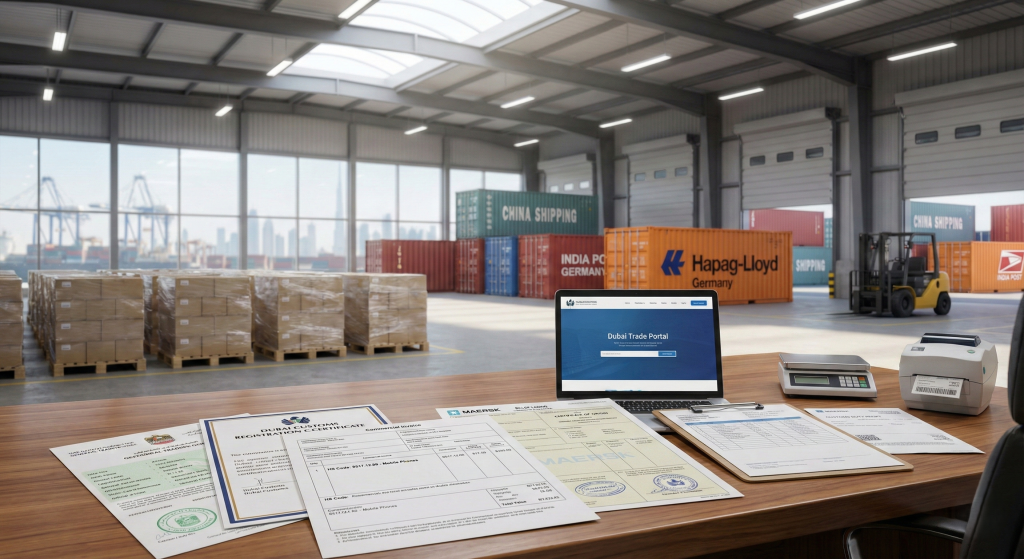
Understanding UAE trading license types and business jurisdiction options, obtaining import-export customs codes through Dubai Trade Portal registration, navigating Mirsal 2 customs declaration system requirements, applying 12-digit HS code classifications, securing required permits and documentation, choosing between mainland and free zone establishment, and leveraging UAE’s strategic position as global trade hub connecting Asia, Europe, and Africa markets. For the step-by-step version, including the customs client registration that gates every shipment, follow our free zone trading company setup path.
The UAE’s position as a premier global trading hub—ranked 10th worldwide for foreign direct investment with USD 45 billion in inflows—makes it strategically attractive for import-export businesses seeking access to 2.5 billion consumers within a four-hour flight radius. Starting an import-export business in the UAE requires obtaining appropriate trading licenses from Department of Economic Development authorities for mainland operations or free zone authorities for zone-based companies, registering with Dubai Customs or Federal Customs Authority to obtain import-export codes enabling customs clearance, and complying with the Mirsal 2 electronic declaration system using mandatory 12-digit HS code classifications effective February 2026.
This guide examines the complete regulatory framework governing import-export business establishment under UAE Commercial Companies Law and Federal Customs Authority regulations, compares mainland versus free zone licensing including advantages and operational restrictions of each jurisdiction, details the customs code registration process through Dubai Trade Portal with required documentation and fees, explains HS code classification requirements and the transition from 8-digit to 12-digit systems, itemizes essential shipping and customs documentation including commercial invoices, bills of lading, certificates of origin, and import permits, outlines step-by-step procedures from business formation through first shipment clearance, and analyzes total setup costs, timelines, and compliance requirements for legally operating import-export businesses across UAE and international markets.
UAE Import-Export Business Landscape: Strategic Advantages
The United Arab Emirates functions as a critical trade corridor linking Asian manufacturing centers, European consumer markets, and African growth economies. UAE’s non-oil foreign trade reached AED 2.997 trillion in 2024, marking 14.6% growth and significantly outperforming global trade expansion averaging 2.4%. Non-oil sectors contribute 74.6% to UAE’s total GDP, with trade, logistics, and re-export operations representing major economic pillars driving sustained growth and infrastructure investment.
Jebel Ali Port in Dubai ranks as the world’s ninth-largest container port, processing approximately 15 million twenty-foot equivalent units (TEUs) annually through 170 shipping routes connecting UAE to virtually every major commercial port globally. Al Maktoum International Airport—positioned to become the world’s largest cargo airport—and Dubai International Airport’s established air freight networks provide comprehensive air cargo connectivity. This dual sea-air infrastructure enables import-export businesses to optimize logistics costs and delivery timelines based on shipment urgency, weight, and destination.
The UAE maintains free trade agreements with numerous countries including Singapore, EFTA states (Switzerland, Norway, Iceland, Liechtenstein), India, and other trading partners, reducing or eliminating customs duties on qualifying goods and simplifying import procedures. Double Taxation Avoidance Agreements (DTAAs) with over 90 countries prevent duplicate taxation on cross-border profits, improving net margins for international trading operations. The UAE’s tax environment features zero personal income tax, zero corporate tax on profits up to AED 375,000 (with 9% rate above that threshold for mainland companies), and zero import/export duties within free zones, creating favorable economics for trading businesses.
Dubai’s regulatory framework in 2025 streamlines business establishment through digitized licensing procedures, one-stop-shop service centers reducing bureaucratic complexity, and business-friendly policies encouraging foreign investment. The UAE government actively promotes trading activities through infrastructure development, free zone expansion, and regulatory reforms including 100% foreign ownership permissions in most mainland sectors since 2021, eliminating previous requirements for 51% UAE national ownership in mainland companies.
One restriction sits outside the licensing system entirely. Where a product is already covered by a commercial agency registered at the Ministry of Economy and Tourism, customs may not release imports of it brought in by anyone other than the registered agent. Check the register before committing to a product line, using our guide to the UAE commercial agency law and exclusive import rights.
Trading License Types and Business Activities
Import-export businesses in the UAE require appropriate trading licenses specifying permitted commercial activities, with license categories varying by scope, product range, and regulatory oversight.
General Trading License
A general trading license authorizes businesses to import, export, distribute, store, and re-export products across multiple categories including electronics, textiles, food products, automotive parts, industrial equipment, consumer goods, building materials, and other commercial merchandise not subject to special restrictions. This license provides maximum flexibility for traders dealing with diverse product portfolios or businesses intending to expand into multiple commodity categories over time without requiring separate licenses for each product type.
General trading licenses apply primarily to mainland company establishment through Department of Economic Development (DED) in Dubai or equivalent authorities in other emirates (Department of Economic Development Abu Dhabi, Sharjah Economic Development Department, etc.). The license permits direct trade with UAE mainland markets—selling to UAE consumers, retailers, wholesalers, and government entities—as well as international import-export operations. Mainland general trading businesses can establish physical retail locations, warehouses accessible to local customers, and showrooms serving UAE clientele.
License requirements include leasing physical office space with tenancy contracts registered through Ejari (in Dubai) or equivalent systems in other emirates, appointing a Local Service Agent for government liaison if establishing as a Limited Liability Company (though 100% foreign ownership is permitted), and obtaining any sector-specific approvals required for particular product categories. Annual license fees typically range AED 15,000-30,000 depending on emirate, business activity count, and office location, with additional municipality fees and chamber of commerce registration costs.
Free Zone Trading License
Free zone trading licenses provide similar import-export authorization but operate within designated free zone jurisdictions offering distinct regulatory and tax advantages. Major free zones specializing in trading and logistics include Jebel Ali Free Zone (JAFZA)—the UAE’s largest free zone with 11,000+ companies and extensive warehouse facilities, Dubai Multi Commodities Centre (DMCC)—focused on commodities trading including gold, diamonds, tea, and agricultural products, Dubai Airport Free Zone (DAFZA)—leveraging Dubai International Airport proximity for air cargo operations, Dubai South—built around Al Maktoum International Airport with modern logistics infrastructure, and International Free Zone Authority (IFZA)—offering cost-effective setup with flexible workspace options.
Free zone advantages include 100% foreign ownership guaranteed without local partner requirements, zero corporate tax on profits for 15-50 years (depending on free zone), zero import/export customs duties on goods entering and exiting the free zone, 100% repatriation of capital and profits with no currency restrictions, and simplified licensing procedures with faster approvals through single-window clearance systems. Free zone companies can import goods into the zone, store inventory in duty-free warehouses, conduct light manufacturing or product assembly, re-export to international markets, and trade globally without mainland restrictions.
Operational restrictions include prohibition on direct trading with UAE mainland customers without additional licensing or distribution arrangements—free zone companies cannot sell directly to UAE consumers or operate retail stores outside the zone. However, regulatory reforms including commercial partnership agreements and the “One Free Zone Passport” initiative gradually ease mainland access, allowing approved free zone companies to serve mainland clients through designated channels while maintaining free zone benefits. Free zone license costs vary substantially: budget zones charge AED 15,000-25,000 annually, mid-tier zones AED 25,000-45,000, premium zones like JAFZA or DMCC AED 40,000-75,000+ depending on office size and visa quota.
Specific Trading Licenses
Businesses focusing on particular product categories may obtain specific trading licenses rather than general trading authorization. Common specific licenses include food import/export licenses for perishable and packaged foods requiring Dubai Municipality and food safety approvals, pharmaceutical import/export licenses requiring Ministry of Health and Prevention registration and compliance with medication import regulations, chemical and hazardous materials licenses requiring Environment and Climate Change Ministry permits, electronics and telecommunications equipment licenses requiring Telecommunications and Digital Government Regulatory Authority approvals for certain devices, and automotive parts trading licenses specifying vehicle components and accessories.
Specific licenses typically cost less than general trading licenses—AED 10,000-20,000 annually—but restrict business activities to the designated product categories. Companies can hold multiple specific licenses or combine specific licenses with general trading authorization if business scope requires broad product coverage alongside specialized categories needing dedicated regulatory compliance.
E-Commerce Trading License
E-commerce licenses authorize online trading operations where businesses import products and sell through digital platforms, marketplaces (Amazon.ae, Noon, etc.), or proprietary websites without physical retail presence. E-commerce licenses permit inventory storage in warehouses or third-party logistics facilities, drop-shipping arrangements where products ship directly from suppliers to customers, and cross-border e-commerce serving international buyers. Costs range AED 12,000-25,000 annually depending on jurisdiction and free zone versus mainland establishment, with many free zones offering specialized e-commerce packages with virtual office options and minimal physical space requirements.
Mainland vs. Free Zone: Strategic Decision Framework
Selecting between mainland and free zone establishment fundamentally shapes business operations, market access, taxation, and long-term scalability.
Mainland Company Setup
Mainland companies register with Department of Economic Development authorities in their emirate of operation and operate under UAE Commercial Companies Law (Federal Decree-Law No. 32 of 2021). Mainland import-export businesses can conduct trade anywhere in the UAE including direct sales to UAE consumers, government entities, and businesses; establish physical retail locations, showrooms, and distribution centers accessible to the public; operate warehouses in industrial areas or commercial zones outside free zones; and engage in construction, contracting, or service delivery requiring mainland presence.
Following 2021 regulatory reforms, foreign investors can own 100% of mainland Limited Liability Companies in most economic sectors without requiring 51% UAE national partners. Certain strategic sectors may still impose ownership restrictions or licensing requirements—defense, security, oil and gas extraction, and some banking activities—but general import-export trading permits full foreign ownership. Mainland companies typically appoint a Local Service Agent (LSA) who facilitates government interactions and provides local expertise without holding ownership stakes, charging annual fees typically AED 5,000-15,000.
Mainland setup requirements include reserving a trade name through DED systems ensuring compliance with naming regulations prohibiting religious, government, or trademarked terms; obtaining initial approval from DED confirming the business activity is permitted; securing any required approvals from sector regulators (Dubai Municipality for food trading, health authorities for medical goods, etc.); signing Memorandum of Association defining company structure, shareholder composition, and share capital; leasing physical office space with tenancy contracts registered through Ejari or equivalent systems; and obtaining the mainland trade license. Setup costs typically total AED 40,000-80,000 for first year including license, office lease, registration fees, and visa processing.
Free Zone Company Setup
Free zones offer streamlined establishment with guaranteed benefits and sector-specific infrastructure. JAFZA (Jebel Ali Free Zone) serves logistics-intensive businesses requiring extensive warehousing—offering pre-built warehouses from 100 square meters to 50,000+ square meters, dedicated logistics districts with container freight stations, temperature-controlled storage for food and pharmaceuticals, and direct access to Jebel Ali Port for seamless sea freight operations. Warehouse leasing rates start around AED 25-40 per square foot annually, with office space AED 45-65 per square foot.
DMCC (Dubai Multi Commodities Centre) specializes in commodities trading with dedicated facilities for precious metals, agricultural products, and industrial materials. The zone provides vault storage for gold and diamonds, commodity-specific regulations streamlining trading procedures, and proximity to Dubai Gold Souk and trading infrastructure. DMCC requires minimum AED 50,000 share capital evidenced by share certificates for investor visa eligibility, with license packages starting AED 35,000-50,000 annually.
Dubai South leverages Al Maktoum International Airport’s cargo capabilities for air freight-dependent businesses handling high-value or time-sensitive shipments. Competitive pricing—office space AED 35-50 per square foot, warehouses AED 20-30 per square foot—represents 20-25% savings versus JAFZA while offering modern infrastructure and aviation connectivity. IFZA and RAK Free Zone provide budget-friendly options for smaller traders or startups, with license packages starting AED 15,000-20,000 including flexi-desk arrangements and basic visa quotas.
Free zone formation involves selecting appropriate zone matching business sector and logistics needs; choosing company type (Free Zone Establishment for sole proprietors, Free Zone Company for partnerships); applying for trade name reservation within the zone; submitting license application with activity descriptions, ownership structure, and business plan; leasing office or warehouse space meeting minimum requirements for intended visa quota; and receiving the free zone trade license typically within one to two weeks. Total costs range AED 25,000-75,000+ for first year depending on zone selection and space requirements.
Import-Export Code Registration: Customs Authorization
After obtaining a trade license, businesses must register with UAE Customs authorities to receive an import-export code (also called customs code, Customs Client Code, or Mirsal Business Code) linking the company to customs declaration systems and authorizing shipment clearance.
Dubai Customs Registration Process
For companies operating in Dubai (mainland or Dubai-based free zones), customs registration occurs through the Dubai Trade Portal (www.dubaitrade.ae), which integrates with Dubai Customs systems. Access the Dubai Trade Portal and create a business account, providing company details, authorized signatory information, and contact details. Navigate to Service Centre → Dubai Customs → Request Business Registration to initiate the formal registration application.
Select appropriate business type from the following categories: Importer (for companies primarily importing goods into UAE), Exporter (for companies primarily exporting UAE-origin or re-exporting goods), Clearing Agent (for customs brokers clearing shipments on behalf of clients), Shipping Agent (for freight forwarders and logistics companies), Free Zone Entity (for companies licensed in Dubai-based free zones), or Airline Agent (for air cargo operators). Most import-export trading companies register as “Importer” and/or “Exporter” depending on business flow direction.
Upload required documentation including valid UAE trade license (mainland DED license or free zone license), establishment card if mainland company, shareholder/owner passport copy, authorized signatory passport copy and Emirates ID, company Memorandum of Association or equivalent incorporation document, and undertaking letter confirming compliance with customs regulations (template downloadable from Dubai Trade Portal during application). Submit the completed application with all attachments.
Pay the registration fee of AED 120 via the portal (AED 100 registration + AED 20 Knowledge and Innovation Dirham). Dubai Customs reviews the application typically within one to three business days. Upon approval, receive confirmation email containing your unique Customs Client Code (also called Business Code or Agent Code), which authorizes customs declaration submissions. This code remains valid as long as your trade license stays active and requires renewal when the trade license renews.
Other Emirates and Federal Customs Registration
Companies operating in emirates outside Dubai register with their respective emirate customs authorities: Abu Dhabi Customs for Abu Dhabi-based companies, Sharjah Customs for Sharjah, Ajman Customs for Ajman (known for particularly fast processing—codes issued within minutes in some cases for minimal AED 100 fee), and other emirate-specific authorities. Procedures mirror Dubai’s process with similar documentation requirements and online registration portals. Some free zones outside Dubai maintain their own customs procedures integrated with emirate-level or federal systems.
The Federal Customs Authority oversees UAE-wide customs policy coordination and manages federal customs operations at certain entry points. Companies engaged in cross-emirate trade or operating in multiple emirates may require registrations with multiple customs authorities depending on shipment routing and clearance locations.
Mirsal 2 Customs Declaration System
Mirsal 2 represents the UAE’s electronic customs declaration platform mandatory for all import and export shipments. The system automates customs processing, calculates duties and fees based on declared goods, facilitates electronic document submission, and provides real-time tracking of shipment clearance status.
System Access and User Setup
After receiving your Customs Client Code, log in to Dubai Trade Portal as the authorized administrator. Create additional user accounts for employees who will submit customs declarations, assigning appropriate roles: Trader Representative (for company employees submitting declarations for own company), Broker Representative (for customs brokers submitting on behalf of client companies), or administrative roles managing user access and company settings.
Apply for digital certificates for users submitting customs declarations—these certificates provide secure authentication for electronic submissions and legally bind declarations to the submitting party. Digital certificate application processes through the portal with identity verification requirements and fees typically AED 100-200 per certificate annually.
Declaration Submission Process
For each import or export shipment, log into Mirsal 2 through Dubai Trade Portal and initiate a new customs declaration. Select declaration type: import (goods entering UAE from international origins), export (UAE-origin goods departing to international destinations), re-export (foreign-origin goods previously imported now departing to third countries), or specialized categories like temporary imports or transit shipments.
Enter shipment details including consignor (seller/shipper), consignee (buyer/recipient), carrier information (shipping line, airline, trucking company), transport document numbers (Bill of Lading number for sea freight, Airway Bill for air cargo), entry point (seaport, airport, land border crossing), and destination. Provide item-level information for each product in the shipment: product description in English and Arabic, quantity and unit of measure, weight (gross and net), value (FOB, CIF, or other Incoterms basis), country of origin, and critically, the HS code classification.
Attach required electronic documentation including commercial invoice from supplier, packing list detailing shipment contents, bill of lading or airway bill from carrier, certificate of origin issued by exporting country’s chamber of commerce, and any special permits or certificates required for restricted goods. The system validates attached documents against declared information, flagging discrepancies for correction before submission.
Mirsal 2 automatically calculates applicable customs duties based on the HS code, shipment value, and origin country (accounting for free trade agreement benefits where applicable), plus VAT at 5% on CIF value plus duties. Review calculated fees, confirm accuracy of all entered information, and submit the declaration electronically. The system generates a declaration reference number for tracking.
Dubai Customs conducts automated risk assessment, potentially selecting shipments for physical inspection based on product type, origin country, value thresholds, or random selection algorithms. If cleared without inspection, receive electronic approval typically within hours. If selected for inspection, coordinate with customs officers at the cargo facility for physical verification—bring original paper documents, ensure shipment matches declared details, and address any discrepancies identified during inspection. Upon clearance approval, pay calculated duties and VAT online, receive payment confirmation and release authorization, and coordinate with shipping agent or warehouse to collect cleared goods.
HS Code Classification: Critical Compliance Requirement
Harmonized System (HS) codes provide standardized international product classification enabling consistent customs duty application, trade statistics compilation, and import/export regulation enforcement across 200+ countries globally. Correct HS code classification is legally mandatory and directly impacts customs duties paid, regulatory approvals required, and potential penalties for misclassification.
UAE HS Code Structure and Transition
Historically, the UAE applied 8-digit HS codes consisting of six digits from the World Customs Organization’s international Harmonized System plus two additional GCC Unified Customs Tariff digits providing regional specificity. From January 2025, the UAE and other GCC countries began transitioning to 12-digit HS codes offering substantially greater classification precision—expanding from approximately 7,800 tariff lines to over 13,400 distinct classifications.
Dubai Customs implemented a six-month transition period from August 2025 through February 2026, during which traders can use either 8-digit or 12-digit codes for GCC-destined shipments. From February 2026, 12-digit codes become mandatory for all GCC trade flows. The transition follows phased implementation: Phase 1 (August 2025 – February 2026) covers GCC-destined shipments with flexibility to use 8-digit or 12-digit codes; Phase 2 (February 2026 – August 2026) mandates 12-digit codes for GCC trade while expanding coverage to additional trade flows; subsequent phases will extend 12-digit requirements to all imports, exports, re-exports, and transit shipments until full implementation concludes.
During the transition period, certain trade flows remain exempt from 12-digit requirements and continue using 8-digit codes: free zone in/out movements (goods entering or exiting free zones), movements between Dubai free zones, transshipments (goods passing through UAE ports without customs clearance), transit trade (goods moving across UAE territory to third countries), and transfers within free zones. These exempted flows will transition to 12-digit codes in later phases.
Determining Correct HS Codes
Dubai Customs and Abu Dhabi Customs provide online HS code search tools accessible through their websites. Enter product descriptions, material composition, or intended use to search the tariff database, which returns matching HS codes with descriptions, applicable duty rates, and any special restrictions. For complex products or unclear classifications, businesses can request binding classification rulings from customs authorities—submit detailed product information, technical specifications, material composition, intended use, and physical samples if requested. Customs issues official rulings confirming the correct HS code, providing legal certainty for future shipments and protecting against misclassification penalties.
HS codes must appear consistently across all shipment documentation: customs declarations in Mirsal 2, commercial invoices from suppliers, certificates of origin, packing lists, and transport documents. Discrepancies between HS codes on different documents trigger customs scrutiny, clearance delays, and potential penalties. Maintaining accurate HS code records and updating classifications when products change or tariff structures update prevents compliance issues.
Penalties for Misclassification
Incorrect HS code classification—whether intentional undervaluation to reduce duties or unintentional errors from improper research—results in fines of minimum AED 500 for first offenses, clearance delays while customs reclassifies goods and recalculates duties, retroactive duty assessments requiring payment of unpaid duties plus penalties, potential seizure of goods for serious or repeated violations, and customs blacklisting affecting future shipments and company reputation. Investing in proper HS code determination, consulting customs brokers or classification specialists for complex products, and requesting binding rulings when uncertain substantially reduces misclassification risk and associated penalties.
Essential Import-Export Documentation
Every import and export shipment requires comprehensive documentation proving transaction legitimacy, enabling duty calculation, and facilitating customs clearance.
Commercial Invoice
The commercial invoice represents the primary transaction document issued by the seller (exporter) to the buyer (importer), detailing goods sold, quantities, prices, and commercial terms. Required information includes seller name, address, contact details, and tax registration number; buyer name, address, and identification; invoice number and date; detailed product descriptions matching HS code classifications; quantity and unit of measure for each item; unit price and total value per line item; currency and payment terms; Incoterms specifying responsibility for shipping, insurance, and customs (FOB, CIF, DDU, etc.); and total invoice value. Customs uses the commercial invoice to calculate import duties and VAT, verify declared shipment contents, and confirm transaction authenticity.
Packing List
The packing list provides item-level detail beyond commercial invoice summaries, specifying exact packaging configuration, dimensions, weights, and serial numbers. Include gross weight and net weight for each package, package dimensions (length, width, height), packaging type (cartons, pallets, crates, drums), number of packages, marks and numbers identifying packages, and itemized contents of each package including serial numbers where applicable. Customs officers use packing lists during physical inspections to match declared goods with actual cargo, verify quantities, and confirm shipment integrity.
Bill of Lading (Sea Freight) / Airway Bill (Air Cargo)
Transport documents issued by carriers acknowledge receipt of goods and serve as contracts of carriage. Bills of Lading for sea freight include shipper details, consignee information, notify party contacts, vessel name and voyage number, port of loading and discharge, description of goods, container numbers and seal numbers, freight charges and payment terms, and signatures from carrier representatives. Airway Bills for air cargo contain similar information adapted for air transport including airline name, flight number, airport codes, and air cargo-specific handling instructions. These documents prove shipment occurred, transfer title of goods, and authorize cargo release at destination.
Certificate of Origin
Certificates of origin verify the country where goods were manufactured or produced, issued by chambers of commerce or designated government authorities in the exporting country. This certificate enables importers to claim preferential duty rates under free trade agreements—for example, goods originating in Singapore imported to UAE under the UAE-Singapore FTA may qualify for reduced or zero duties if proper certificate of origin accompanies the shipment. UAE importers present certificates to customs during declaration to claim applicable benefits. Certificates require attestation by the UAE Ministry of Foreign Affairs if issuing country requires this for validity in UAE.
Import Permits and Special Approvals
Certain product categories require permits or approvals from UAE regulatory authorities before importation: Food products require Dubai Municipality food import permits and food safety certificates, sometimes Halal certification for meat and poultry products, and health certificates from exporting country government agencies confirming fitness for consumption. Pharmaceuticals and medical devices require Ministry of Health and Prevention registration and import permits proving products meet UAE medical standards. Chemicals and hazardous materials require Environment and Climate Change Ministry approvals confirming safe handling, storage, and disposal procedures. Telecommunications equipment (certain devices) requires Telecommunications and Digital Government Regulatory Authority approval ensuring devices meet technical standards and do not interfere with UAE telecommunications networks. Plants and agricultural products require plant health certificates and Ministry of Climate Change and Environment phytosanitary approvals preventing pest and disease introduction.
Businesses importing restricted goods should obtain required permits before shipping to avoid cargo detention at UAE ports awaiting permit issuance. Permit applications typically require product specifications, test certificates, manufacturer licenses, and intended use declarations, with processing timelines ranging from few days to several weeks depending on product complexity and regulatory authority workload.
| Document | Issued By | Purpose | Key Information Required |
|---|---|---|---|
| Commercial Invoice | Seller/Exporter | Transaction proof, duty calculation, VAT assessment | Seller/buyer details, product descriptions, quantities, prices, Incoterms, total value |
| Packing List | Seller/Exporter or Freight Forwarder | Physical shipment verification, inspection matching | Package count, weights, dimensions, packaging type, contents per package, marks/numbers |
| Bill of Lading / Airway Bill | Shipping Line or Airline | Shipment receipt, cargo release authorization, title transfer | Shipper/consignee, carrier, vessel/flight, origin/destination, cargo description, freight terms |
| Certificate of Origin | Exporting Country Chamber of Commerce | Origin verification, FTA duty reduction claims | Manufacturer, product description, country of manufacture, chamber certification, MOFA attestation if required |
| Import Permit | Relevant UAE Ministry/Authority | Regulatory approval for controlled goods | Importer license, product specifications, intended use, compliance certificates, permit validity dates |
| Customs Declaration (Mirsal 2) | Importer/Exporter via Dubai Trade Portal | Official customs entry, duty/VAT calculation, clearance authorization | HS codes, CIF values, transport details, all supporting documents attached electronically |
Step-by-Step Process: From Business Formation to First Shipment
Establishing and operationalizing an import-export business follows a defined sequence from initial planning through first cargo clearance.
Step 1: Business Planning and Jurisdiction Selection (1-2 Weeks)
Define business scope including product categories you intend to trade, target markets (importing into UAE, re-exporting internationally, or both), anticipated shipment volumes and frequency, and whether operations require extensive warehousing. Research product-specific regulations to identify any restricted categories requiring special permits or categories prohibited entirely (weapons, narcotics, counterfeit goods, etc.).
Choose between mainland and free zone establishment based on your business model. Select mainland if you plan to sell directly to UAE consumers, operate physical retail locations, or engage in construction/contracting requiring mainland presence. Choose free zone if 100% foreign ownership, tax benefits, and duty-free warehousing are priorities, you focus on international trade rather than UAE market sales, or you operate in sectors with specialized free zone infrastructure (JAFZA for logistics, DMCC for commodities, DAFZA for air cargo).
Select specific free zone if choosing that path—evaluate zones based on location relative to ports/airports, warehouse availability and costs, license package pricing, visa quota allocations, and sector specialization matching your business. Request quotations from multiple zones to compare total costs including license, office/warehouse space, visas, and renewal fees.
Step 2: Company Formation and Trade License (2-4 Weeks)
Reserve trade name through DED portal for mainland companies or free zone application systems for zone companies, ensuring compliance with naming rules prohibiting religious, government, or trademarked terms. Submit at least three name options ranked by preference—authorities approve if names are available and compliant. For mainland companies, obtain initial approval from DED confirming the proposed business activity is permitted and no objections exist to your establishment. Free zones typically incorporate initial approval within their license application process.
Prepare incorporation documents including Memorandum of Association for partnerships defining shareholder structure, capital contributions, profit distribution, and management authority, or sole proprietorship documentation for single-owner businesses. Mainland companies may require Local Service Agent agreements even with 100% foreign ownership, specifying agent responsibilities and annual fees. Sign all documents with notarization where required.
Secure office or warehouse space meeting regulatory requirements. Mainland companies need physical offices with Ejari-registered tenancy contracts proving legitimate business address—co-working spaces or business centers may satisfy requirements for trading companies not requiring large premises. Free zone companies lease space from the free zone authority ranging from flexi-desks (supporting 1-2 visas) to dedicated offices or large warehouses (supporting dozens of visas based on square footage). Warehouse requirements depend on inventory volume—small traders using third-party logistics may manage with minimal office space, while import-export businesses maintaining substantial inventory need dedicated warehousing.
Obtain any required sector-specific approvals: Dubai Municipality food safety permits for food importers, health authority medical device registrations for healthcare goods, etc. Submit trade license application with all completed documentation and pay license fees (AED 15,000-30,000 mainland, AED 15,000-75,000 free zone depending on jurisdiction). Receive trade license typically within two to four weeks for mainland, one to two weeks for free zones.
Step 3: Establishment Card and Immigration Registration (3-7 Days)
After receiving your trade license, register with GDRFA (General Directorate of Residency and Foreigners Affairs) to obtain an establishment card linking your company to the UAE immigration system. This card authorizes the company to sponsor employee and investor residence visas. Apply through GDRFA service centers or online portals, providing trade license, company incorporation documents, office tenancy contract, and authorized signatory identification. Pay establishment card fees (AED 2,000-3,000 annually) and complete E-Channel registration for electronic visa processing. Receive establishment card and visa quota allocation within three to seven working days.
Step 4: Customs Registration and Import-Export Code (2-5 Days)
Register with Dubai Customs (for Dubai-based companies) or relevant emirate customs authority through Dubai Trade Portal or equivalent systems. Complete business registration application selecting appropriate business type (Importer, Exporter, or both), upload required documents (trade license, passport copies, undertaking letters), and pay AED 120 registration fee. Receive customs approval and Customs Client Code typically within one to three business days, with some emirates like Ajman processing within same day or hours.
After receiving the Customs Client Code, log into Dubai Trade Portal and set up user accounts for employees who will submit customs declarations. Apply for digital certificates providing secure authentication for Mirsal 2 submissions, paying certificate fees and completing identity verification processes.
Step 5: Corporate Bank Account Opening (1-4 Weeks)
Open corporate bank account with UAE banks for handling import-export transactions, paying suppliers, receiving customer payments, and managing customs duty/VAT payments. Banks require trade license, Memorandum of Association, shareholder passports and Emirates IDs, proof of address, business plan explaining trading activities and projected revenues, and source of funds documentation explaining capital origins and business financing.
UAE banks conduct extensive due diligence particularly for trading companies due to anti-money laundering and counter-terrorism financing regulations. Prepare comprehensive documentation demonstrating legitimate business operations, clear transaction flows, and compliance frameworks. Account opening timelines vary substantially: one to two weeks for established banks with streamlined processes, three to four weeks or longer for banks with strict policies or applications requiring additional verification. Some free zones maintain partnerships with specific banks offering expedited account opening for free zone companies.
Step 6: Investor Visa Application (2-3 Weeks)
As company owner or partner holding qualifying share capital (typically AED 50,000 minimum), apply for investor residence visa. The process involves applying for entry permit if outside UAE or status change if already present on another visa, completing medical fitness tests at approved health centers (AED 300-500), registering for Emirates ID with biometric data capture (fees AED 370-1,070 depending on validity), and receiving visa stamping in passport (fees AED 3,000-6,000 depending on duration). Total investor visa processing requires two to three weeks after company formation completes, with costs AED 8,000-15,000 including all fees, medical tests, Emirates ID, and health insurance.
Step 7: VAT Registration (If Applicable) (1-2 Weeks)
Businesses with annual revenue exceeding AED 375,000 must register for UAE Value Added Tax with the Federal Tax Authority. Import-export companies often reach this threshold quickly, as import values and re-export revenues count toward turnover calculations. Register through the FTA online portal, obtain Tax Registration Number (TRN), and implement VAT accounting procedures including proper invoicing with VAT line items, VAT collection on taxable supplies (5% standard rate), VAT payment on imports, and quarterly VAT return filing.
Import-export activities may qualify for zero-rated VAT treatment (0% rate with input VAT recovery) on international exports, certain re-export transactions, and designated free zone supplies. Consult tax advisors or VAT specialists to ensure proper rate application and maximize VAT efficiency.
Step 8: First Shipment and Customs Clearance (2-7 Days)
Coordinate with international suppliers to arrange first shipment, confirming Incoterms, shipping arrangements, and required documentation. Request suppliers provide complete commercial invoices, packing lists, and arrange transport documents (Bills of Lading or Airway Bills). Obtain certificates of origin from supplier’s country chamber of commerce, with UAE Embassy attestation if required. Ensure all documents use consistent product descriptions and correctly classified HS codes.
When shipment arrives at UAE port or airport, receive notification from shipping line or airline with transport document details. Log into Mirsal 2 through Dubai Trade Portal and file import declaration, entering all shipment data, attaching electronic documentation, and submitting for customs processing. Pay calculated customs duties and VAT online upon clearance approval. If shipment selected for physical inspection, coordinate with customs officers at cargo facility, present original paper documents, and facilitate inspection process. Upon receiving clearance approval and release authorization, coordinate with shipping agent or warehouse to collect cargo and transport to your storage facility.
First shipments often experience longer processing as customs authorities may conduct enhanced scrutiny of new importers establishing trade history. Expect two to seven days for first import clearance including potential inspection delays. Subsequent shipments typically clear faster—within hours to one day—once you establish track record of compliant declarations and accurate documentation.
Costs and Investment Requirements
Total investment required to establish and launch import-export operations varies based on jurisdiction, scale, and business model.
Initial Setup Costs
Company formation and licensing: AED 40,000-80,000 for mainland companies (trade license AED 15,000-30,000, office lease AED 20,000-40,000 annually, Memorandum of Association and notarization AED 3,000-5,000, Local Service Agent fees AED 5,000-15,000); or AED 25,000-75,000 for free zone companies (license packages AED 15,000-75,000 including office/flexi-desk, with premium zones like JAFZA commanding higher fees, warehouse space additional AED 25,000-100,000+ annually if required for inventory-heavy operations).
Customs registration and digital certificates: AED 120 customs code registration, AED 100-200 per user for digital certificates enabling Mirsal 2 submissions. Immigration and visa costs: AED 2,000-3,000 establishment card, AED 8,000-15,000 per investor visa (entry permit, medical tests, Emirates ID, visa stamping, health insurance). Corporate bank account setup: typically no account opening fees but minimum balance requirements AED 25,000-100,000 depending on bank and account type.
Total initial investment for modest import-export startup: AED 50,000-100,000 including company formation, customs registration, one investor visa, and basic working capital. Larger operations with extensive warehousing, multiple visas, or premium free zone locations: AED 150,000-300,000+ for comprehensive setup.
Ongoing Operational Costs
Annual trade license renewal: AED 15,000-30,000 mainland, AED 15,000-75,000 free zone depending on jurisdiction. Office or warehouse lease: AED 20,000-40,000 for modest office, AED 50,000-200,000+ for warehouses depending on size and location. Visa renewal every 2-3 years: AED 5,000-10,000 per visa including medical tests, Emirates ID renewal if expiring, and visa fees. Establishment card renewal annually: AED 2,000-3,000.
Customs duties and VAT on imports: typically 5% customs duty on CIF value for most goods (higher rates for alcohol, tobacco; zero for many consumer electronics and certain categories), plus 5% VAT on CIF value plus duties. Shipping and logistics costs: vary dramatically based on shipment size, origin, and transport mode—container shipping from China to Dubai AED 5,000-15,000 per 20-foot container depending on route and season, air cargo AED 8-25 per kilogram. Freight forwarding and customs brokerage services: AED 500-2,000 per shipment depending on complexity, value, and services required.
Working capital requirements: sufficient funds to pay suppliers upfront, cover shipping costs before customer payment, finance duty/VAT outlays before sales recovery, and maintain buffer for operational expenses. Typical working capital needs: AED 100,000-500,000 for small operations, AED 500,000-2,000,000+ for medium-scale trading.
Strategic Considerations for Long-Term Success
Beyond regulatory compliance, successful import-export businesses require strategic positioning, operational excellence, and market knowledge.
Product Selection and Market Research
Focus on products with strong demand in UAE or regional markets, reasonable profit margins after duties and shipping costs, manageable regulatory requirements avoiding heavily restricted categories requiring extensive permits, and reliable supplier bases in exporting countries with consistent quality and capacity. Conduct market research identifying competitor pricing, consumer preferences, seasonal demand patterns, and distribution channel requirements. UAE’s diverse expatriate population creates demand for ethnic foods, home country products, and specialized goods underserved by mainstream retailers, presenting opportunities for niche importers.
Supplier Relationship Management
Develop reliable supplier networks in source countries, negotiating favorable payment terms, quality assurance procedures, and consistent delivery schedules. Diversify suppliers across multiple manufacturers or countries to mitigate supply chain disruptions, price volatility, or quality issues with individual vendors. Establish clear specifications, inspect samples before bulk orders, and implement quality control procedures ensuring imported goods meet UAE standards and customer expectations.
Logistics Optimization
Choose appropriate shipping modes balancing cost versus speed: sea freight for high-volume, non-urgent cargo (4-6 weeks from Asia, 2-3 weeks from Europe), air cargo for urgent, high-value, or perishable goods (3-7 days from most origins but 3-5x sea freight cost per kilogram), or multimodal combinations optimizing different legs of transportation. Leverage free zone warehousing for duty deferral—import goods into free zones duty-free, store inventory, and pay duties only when releasing specific quantities to UAE mainland as needed, improving cash flow.
Establish relationships with customs brokers and freight forwarders providing expertise in documentation, clearance procedures, and problem resolution. While many businesses manage customs declarations internally using Mirsal 2, complex shipments, multiple regulatory approvals, or high-value cargo benefit from professional broker services ensuring compliance and expediting clearance.
Compliance and Record-Keeping
Maintain comprehensive records of all import-export transactions including commercial invoices, packing lists, transport documents, customs declarations, duty/VAT payment receipts, and certificates of origin. UAE regulations require retaining business records for minimum five years for tax purposes and indefinitely for certain corporate documents. Organized record-keeping facilitates VAT returns preparation, customs audits, financial reporting, and dispute resolution.
Stay current with regulatory changes including customs duty rate adjustments, HS code updates, free trade agreement expansions, and sector-specific rule modifications. Subscribe to Dubai Customs notifications, FTA alerts, and free zone authority updates to receive timely information affecting your operations. Periodic compliance reviews with legal advisors or trade consultants identify regulatory gaps and ensure ongoing adherence to evolving requirements.
FAQ
What is the difference between a general trading license and a specific trading license in the UAE?
A general trading license authorizes businesses to import, export, distribute, and re-export products across multiple categories including electronics, textiles, food, automotive parts, building materials, and other commercial goods not subject to special restrictions—providing maximum flexibility for traders dealing with diverse product portfolios. This license costs AED 15,000-30,000 annually for mainland setup and permits direct trade with UAE consumers and international markets. A specific trading license restricts business activities to particular product categories like food import-export, pharmaceuticals, electronics, chemicals, or automotive parts, typically costing less (AED 10,000-20,000 annually) but limiting trading scope to the designated categories. Businesses focusing exclusively on one product type may prefer specific licenses for cost savings, while companies intending to expand across multiple categories or uncertain about future product mix benefit from general trading licenses’ broader authorization. You can hold multiple specific licenses simultaneously or combine specific licenses with general trading if business scope requires specialized categories alongside broad product coverage.
Should I set up my import-export business in mainland Dubai or in a free zone like JAFZA?
The optimal choice depends on your business model and target markets. Choose mainland if you plan to sell directly to UAE consumers, operate physical retail locations or showrooms accessible to the public, engage in construction, contracting, or services requiring mainland presence, or need unrestricted access to UAE government procurement contracts. Mainland setup permits trade anywhere in the UAE but costs AED 40,000-80,000 for first year including license and office lease, requires physical office space with Ejari registration, and may involve Local Service Agent appointments. Choose free zone (JAFZA, DMCC, DAFZA, etc.) if 100% foreign ownership guarantee, zero corporate tax benefits, and duty-free warehousing are priorities; your business focuses on international import-export and re-export rather than UAE market sales; you require extensive warehouse facilities for logistics operations (JAFZA offers 100 sqm to 50,000+ sqm warehouses); or you operate in specialized sectors with dedicated free zone infrastructure (commodities trading in DMCC, air cargo in DAFZA). Free zone setup costs AED 25,000-75,000+ depending on zone selection and space requirements, processes faster (1-2 weeks versus 2-4 weeks for mainland), but restricts direct mainland market access—free zone companies cannot sell directly to UAE consumers without establishing mainland distribution arrangements or obtaining additional permits. Many successful import-export businesses start in free zones to leverage tax benefits and warehousing for international trade, then expand with mainland presence when developing UAE consumer market sales becomes strategic priority.
How do I obtain the import-export code and how long does it take?
After obtaining your UAE trade license, register with Dubai Customs (for Dubai-based companies) or your emirate’s customs authority through the Dubai Trade Portal at www.dubaitrade.ae. Access the portal, create a business account, navigate to Service Centre → Dubai Customs → Request Business Registration, and select business type (Importer, Exporter, or both). Upload required documents including trade license, establishment card if mainland company, owner/manager passport copy, Memorandum of Association, and undertaking letter confirming customs regulation compliance (template available on the portal). Pay AED 120 registration fee (AED 100 registration + AED 20 Knowledge and Innovation fee). Dubai Customs reviews your application typically within one to three business days and emails approval with your unique Customs Client Code (also called Business Code) authorizing customs declaration submissions. Some emirates process even faster—Ajman Customs issues codes within hours or same day in many cases. The code remains valid as long as your trade license is active and requires renewal when you renew your license. After receiving the code, log into Dubai Trade Portal as administrator and create user accounts for employees who will submit customs declarations, then apply for digital certificates (AED 100-200 per user) providing secure authentication for Mirsal 2 system access. Total customs registration from application to operational readiness: two to five days for most jurisdictions.
What are HS codes and why are they important for my import-export business?
HS codes (Harmonized System codes) are standardized international product classification numbers used by over 200 countries to identify traded goods for customs purposes. Every product you import or export must be assigned the correct HS code, which determines the customs duty rate you pay, identifies any regulatory restrictions or permit requirements for that product category, enables accurate trade statistics compilation, and facilitates consistent treatment across different countries and ports. The UAE is transitioning from 8-digit to 12-digit HS codes, with mandatory 12-digit classification for GCC trade from February 2026 and phased expansion to all trade flows thereafter. During the transition period (August 2025 – February 2026), businesses can use either 8-digit or 12-digit codes for GCC-destined shipments, but 12-digit becomes mandatory after February 2026. Correct HS code classification is legally required and directly impacts your costs and compliance—incorrect codes result in minimum AED 500 fines, clearance delays while customs reclassifies goods, retroactive duty assessments requiring payment of unpaid duties plus penalties, and potential cargo seizure for serious violations. Determine correct HS codes using Dubai Customs’ online HS code search tool at www.dubaicustoms.gov.ae where you enter product descriptions and the system returns matching codes with duty rates, or request binding classification rulings from customs authorities for complex products by submitting detailed specifications and samples. Ensure HS codes appear consistently across all shipment documents: customs declarations, commercial invoices, certificates of origin, and transport documents—discrepancies trigger customs scrutiny and clearance delays.
Can I run my import-export business on a visit visa or do I need a residence visa?
No, you cannot legally operate an import-export business on a visit visa—UAE regulations require residence visa status linked to your company’s trade license for business owners conducting commercial operations. Visit visas authorize tourism, family visits, or short business trips (attending meetings, exploring opportunities) but do not permit establishing businesses, signing commercial contracts as company principal, or managing ongoing trading operations. As the owner or partner in your import-export company, you must obtain an investor residence visa sponsored by your company, which requires holding minimum share capital (typically AED 50,000 for standard investor visas), completing medical fitness tests, registering for Emirates ID, and receiving visa stamping providing legal residence authorization. The investor visa application process takes two to three weeks after company formation and costs AED 8,000-15,000 including all fees, medical tests, Emirates ID, and mandatory health insurance. Without proper residence visa status, you cannot open corporate bank accounts, sign tenancy contracts for business premises, sponsor employee visas, or conduct the full range of commercial activities necessary for operating an import-export business. Attempting to conduct business on visit visa status risks immigration violations, business license cancellation, fines, and deportation with entry bans. Some entrepreneurs explore the business while on visit visas—conducting market research, meeting potential suppliers, touring free zones—but must obtain proper residence visas before commencing actual trading operations, signing incorporation documents, or representing the company in official capacities.
Do I need a warehouse to start an import-export business or can I operate without one?
A warehouse is not mandatory for all import-export businesses—requirements depend on your business model, inventory volumes, and product handling needs. You can operate without dedicated warehouse space if you conduct drop-shipping where goods ship directly from suppliers to customers without UAE storage, use third-party logistics (3PL) providers who receive, store, and ship inventory on your behalf, trade high-value low-volume products requiring minimal storage (electronics, jewelry, specialized machinery), or focus on re-export operations where goods transit through UAE ports without long-term storage needs. In these scenarios, modest office space (flexi-desk, serviced office, or small dedicated office) satisfies trade license requirements without warehouse investments. However, you will benefit from warehouse facilities if you maintain substantial inventory for UAE market sales, import bulk shipments requiring breakdown into smaller quantities for distribution, conduct light assembly, packaging, or quality control before resale, or leverage free zone warehousing for duty deferral—importing goods duty-free into free zones, storing inventory, and paying duties only when releasing specific quantities to UAE mainland as needed. JAFZA offers extensive pre-built warehouses from 100 square meters to 50,000+ square meters with leasing rates starting AED 25-40 per square foot annually, while Dubai South provides modern warehouses at AED 20-30 per square foot. Smaller traders can begin with third-party logistics or minimal storage, then expand to dedicated warehousing as business volume grows and justifies the investment. Many free zones offer flexible arrangements allowing companies to start with basic office space and add warehouse capacity incrementally as operations scale.
How much capital do I need to start an import-export business in the UAE?
Total capital requirements vary based on business scale, jurisdiction choice, and operational model, but expect minimum investment of AED 50,000-100,000 for basic setup covering: company formation and trade license (AED 25,000-80,000 depending on mainland versus free zone and jurisdiction selection); customs registration and digital certificates (AED 500-1,000); one investor visa with medical tests, Emirates ID, and health insurance (AED 8,000-15,000); corporate bank account minimum balance (AED 25,000-50,000 depending on bank); and initial working capital for first shipments, supplier payments, and operational expenses (AED 20,000-50,000 minimum). Free zone budget options like IFZA or RAK Free Zone enable lean startups with total setup around AED 50,000-70,000 including license, flexi-desk, one visa, and minimal working capital, suitable for traders using drop-shipping or low inventory models. More substantial operations requiring warehouse space, multiple employee visas, or premium locations like JAFZA or DMCC require AED 150,000-300,000+ initial investment. Beyond setup costs, ensure adequate working capital to finance ongoing operations: paying suppliers before receiving customer payments (often 30-90 day payment cycles), covering shipping and logistics costs, financing customs duty and VAT payments before sales revenue recoups these outlays, and maintaining operational buffer for licenses renewals, unexpected expenses, and cash flow gaps. Typical working capital needs range AED 100,000-500,000 for small import-export operations handling AED 1-5 million annual trade volume, scaling to AED 500,000-2,000,000+ for medium-scale businesses with AED 10-50 million turnover. Conservative financial planning suggests maintaining working capital equal to three to six months of operational expenses plus inventory investment to weather market fluctuations, supplier delays, or customer payment gaps without jeopardizing business continuity.
What products are prohibited or restricted from import into the UAE?
UAE customs prohibit certain goods entirely and restrict others to licensed importers with special permits. Absolutely prohibited items that cannot be imported under any circumstances include narcotic drugs and psychotropic substances (except licensed pharmaceutical companies with health authority permits), firearms, ammunition, and explosives (except licensed security companies and government entities), counterfeit goods infringing intellectual property rights, materials contradicting Islamic values or public morality (pornographic content, idol worship items), certain gambling equipment and materials, and products from countries under UAE embargo or international sanctions. Restricted items requiring special import permits include food products and perishable goods (Dubai Municipality food import permits, food safety certificates, sometimes Halal certification for meat), pharmaceuticals and medical devices (Ministry of Health and Prevention registration and import permits), chemicals and hazardous materials (Environment and Climate Change Ministry approvals for safe handling), live animals and animal products (veterinary certificates, quarantine approvals), plants and seeds (phytosanitary certificates preventing pest introduction), telecommunications equipment (Telecommunications and Digital Government Regulatory Authority approvals for certain devices), and alcohol and tobacco products (limited to licensed distributors with special permits, heavy excise duties apply). Before selecting products for your import-export business, research UAE import regulations for your intended categories through Dubai Customs website, Federal Customs Authority resources, or consulting with customs brokers. Attempting to import prohibited goods results in cargo seizure, destruction at importer’s expense, substantial fines, and potential criminal prosecution. Importing restricted goods without proper permits triggers cargo detention until permits obtained, storage fees accumulating daily, and clearance delays disrupting business operations. Stick to permissible product categories or ensure you can obtain required regulatory approvals before committing to supplier relationships or shipping arrangements.
Do I need to register for VAT immediately when starting my import-export business?
VAT registration is mandatory only when your annual taxable revenue exceeds AED 375,000—if your business reaches this threshold, you must register with the Federal Tax Authority within 30 days. For import-export businesses, “taxable revenue” includes the value of goods sold in UAE mainland markets, certain supplies made from free zones to mainland, and other UAE-based trading activities. International exports, re-exports, and some designated free zone supplies may qualify for zero-rated VAT treatment (0% rate but still counted toward registration threshold). Many import-export businesses reach the AED 375,000 threshold quickly because import values count toward turnover calculations—for example, importing AED 500,000 worth of goods annually triggers mandatory VAT registration even if you haven’t yet sold all inventory. You can voluntarily register for VAT even below AED 375,000 threshold if annual revenue exceeds AED 187,500, which may be advantageous for recovering input VAT paid on business expenses, establishing VAT compliance from inception, or meeting customer requirements for VAT-registered suppliers. Do not register for VAT until you genuinely expect to reach or have reached the threshold, as registration creates quarterly VAT return filing obligations, accounting system requirements, compliant invoicing procedures, and potential VAT payment obligations even during low-revenue periods. The registration process through FTA portal (www.tax.gov.ae) takes one to two weeks, requires trade license, Memorandum of Association, bank account details, financial projections, and authorized signatory identification. Upon registration, receive Tax Registration Number (TRN) to include on all invoices, implement VAT-compliant accounting tracking input VAT paid and output VAT collected, charge 5% VAT on taxable supplies to UAE customers, and file quarterly VAT returns by the 28th day following each quarter. Import-export VAT mechanics involve paying 5% VAT on import CIF value plus customs duties at the point of customs clearance, recovering this input VAT through your VAT returns if you’re registered, charging 5% VAT on sales to UAE mainland customers, and potentially benefiting from 0% zero-rating on international exports. Consult VAT specialists or tax advisors to optimize VAT treatment for your specific business model and ensure proper compliance from commencement.
How long does it take to clear my first import shipment through Dubai Customs?
First import shipments typically require two to seven days for customs clearance including potential inspection delays, as customs authorities often conduct enhanced scrutiny of new importers establishing trade history and compliance track records. The clearance timeline depends on several factors: documentation completeness—shipments with accurate, complete documentation clear faster than those with missing certificates, incorrect HS codes, or invoice discrepancies requiring correction; product type—routine consumer goods clear quickly, while restricted categories requiring permit verification (food, pharmaceuticals, electronics) take longer; physical inspection—random selection or risk assessment may trigger physical inspection adding one to three days for scheduling, inspection execution, and post-inspection processing; and shipment complexity—single-item containers clear faster than mixed cargo requiring line-by-line verification. For your first shipment, ensure documentation excellence: obtain complete commercial invoices with accurate descriptions, comprehensive packing lists with itemized contents, properly attested certificates of origin, all required import permits obtained before shipment arrival, and correctly classified 12-digit HS codes researched using Dubai Customs database. File your Mirsal 2 customs declaration immediately when notified of shipment arrival rather than delaying—early submission allows customs to begin processing before cargo physically arrives at storage facilities. Many importers engage customs brokers for first shipments to navigate procedures, ensure documentation accuracy, and troubleshoot issues—broker fees of AED 500-2,000 per shipment provide expertise preventing costly delays from procedural mistakes. After successfully clearing your first few shipments with accurate declarations and compliant documentation, subsequent clearances accelerate dramatically—routine shipments often clear within hours to one day once you’ve established positive compliance history. Customs may still select occasional shipments for random inspection regardless of track record, but most traders with consistent accuracy enjoy fast, predictable clearance supporting reliable supply chains and customer commitments. To minimize first shipment delays, consider importing smaller trial shipment initially rather than bulk container load—lower value and simpler cargo reduces scrutiny while you learn procedures, with knowledge gained applied to subsequent larger shipments.
This information is current and represents general guidance on establishing import-export businesses in the UAE. Trade regulations, customs procedures, HS code requirements, licensing fees, and free zone policies are subject to change by the Federal Customs Authority, Dubai Customs, Department of Economic Development authorities in individual emirates, free zone licensing authorities, and the Federal Tax Authority. The transition to mandatory 12-digit HS codes, Mirsal 2 system updates, duty rates, and VAT treatment may evolve. Specific requirements for restricted goods including food products, pharmaceuticals, chemicals, telecommunications equipment, and other regulated categories vary by product type and change based on regulatory authority policies. Costs for trade licenses, office space, warehouse facilities, customs registration, and visa processing fluctuate based on emirate, jurisdiction, free zone authority, market conditions, and service provider rates. Free trade agreement benefits, duty rates, and preferential treatment depend on goods origin, certificate of origin validity, and bilateral agreement terms subject to modification. Consult licensed business setup consultants, customs brokers, freight forwarders, and trade lawyers for advice specific to your product categories, target markets, and business model before establishing import-export operations or committing to supplier contracts. This guide provides educational information and does not constitute legal, tax, or business advice for specific circumstances.