

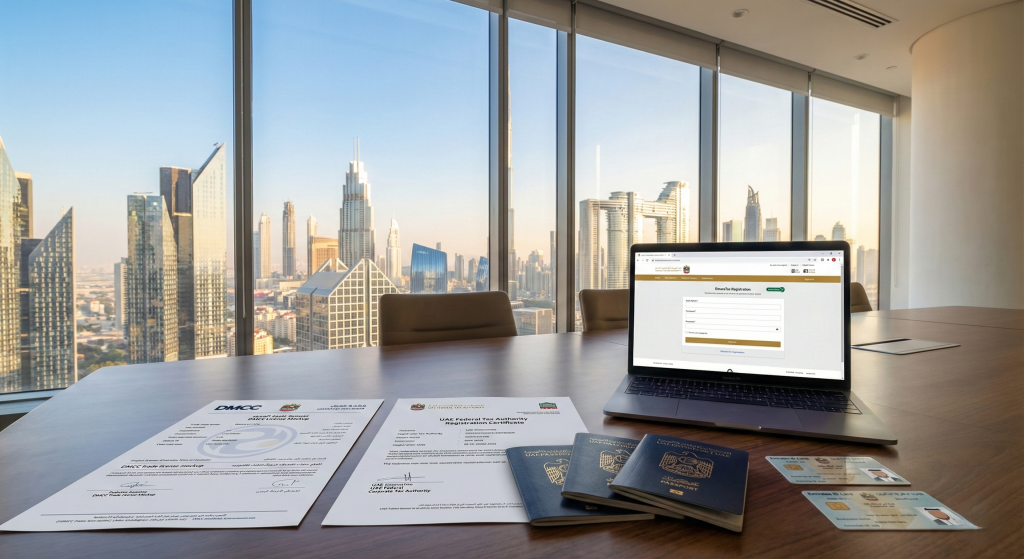
1. Understanding DMCC within the UAE Free Zone Framework
A “Free Zone Person” under UAE Corporate Tax Law encompasses entities established in a free zone, including branches of UAE or foreign companies registered within designated free zones. DMCC (Dubai Multi Commodities Centre) operates as one of Dubai’s free zone authorities, regulated by its own governance framework and empowered to issue business licences, manage office facilities and set internal operational rules. Whilst federal authorities such as u.ae provide oversight and general investor guidance, detailed DMCC-specific fees, visa quotas per office type and capital requirements are published exclusively on DMCC’s official channels.
Free zones offer significant advantages drawn from federal investor frameworks: 100% foreign ownership without UAE national partnership requirements, full repatriation of profits and capital, exemption from customs duties on imports into the free zone, and streamlined administrative procedures. These incentives coexist with the federal Corporate Tax regime introduced in 2023, under which free zone entities may qualify for preferential 0% tax on qualifying income whilst remaining subject to 9% tax on non-qualifying revenue streams. DMCC companies benefit from modern infrastructure, sector-specific licencing options and access to Dubai’s business ecosystem whilst operating under free zone-specific employment and commercial regulations.
2. Legal Forms and Licencing Options for a DMCC Company
UAE free zones recognise several legal entity structures. A Free Zone Establishment (FZE or FZ-LLC) permits a single shareholder, either a natural person or juridical entity, providing flexibility for sole foreign investors. A Free Zone Company (FZC or FZCO) accommodates two or more shareholders, enabling joint ventures and multi-investor structures. Existing companies, whether UAE-based or foreign, may establish branches within free zones, extending their operations into DMCC’s regulated environment. Some free zones additionally offer freelancer permits for individual professionals, though availability depends on each authority’s specific framework. If the plan is to import and re-export rather than serve the local market, the free zone trading route sets out the customs code and the mainland-sales restriction.
Free zone licences typically categorise into trading (import, export, distribution), services (consultancy, professional services), industrial (manufacturing, processing) and sector-specific categories aligned with DMCC’s strategic focus areas. According to u.ae guidance, minimum capital requirements vary significantly: some free zones impose no minimum capital for selected licence types, whilst others mandate thresholds. DMCC specifically requires AED 50,000 minimum share capital per company and AED 10,000 per shareholder, as stated on u.ae free zone pages. Investors should verify current DMCC capital requirements and permitted activities directly with DMCC Authority, as these parameters govern licence eligibility and structure selection.
| Legal Form | Shareholder Structure | Typical Use Case |
|---|---|---|
| FZE / FZ-LLC | Single shareholder (individual or corporate) | Sole foreign investor, wholly-owned subsidiary |
| FZC / FZCO | Two or more shareholders | Joint ventures, multi-investor projects |
| Free Zone Branch | Parent company (UAE mainland or foreign) | Extending existing company operations into free zone |
3. Step-by-Step DMCC Company Setup Process
3.1 Determine Legal Form, Activities, and Trade Name
Initial setup decisions involve selecting the appropriate legal entity type aligned with shareholder structure and business objectives, defining intended business activities precisely as they must correspond to DMCC’s permitted activities list, and choosing a trade name compliant with UAE and free zone naming conventions. U.ae guidance specifies that trade names must not violate public morals or public order, and certain geographic terms like “Dubai” or “United Arab Emirates” may be restricted. DMCC publishes a list of restricted trade names that investors should review before finalising name selection. Proposed activities should be checked against DMCC’s current licence categories and assessed for any regulatory approvals required from sector-specific authorities or whether they trigger Economic Substance Regulations obligations for “Relevant Activities”.
3.2 Apply for the DMCC Licence and Secure Office Facilities
Following entity selection and name reservation, investors apply to DMCC Authority for business licence issuance and simultaneously lease office space within the free zone. U.ae guidance confirms that free zone authorities link visa eligibility and quota to office type and size. DMCC offers various office configurations: flexi-desk arrangements providing shared workspace access, dedicated offices for single companies, and larger facilities for operations requiring substantial physical presence. Each office category carries specific visa entitlements—the number of residence visas a company may sponsor depends directly on office package selection. Investors must review DMCC’s current office packages, associated costs and visa allocations before committing to facilities, as these parameters fundamentally determine immigration capacity and setup costs.
3.3 Final Approvals, Incorporation Documents, and Opening the Immigration File
After DMCC approves the licence application and verifies office lease execution and fee payment, the authority issues incorporation documents including trade licence, Memorandum of Association and shareholder certificates. Every DMCC entity must also name a Manager at this point, and contrary to widespread claims, a DMCC Manager does not have to be a UAE resident. To sponsor employee and dependent visas, DMCC companies in Dubai must obtain an establishment card from the General Directorate of Residency and Foreigners Affairs (GDRFA-Dubai) through the service “Establishment Card for Institutions in the Private Sector/Free Zone”. Application occurs via GDRFA’s smart services system or Customer Happiness Centres, requiring a partners list appendix, passport copies of authorised signatories, and authorisation documentation certified by notary public for appointed managers. The establishment card creates the company’s immigration file, enabling subsequent residence entry permit and visa applications for sponsored employees and their families.
4. Cost Components of Setting Up and Maintaining a DMCC Company
U.ae confirms that individual free zone authorities publish their own detailed fee schedules. DMCC’s exact formation fees, annual licence renewal charges and office lease rates must be verified directly on DMCC Authority channels, as these amounts are subject to periodic revision and vary by licence type, activities and office selection. Investors should budget across several main cost categories when planning DMCC company establishment.
4.1 DMCC Authority Fees and Capital Requirements
Typical free zone fee headings include company registration charges, business licence issuance fees, trade name reservation costs and office lease payments. DMCC packages should be reviewed considering both the authority’s internal fee structure and the interaction with federal Corporate Tax obligations now applicable to all UAE entities. Whilst DMCC and other free zones may offer guaranteed periods without local emirate-level corporate taxation, all Free Zone Persons must comply with federal Corporate Tax registration, filing and payment requirements under the 2023 Corporate Tax Law.
4.2 Immigration, Visa, and Government Charges
Beyond DMCC Authority fees, companies face federal and emirate-level government charges for immigration services. GDRFA-Dubai charges for establishment card issuance include AED 200 base fee plus 5% VAT, AED 10 Knowledge Dirham, AED 10 Innovation Dirham, AED 50 service fee, and optional AED 100 urgent processing fee. If submitted through Amer centres, an additional AED 100 fee applies. Annual establishment card renewal costs AED 100 per year. Residence entry permit fees vary by application location: AED 1,035 for applications where the sponsored person is inside the UAE, and AED 365 when the sponsored person applies from outside the UAE. Overstay fines accrue at AED 25 per day after entry for this visa category. These government charges apply universally to Dubai-based companies regardless of free zone or mainland status.
4.3 Ongoing Annual Costs and Compliance
Recurring expenditure includes annual DMCC licence renewal, office lease renewal, visa renewal fees for all sponsored employees and dependents, and compliance costs associated with Corporate Tax and Economic Substance Regulations filing obligations. Qualifying Free Zone Persons seeking 0% tax treatment on qualifying income must maintain audited financial statements, necessitating engagement of licensed auditors. ESR compliance for companies conducting Relevant Activities requires annual notification and economic substance reporting. Investors should budget for professional advisory, bookkeeping, audit and tax compliance services, as these represent ongoing operational necessities rather than optional expenses under current UAE regulatory frameworks.
5. Visa Allocation and Immigration for DMCC Free Zone Companies
5.1 Establishment Card and Company Immigration File
GDRFA-Dubai requires DMCC companies to obtain an establishment card as the foundational step for visa sponsorship. Application channels include GDRFA’s smart services system accessed via UAE Pass or username, or in-person submission at Customer Happiness Centres. Required documents comprise the partners list appendix, passport copies of all authorised signatories, and certified authorisation documents for appointed managers. If the company’s GDRFA file is placed under “temporary closure” due to administrative issues or licence lapses, the ability to issue entry permits and residence visas is suspended until the closure is formally removed through GDRFA’s dedicated service process. Companies must maintain active establishment cards and comply with all GDRFA notification requirements to preserve immigration privileges.
5.2 Employee Work Permits and Residence Visas
U.ae guidance confirms that work permits and residence visas for free zone employees are processed through the respective free zone authority, which coordinates with federal immigration entities. Each free zone, including DMCC, establishes its own regulations for recruiting staff, sponsoring work permits and issuing residence visas. Free zone employees are generally governed by the free zone’s internal employment regulations rather than Federal Decree-Law No. 8 of 1980 (UAE Labour Law) applicable to mainland companies. The number of employees a DMCC company may sponsor depends on the visa quota allocated to its office type—flexi-desks typically permit fewer visas than dedicated offices, whilst larger facilities enable proportionally greater employee sponsorship capacity. Investors must confirm current DMCC visa quota rules before selecting office facilities, as insufficient visa allocation constrains hiring capacity.
5.3 Family Sponsorship by DMCC Investors and Staff
U.ae eligibility criteria for family sponsorship from free zones include minimum monthly salary thresholds: typically AED 4,000 or AED 3,000 plus accommodation provision, though specific amounts should be verified from current GDRFA guidance. Residence entry permit applications for family members proceed through Amer centres or GDRFA mobile applications, requiring passport copies and photographs of sponsored family members, sponsor’s passport and Emirates ID, attested tenancy contract, recent utility bill, and salary certificate or labour contract demonstrating income threshold compliance. Arabic-format salary certificates are required for government, semi-government and free zone employees, whilst private sector employees provide attested labour contracts. Family sponsorship capacity exists independently from employment visa quota, allowing DMCC company owners and employees to sponsor eligible dependents provided salary and accommodation requirements are met.
5.4 Visa Cancellation and Closing a DMCC Free Zone Business
GDRFA requires visa cancellation applications via Amer centres or mobile application, with original passports and Emirates IDs submitted. Cancellation fees differ based on sponsored person’s location: companies pay AED 225 if the sponsored person is inside UAE or AED 325 if outside UAE, plus applicable Amer centre charges. U.ae guidance specifies that closing a free zone business involves cancelling the trade licence and all associated permits and visas in coordination with both the free zone authority (DMCC) and GDRFA. Proper visa cancellation before licence termination prevents administrative complications and ensures sponsored employees’ legal status is resolved before company closure finalisation.
6. Tax and Regulatory Considerations for DMCC Companies
DMCC entities are Free Zone Persons under Federal Decree-Law No. 47 of 2022 on the Taxation of Corporations and Businesses. All Free Zone Persons must register for Corporate Tax and file annual tax returns via EmaraTax or approved channels, as confirmed by the Federal Tax Authority. Registration, filing and compliance obligations apply regardless of whether the entity qualifies for preferential tax treatment.
6.1 Corporate Tax and Qualifying Free Zone Person (QFZP) Status
A Free Zone Person that qualifies as a QFZP may benefit from a 0% Corporate Tax rate on “Qualifying Income”, whilst non-qualifying income faces the standard 9% rate. FTA guidance establishes key QFZP conditions: the entity must maintain adequate substance in a UAE free zone, derive Qualifying Income as defined by Cabinet decisions, not elect into standard taxation, comply with arm’s length principle and transfer pricing documentation rules for Related Party transactions, maintain audited financial statements, and observe the de minimis threshold for non-qualifying revenue. The de minimis threshold is the lower of AED 5 million or 5% of total revenue—non-qualifying revenue below this threshold does not disqualify QFZP status, but the non-qualifying revenue itself remains taxable at 9%. Any Taxable Income that is not Qualifying Income, including the first AED 375,000 of such non-Qualifying Income, is fully taxed at 9%. If a Qualifying Free Zone Person fails to meet any condition or makes an election to be subject to regular Corporate Tax, they become subject to standard 9% Corporate Tax from the beginning of the Tax Period where conditions were not met.
6.2 Economic Substance Regulations and Operating in DMCC
U.ae Economic Substance Regulations require UAE mainland and free zone companies conducting specified “Relevant Activities” to demonstrate adequate economic presence in the UAE. Relevant Activities include banking, insurance, investment fund management, lease-finance, headquarters, shipping, holding company, intellectual property, and distribution and service centre activities. Entities within ESR scope must submit annual notification forms and Economic Substance Reports to their regulatory authority within 12 months from financial year end. For DMCC companies, ESR compliance influences practical operational decisions: selecting appropriate office facilities and staffing models, ensuring management and core income-generating activities occur physically in the UAE, and maintaining records demonstrating that relevant activities are directed and managed in the UAE with adequate employees, expenditure and physical assets relative to activity volume. ESR obligations align with Corporate Tax substance requirements for QFZPs, creating a unified compliance framework governing both tax treatment and regulatory reporting.
7. Practical Planning Checklist for New DMCC Investors
Before committing to DMCC company formation, investors should systematically verify: legal form selection aligned with shareholder structure and business model; confirmation of proposed activities’ appearance on DMCC’s current permitted licence list; capital requirements and initial setup costs from latest DMCC Authority fee schedules; office type selection and associated visa quota ensuring sufficient employee sponsorship capacity; expected employee headcount and family sponsorship needs mapped against available visa allocations; Corporate Tax impact assessment including QFZP qualification analysis and Qualifying Income determination; ESR applicability for intended activities and resulting substance requirements; and comprehensive budget covering DMCC fees, government immigration charges, compliance costs and recurring annual expenses. All planning should reference current official sources: u.ae for federal regulations and investor guidance, tax.gov.ae for Corporate Tax and QFZP requirements, gdrfad.gov.ae for Dubai immigration services and fees, and DMCC Authority channels for entity-specific rules, fees and visa quotas before finalising structural decisions.
8. How UAE Experts HUB Can Support Your DMCC Free Zone Setup
UAE Experts HUB operates as an official government services facilitation centre, helping investors interpret UAE federal rules, coordinate with relevant authorities and plan compliant DMCC structures. UAE Experts HUB advisors guide clients through documentation requirements, timeline expectations, Corporate Tax registration, ESR compliance planning and coordination with DMCC Authority and GDRFA-Dubai, whilst always directing investors to latest official sources for definitive confirmation of fees, visa quotas and procedural requirements. Contact UAE Experts HUB for tailored guidance on navigating DMCC company setup, immigration procedures and federal tax compliance.
This guide provides informational content based on current UAE federal regulations and publicly available guidance from u.ae, tax.gov.ae and gdrfad.gov.ae. DMCC-specific fees, visa quotas, office packages and internal procedures are subject to change and must be confirmed directly with DMCC Authority. Corporate Tax and Economic Substance Regulations interpretation should be verified with qualified tax advisors. UAE Experts HUB provides expert interpretation of official UAE procedures but does not replace professional legal or tax advice for specific business circumstances.