
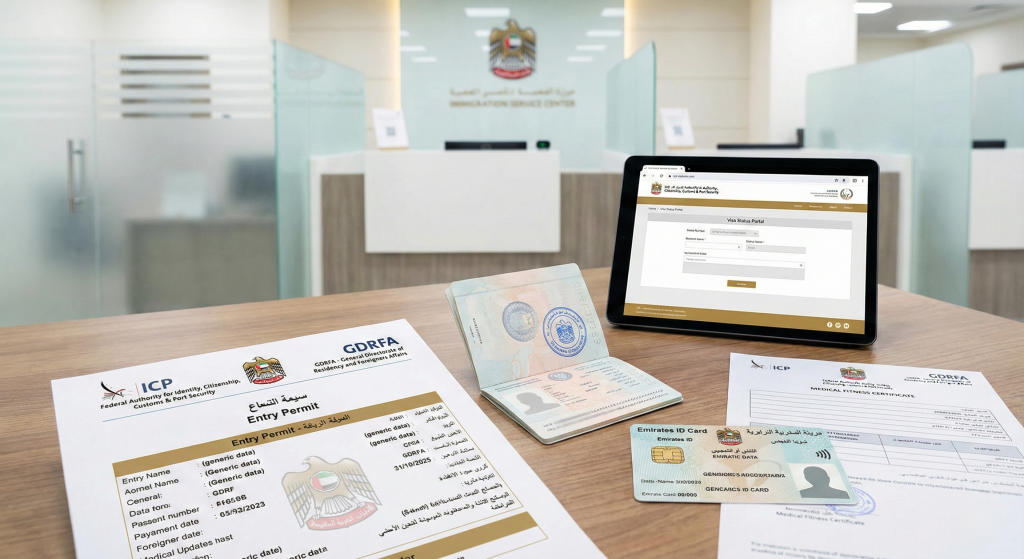
Clear guidance on UAE entry permits and residence visas, their validity periods, grace periods and compliance requirements
Many expatriates moving to the UAE assume that an approved visa notification or e-mail confirmation is equivalent to a residence visa, when in practice the UAE immigration system distinguishes between an entry permit and a residence visa as separate legal stages. Misunderstanding these terms can lead to status violations, overstay fines or inadvertent breaches of residence validity rules. This article provides a concise overview of the practical and legal differences between a UAE entry permit and a residence visa, based on official UAE government information from u.ae, the Federal Authority for Identity, Citizenship, Customs and Port Security (ICP) and the General Directorate of Residency and Foreigners Affairs (GDRFA).
Immigration regulations are subject to periodic revision, so readers should always confirm current requirements and fees through official channels including u.ae, ICP and GDRFA before making immigration decisions. This guide offers expert interpretation of publicly available official procedures but does not replace personalised verification for individual circumstances. To see exactly where the entry permit and residence visa fit in the wider hiring sequence, follow our step-by-step Dubai employment visa process.
1. What Is a UAE Entry Permit?
1.1 Definition and Purpose
A UAE entry permit is an initial electronic document issued by ICP or GDRFA after a visa application is approved, which allows a foreigner to enter the UAE and remain for the period and purpose specified in the permit. According to u.ae, entry permits facilitate entry into the UAE for various purposes including finalising residence visa procedures, medical treatment, official missions, tourism, transit, attending events, visiting family members or exploring business and job opportunities. Entry permits issued for short visits are commonly referred to as visit visas, tourist visas or transit visas, whilst entry permits issued specifically to complete residence formalities serve as the preliminary stage before residence visa issuance.
Entry permits are time-bound and purpose-specific, meaning each permit authorises entry and stay for a defined period and designated activity. An entry permit alone does not confer the long-term resident benefits associated with a residence visa, such as unrestricted ability to work, sponsor family members or access resident financial services. The permit serves as the legal basis to enter the UAE and undertake the subsequent in-country procedures required for residence status.
1.2 Validity Periods and Where to Apply
For most entry permits, the validity period is two months (60 days) from the date of issuance, during which the permit holder must either enter the UAE and complete residence procedures, renew the permit where eligible, or allow the permit to lapse. U.ae specifies that entry permit validity cannot be extended beyond the initial period—permits automatically expire upon lapse of their validity timeframe. The duration of stay after entering the UAE differs according to entry permit type: transit permits allow 4 days in-country stay, whilst entry permits for employment purposes allow two months during which the sponsor must convert the employee’s status to residence visa.
Special validity periods apply when an entry permit is issued specifically to finalise residence visa procedures. According to u.ae, such entry permits are valid for two months for normal residence visas and Green residence visas (with duration of 1 to 5 years), and six months with multiple entry privileges for Golden Visa procedures. These extended validity periods enable applicants to enter the UAE, complete medical examinations, security clearances and Emirates ID registration, and receive residence visa stamping without time pressure from a standard 60-day limit.
Application channels for entry permits include ICP’s eChannels portal and ICP mobile application for Abu Dhabi, Sharjah, Ajman, Umm Al Quwain, Ras Al Khaimah and Fujairah. For Dubai, applicants use GDRFA Dubai’s online services or the Dubai Now application. Alternatively, applications may be processed through authorised typing centres registered with ICP or GDRFA, where applications are typed and submitted through the relevant emirate’s residency authority. The sponsor—which may be a private sector company, public entity, family member, UAE-based airline, hotel or other eligible party—handles the entry permit transaction through these official channels.
2. What Is a UAE Residence Visa (Residence Permit)?
2.1 Definition, Duration and Categories
A UAE residence visa, also termed a residence permit, is the authorisation issued to a foreigner already inside the UAE after entering on an entry permit, which allows that person to legally reside in the country for a specified period. According to u.ae, residence visa validity varies according to visa type and sponsor, ranging from 1, 2 or 3 years for standard sponsored visas to 5 or 10 years for unsponsored long-term categories. Recent regulatory changes have introduced extended-duration residence options including 5-year and 10-year visas subject to specific eligibility conditions such as Golden Visa categories for investors, entrepreneurs, specialised talents, outstanding students and humanitarian pioneers.
The residence visa is stamped in the holder’s passport by ICP or GDRFA after all procedural requirements are satisfied, enabling the holder to travel freely in and out of the UAE within the visa’s validity period. The expiry date of a dependent’s residence visa does not exceed that of the sponsor—family members’ residence visas are directly linked to the sponsor’s residence visa and terminate when the sponsor’s visa expires or is cancelled. This linkage ensures that family residence rights remain contingent on the sponsor maintaining valid residency status.
2.2 Conditions, Linked Family Visas and Resident Benefits
To obtain or renew a UAE residence visa, applicants aged 18 and above must undergo a medical fitness examination at approved health centres to prove they are medically fit, pass security checks administered by federal authorities, and apply for an Emirates ID card from ICP. Medically unfit individuals are not granted residence visas under current UAE regulations. The Emirates ID serves as the official identity document for UAE residents and must be maintained throughout the residence period, expiring concurrently with the residence visa.
Expatriate residents with valid residence visas may sponsor eligible family members to reside in the UAE if they meet minimum salary thresholds and other sponsorship conditions. According to u.ae, sponsors must earn a minimum salary of AED 4,000 or AED 3,000 plus accommodation provision to sponsor spouses and children. A resident sponsor has 60 days from the date dependants enter the UAE on an entry permit to apply for their residence visas; failure to complete this within the timeframe risks dependants falling out of legal status. Family sponsorship extends to spouses, unmarried daughters (no age limit), sons up to age 25 (sons with special needs have no age restriction), and in certain cases parents on annual renewable residence permits.
Holding a valid UAE residence visa entitles residents to significant practical benefits as outlined by u.ae: opening bank accounts, accessing financial facilities including mortgages and loans, applying for UAE driving licences, accessing government health services and obtaining health insurance, registering children in government and private schools, working legally and investing in UAE businesses, and in some cases enjoying visa-free or visa-on-arrival privileges when travelling to certain international destinations. These benefits distinguish residence visa holders from entry permit holders or visitors, who lack access to resident-specific services and long-term stability.
3. Entry Permit vs Residence Visa: Key Differences at a Glance
3.1 Summary Comparison
The fundamental distinction between a UAE entry permit and a residence visa lies in their purpose and duration. An entry permit authorises short-term entry and initial stay in the UAE for a specific purpose, typically valid for approximately 60 days or special extended periods (2 months for residence finalisation, 6 months for Golden Visa procedures). A residence visa, conversely, authorises long-term residence ranging from 1 to 10 years depending on category, granted only after the applicant has entered the UAE on an entry permit and completed in-country formalities including medical examination, security clearance and Emirates ID registration.
Entry permits generally precede residence visas in the immigration timeline—applicants first receive approval and an entry permit, then enter the UAE, then undergo medical and administrative processing, and finally receive residence visa stamping. An entry permit alone does not confer long-term resident benefits such as unrestricted employment rights, family sponsorship capacity, banking access or driving licence eligibility. These privileges attach exclusively to residence visa holders who have completed the full immigration process and maintain valid residence status.
| Aspect | Entry Permit | Residence Visa |
|---|---|---|
| Primary Purpose | Authorise entry and initial short-term stay for specific purpose | Authorise long-term legal residence in UAE |
| Typical Validity | 60 days (2 months for residence procedures; 6 months for Golden Visa) | 1, 2, 3, 5 or 10 years depending on category and sponsor |
| Issuance Stage | Before entering UAE; preliminary approval document | After entering UAE and completing medical, security, Emirates ID procedures |
| Authority | ICP (most emirates), GDRFA Dubai (Dubai) | ICP (most emirates), GDRFA Dubai (Dubai) |
| Family Sponsorship | Not applicable; entry permit holder cannot sponsor | Residence visa holder may sponsor eligible family members if salary and conditions met |
| Resident Benefits | Limited; no banking, driving licence, unrestricted work rights | Full resident privileges: banking, finance, driving, healthcare, education, employment |
3.2 When Do You Need Which Document?
Most foreign nationals intending to reside in the UAE first receive an entry permit (or work permit functioning as entry authorisation) which enables them to enter the country legally. After arrival, they convert this entry status to a residence visa by completing mandatory medical examinations, security checks and Emirates ID registration within the entry permit’s validity period. Visitors entering the UAE for short-term tourism, business meetings or family visits may only require visit or tourist visas or qualify for visa-on-arrival depending on nationality, and do not proceed to residence visa issuance unless they subsequently secure employment or family sponsorship.
The key determination is whether the person intends to establish legal residence or merely visit temporarily. Those planning to work, invest, study or join family members in the UAE require residence visas and thus must first obtain appropriate entry permits to commence the residence application process. The entry permit serves as the gateway document; the residence visa represents the culmination of successful immigration processing and the foundation of legal long-term presence in the UAE.
4. Typical Pathways: From Entry Permit to Residence Visa
4.1 Employment Route
For employment-based residence, the Ministry of Human Resources and Emiratisation (MoHRE) issues a work permit that allows an expatriate to enter the UAE for employment purposes. According to u.ae, work permits are typically valid for two months from issuance. After the employee enters the UAE using the work permit as entry authorisation, the employer must complete several mandatory procedures within 60 days: medical fitness testing at approved health centres, security clearance processing, Emirates ID application and issuance, labour card issuance from MoHRE, and stamping of the work residence permit in the employee’s passport. This sequence converts temporary entry status into a formal residence visa linked to employment, enabling the employee to work legally and access resident benefits.
Failure to complete these procedures within the 60-day timeframe requires the employee to exit the UAE or face overstay penalties, as the work permit’s entry authorisation function expires. Employers bear responsibility for timely processing of residence visa procedures for sponsored employees, and delays in medical testing, document submission or fee payment can jeopardise the employee’s legal status.
4.2 Family Sponsorship Route
Expatriate residents holding valid residence visas who meet minimum salary requirements and other sponsorship conditions may sponsor eligible family members including spouses, children and in certain cases parents. The sponsor applies for family members’ entry permits through ICP or GDRFA channels, and upon approval family members enter the UAE on these permits. According to u.ae, the resident sponsor has 60 days from the dependants’ entry date to apply for their residence visas. During this period, dependants must undergo medical fitness examinations (if aged 18 or above), pass security checks, and receive Emirates ID cards before residence visa stamping occurs.
The 60-day timeframe is critical—if residence visa applications are not submitted within this period, dependants risk falling out of legal status and may face overstay fines or enforcement action. Sponsors should prepare required documents in advance, including attested marriage certificates for spouses, birth certificates for children, proof of salary meeting minimum thresholds (AED 4,000 or AED 3,000 plus accommodation), tenancy contracts demonstrating suitable housing, and other documentation specified by ICP or GDRFA. Family members’ residence visas, once issued, are linked to the sponsor’s residence visa and expire concurrently with or before the sponsor’s visa expiry date.
4.3 Long-Term Residence and Golden Visa Route
For long-term residence categories including Golden Visas (5-year or 10-year validity) and Green residence visas (5-year validity), applicants who qualify based on investment, entrepreneurship, specialised talent, academic achievement or other criteria receive entry permits specifically to complete residence formalities. U.ae specifies that entry permits issued for normal residence visa procedures and Green residence visas are valid for two months, whilst entry permits for Golden Visa procedures carry six-month validity with multiple entry privileges. This extended validity accommodates the often complex documentation and verification requirements for long-term residence categories.
During the entry permit validity period, applicants must enter the UAE, submit required supporting documents to ICP or GDRFA, undergo medical fitness examinations and security clearances where applicable (individuals under 18 may be exempt from medical testing depending on category), obtain Emirates ID cards, and receive residence visa stamping. The six-month multiple-entry provision for Golden Visa entry permits allows applicants to enter and exit the UAE multiple times whilst finalising residence procedures, providing flexibility for investors and entrepreneurs managing international commitments. Residence is only formally confirmed once the residence visa is stamped in the passport and linked to a valid Emirates ID card issued by ICP.
5. Validity, Grace Periods and Overstay Rules
5.1 Checking Your Entry Permit or Residence Visa Status
Applicants can track the status and validity of both entry permits and residence visas through official government channels. For Abu Dhabi, Sharjah, Ajman, Umm Al Quwain, Ras Al Khaimah and Fujairah, visa status checking occurs via ICP’s official website using application reference numbers and other identifying information provided when the visa application was submitted. For Dubai, applicants check status through GDRFA Dubai’s dedicated online visa status service. Both platforms enable users to verify issuance dates, expiry dates, visa type and current validity status. According to u.ae, applicants should request application and reference numbers from their visa service provider at the time of application to facilitate self-service tracking.
Regular status checking is essential for compliance. Entry permit holders should verify remaining validity before travel to ensure sufficient time exists to enter the UAE and complete residence procedures. Residence visa holders should monitor expiry dates to initiate renewal procedures in advance, avoiding lapses that trigger grace periods and potential overstay fines. ICP and GDRFA also offer telephone enquiry services for visa-related questions: ICP operates a toll-free number 600522222, whilst GDRFA Dubai provides Amer service toll-free support at 800 5111 for callers within the UAE.
5.2 Grace Periods, Automatic Cancellation and Overstay Fines
UAE residence visas are generally cancelled automatically if the holder remains outside the UAE for more than 180 consecutive days. This rule ensures that residence visas are used by individuals maintaining genuine residence in the UAE rather than nominal ties. According to u.ae, exceptions to the 180-day rule include Golden Visa holders and Green Residency holders who may stay outside the UAE for extended periods without automatic visa cancellation, expatriate residents sent abroad for treatment with approved medical reports from UAE medical authorities, public sector employees posted abroad for training or assignments with valid residence visas, students studying at foreign universities, investors, domestic helpers of ruling family members working abroad, and certain other categories specified by ICP. Holders of standard 1-year, 2-year or 3-year residence visas must enter the UAE at least once every 180 days to maintain residence validity.
After a residence visa expires, UAE residents are granted grace periods ranging from 30 days to up to 6 months depending on the resident category, during which they must either renew their residence visa, change status to another valid category, or exit the UAE. These grace periods provide reasonable time to regularise status without immediate penalty. However, overstaying beyond the grace period results in a unified overstay fine of AED 50 per day, as confirmed by u.ae. This standardised fine applies to visit visas, tourist visas and residence visa overstays, replacing previous variable fine structures. Overstay fines accumulate daily and must be settled before the person can exit the UAE or regularise status, potentially reaching substantial amounts for prolonged overstays.
When a residence visa expires, the associated Emirates ID card also expires simultaneously, as both documents are linked. Residents requiring early renewal of residence visas (one to six months before expiry) for travel or other legitimate reasons must obtain special permission and approval from ICP before proceeding with renewal. If a resident decides to leave the UAE permanently, the residence visa must be formally cancelled through the sponsor via ICP or GDRFA; sponsors are the only parties authorised to initiate visa cancellation for sponsored individuals. Failure to cancel residence visas before permanent departure can result in administrative complications, fines and potential difficulties with future UAE immigration applications.
6. Practical Questions About Entry Permits and Residence Visas
Can I Work in the UAE with Only an Entry Permit?
No. Legal employment in the UAE requires a valid work permit issued by MoHRE and a subsequent work residence visa stamped in the passport. An entry permit alone does not authorise employment, even if the entry permit was issued for employment purposes. The entry permit serves to enter the UAE and commence residence procedures; actual work authorisation arises only after MoHRE issues the work permit, the employer completes medical testing and Emirates ID registration, and the work residence visa is stamped. Working without proper permits violates UAE labour law and immigration regulations, exposing both employee and employer to administrative penalties, fines and potential visa cancellation.
What Happens If I Do Not Complete Residence Procedures Within the Entry Permit Validity?
If residence visa procedures are not completed within the entry permit’s validity period (typically 60 days, or 2 months for residence-related permits, or 6 months for Golden Visa permits), the entry permit expires and the holder must either renew or extend the permit if eligible, convert to another valid status category, or exit the UAE before overstay penalties begin. Starting from 21 October 2018, visit visas and entry permits can be extended for 30 days twice upon renewal without leaving the UAE, though this extension privilege does not apply to visitors and tourists who are GCC country residents. Overstaying beyond the permitted period without renewal triggers the AED 50 per day overstay fine. Individuals facing timing difficulties should contact ICP or GDRFA immediately to explore available options specific to their case, as each situation may have different solutions depending on visa type, sponsor and circumstances.
Does My Family’s Residence Visa Automatically Continue If My Own Residence Visa Ends?
No. Family members’ residence visas are directly linked to the sponsor’s residence visa and expire when the sponsor’s residence visa expires or is cancelled. According to u.ae, the expiry date of a dependent’s residence visa does not exceed that of the sponsor. If a sponsor’s residence visa ends, all dependants sponsored under that visa lose their residence status unless they secure alternative sponsorship (such as employment sponsorship or sponsorship by another family member who qualifies as a sponsor). Sponsors who face visa expiry or cancellation should plan proactively for dependants’ status, either by renewing the sponsor’s visa before expiry, transferring dependants to another sponsor, or making arrangements for dependants to exit the UAE before their linked visas lapse.
Can My Residence Visa Be Cancelled If I Stay Abroad for a Long Time?
Yes, subject to specific conditions. UAE residence visas are generally cancelled automatically if the holder stays outside the UAE for more than 180 consecutive days. This automatic cancellation rule applies to standard residence visa holders but does not apply to Golden Visa holders, Green Residency holders, or other exempt categories specified by ICP including expatriates sent abroad for treatment with approved medical documentation, public sector employees on official postings abroad, students studying at foreign institutions, investors and certain other categories. Residence visa holders planning extended absences should verify whether their specific visa category qualifies for exemption from the 180-day rule by contacting ICP or GDRFA before travel. For standard visa holders, maintaining compliance requires entering the UAE at least once every 180 days to preserve residence validity.
How Do I Know Which Authority to Contact?
Immigration authorities in the UAE are organised by emirate. For Abu Dhabi, Sharjah, Ajman, Umm Al Quwain, Ras Al Khaimah and Fujairah, the Federal Authority for Identity, Citizenship, Customs and Port Security (ICP) is the competent authority for entry permits, residence visas, visa status tracking and related immigration services. Contact ICP via its toll-free number 600522222, through the ICP feedback platform online, or via ICP’s eChannels portal and mobile application. For Dubai, the General Directorate of Residency and Foreigners Affairs (GDRFA Dubai) handles all immigration services including entry permits, residence visas and visa tracking. Contact GDRFA Dubai through its official website, Amer service toll-free number 800 5111 (for callers within UAE), Amer service centres or the Dubai Now mobile application. For employment-related work permits and labour cards, the Ministry of Human Resources and Emiratisation (MoHRE) is the responsible federal authority, accessible through MoHRE’s online services portal and customer service centres.
7. How UAE Experts HUB Supports Applicants and Key Compliance Reminders
UAE Experts HUB operates as a government services facilitation centre, assisting applicants in understanding immigration requirements, preparing documentation accurately, and accessing official channels including ICP, GDRFA and MoHRE-related services. UAE Experts HUB advisors provide expert interpretation of published UAE immigration procedures and help clients navigate the practical steps involved in entry permit applications, residence visa processing, family sponsorship, visa renewals and status checking. However, UAE Experts HUB does not replace the decisions of federal and emirate immigration authorities—all entry permits, residence visas and related approvals are issued exclusively by ICP, GDRFA or other competent UAE government entities based on their independent assessment of applications.
Key compliance reminders for all UAE entry permit and residence visa holders: respect entry permit validity periods and complete residence procedures within the specified timeframe (typically 60 days for employment and family sponsorship, up to 6 months for Golden Visa procedures); check visa status regularly via ICP or GDRFA official platforms using application reference numbers; observe grace periods after residence visa expiry and renew or regularise status promptly to avoid overstay fines of AED 50 per day; ensure residence visas are formally cancelled through the sponsor before permanent departure from the UAE; maintain valid Emirates ID cards linked to residence visas and renew both documents concurrently; and for standard residence visa holders, enter the UAE at least once every 180 days to prevent automatic cancellation under the 180-day absence rule. Adherence to these obligations ensures legal immigration status, avoids administrative penalties, and preserves access to resident benefits and future UAE immigration privileges.
This guide provides informational content based on current UAE federal regulations and publicly available guidance from u.ae, ICP and GDRFA. Entry permit and residence visa procedures, fees, grace periods and eligibility criteria are subject to change and must be confirmed with ICP, GDRFA or u.ae for individual circumstances. UAE Experts HUB provides expert interpretation of official UAE procedures but does not replace professional legal advice or independent verification with competent immigration authorities for specific cases.