
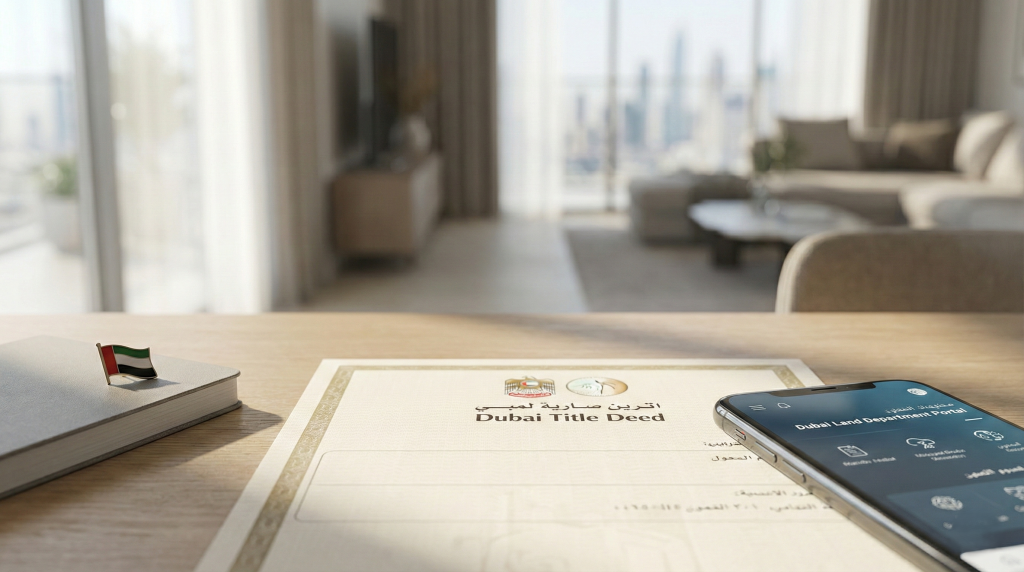
A Dubai title deed is the formal record of who owns a particular land plot, villa or apartment, and what rights they hold over it, maintained by Dubai Land Department (DLD). Owners, buyers, heirs and lenders all rely on the accuracy of this record when buying, selling, gifting or financing real estate in the emirate.
This guide explains, in practical terms, how a title deed in Dubai is issued, re‑issued and modified, who can hold one, what types of rights exist, which authorities and channels are involved, and what standard fees and timelines apply. UAE Experts HUB provides expert guidance to help you understand these procedures before you deal with DLD, Real Estate Registration Trustee Centres or digital portals such as Oqood.
What a Dubai Title Deed Is and Who Issues It
Under DLD’s own definition, the “Issue Title Deed” service registers the issuance of a property title deed to update the approved ownership document and its date in DLD’s records. In practice, the title deed is DLD’s official confirmation of the current owner, the property details (plot or unit number, community, area) and the nature of the ownership right.
According to DLD’s FAQs, title deeds for lands and built properties in Dubai are issued either directly at Dubai Land Department or through accredited Real Estate Registration Trustee Centres, which act as service partners but not as independent registries. DLD has moved to electronic title deeds as the default output for most registration services, so owners now typically receive an e‑title deed rather than a paper certificate.
For services such as sale registration, off‑plan completion and property exchange, DLD systems generate both an electronic title deed and an electronic map linked to that property. Once the registration is approved and all government and partner fees are paid, DLD’s e‑services send the e‑title deed and e‑map to the owner via an emailed link.
Who Can Hold a Title Deed in Dubai?
The federal government portal (u.ae) confirms that Dubai Land Department may issue title deeds to UAE nationals, expatriate residents and non‑resident foreigners, provided the property lies in an area where their form of ownership is legally permitted. For foreigners and most expatriates, this generally means designated freehold or similar investment areas defined under Dubai’s real estate regulations.
The same federal guidance states that foreign ownership of real estate in Dubai is allowed only in areas designated as freehold, while outside those areas ownership is typically restricted to UAE and GCC nationals or to specific long‑term rights. u.ae also clarifies that there is no legal age limit to own property in Dubai, so minors can technically hold registered property rights, often with guardianship or court supervision.
DLD service descriptions and FAQs show that many title deed services are available to citizens, residents and, in specific cases, visitors who own property or act under a valid power of attorney. The key eligibility checks are therefore location (whether the project or plot falls in a designated area) and the legal capacity or authority of the person named as owner, rather than nationality alone.
Ownership Types and Related Documents in Dubai
The UAE Government’s Dubai property guidance distinguishes between several main forms of real estate rights: full freehold ownership, usufruct rights and leasehold rights of up to 99 years in designated areas. A freehold title deed records outright ownership of the unit or land; a usufruct title deed records long‑term use and enjoyment rights over a property owned by someone else; a long leasehold interest may be documented in a similar way depending on the structure of the project.
DLD’s service descriptions, including Property Gift Registration, show that the authority can issue different outputs depending on the underlying right: an Electronic Title Deed for full ownership, a Usufruct Title Deed where only usufruct is granted, and a Map Statement e‑Certificate capturing the technical details of the land or unit. For most transactions the title deed and associated map are generated together so that the legal record and the cadastral record remain synchronized.
DLD recognizes several map classifications in its technical approvals: the main topographic map, the land unit map and the land area map, which together define the parcel’s location and boundaries. Depending on the property type and location, DLD issues either a unified map with Dubai Municipality, a specific land map for areas outside Dubai Municipality’s jurisdiction, or a villa/apartment map for built units in multi‑unit developments.
Main Situations When a Title Deed Is Issued or Updated
Most interactions with DLD involving a Dubai title deed fall into a small number of recurring scenarios. Understanding the official service name, channel and fees for each scenario helps owners prepare documents correctly and avoid repeated visits.
1. Sale Registration for Completed Properties
DLD’s “Request for Sale Registration” service records the transfer of ownership for completed properties and is accessed through Real Estate Registration Trustee Centres across Dubai. The parties present identification documents (Emirates ID cards for resident sellers and buyers, or valid passports for non‑resident foreigners) together with sale documents required by the Trustee.
Once the transaction is approved, the outputs include an electronic title deed in the buyer’s name and an electronic property map. Standard government fees include a title deed certificate issuance fee of AED 250, plus map fees of AED 225 for a unified map with Dubai Municipality, AED 100 for land maps outside Dubai Municipality and AED 250 for villa or apartment maps. In addition, DLD’s transfer fee in a standard sale is 2% of the sale value from the seller and 2% from the buyer, while Real Estate Registration Trustee Centres charge their own partner fees: typically AED 4,000 + VAT where the sale value is AED 500,000 or more and AED 2,000 + VAT for lower‑value sales.
2. Issuing a New Title Deed for an Existing Owner
The “Issue Title Deed” / “Issuance of Title Deed” service at DLD’s main Customer Happiness Center allows an existing owner to request a fresh title deed, often to obtain an updated document with a current issue date or to replace older formats. The required documents are a copy of the owner’s Emirates ID and a copy of the current property title deed certificate, with additional documents only if the specific case requires them.
DLD’s standard fee for issuing a title deed certificate under this service is AED 250 per ownership, plus a AED 10 knowledge fee and AED 10 innovation fee. Some service descriptions also show a separate map issuance fee of AED 120 where a new map is generated or printed. Payment can usually be made by cash, cheque or manager’s cheque, credit card or through DLD’s smart/ePay channels, depending on the exact counter or e‑service used.
3. Title Deed Modification
The “Title Deed Modification” service is used when the owner’s personal data on the title deed must be corrected or updated without changing the underlying ownership right. Typical changes include correcting the spelling of a name, updating nationality or passport information, or amending place of birth; some cases may also involve adjustments to area data where supported by official maps or survey records.
Standard documents for a modification request include the owner’s Emirates ID or a valid power of attorney for a representative, copies of valid passports for non‑resident owners and, for area‑related modifications, supporting official letters or updated maps from the competent body. DLD charges the same AED 250 issuance fee for the updated title deed certificate, plus AED 10 knowledge and AED 10 innovation fees, with processing normally completed quickly once documents are approved.
4. Completing Initial Procedures for Off‑Plan Properties (Oqood)
For buyers of off‑plan properties, the “Request to complete the initial procedures data” service via the Oqood portal converts a provisional off‑plan registration into a final title once contractual and regulatory conditions are satisfied. The buyer (or authorized party) logs into Oqood, selects the property, completes the required data fields, uploads supporting documents, selects a payment method and submits the request online.
When the registration fee has already been collected at the provisional stage, the remaining charges are those for issuing the final documents: AED 250 for the title deed, AED 250 for a unit or villa map, AED 100 for a land map outside Dubai Municipality and AED 225 for a unified land map, plus AED 10 knowledge and AED 10 innovation fees. After DLD approves the request and payment is confirmed, the system emails the e‑title deed and e‑map to the registered owner.
5. Exchange of Two Properties
DLD’s “Two properties exchange application” service records the exchange of ownership between two properties, frequently involving grant land plots where Dubai Municipality or another authority has pre‑approved an exchange. The application must be supported by an approval letter from Dubai Municipality or the relevant government entity, together with the owner’s UAE ID and any existing title deed details requested by DLD.
For each new ownership record created after the exchange, DLD charges a title deed issuance fee of AED 250 for the Certificate of Title / Title deed. Separate map fees apply according to the property characteristics: AED 100 for land plots outside Dubai Municipality, AED 225 for unified land maps within its jurisdiction, AED 250 for apartment maps and AED 250 for villa maps, plus AED 10 knowledge and AED 10 innovation fees per drawing.
6. Property Gift (Grant) Registration
The “Property Gift Registration” or grant registration service records a transfer of property by way of gift, often between close relatives, and can result in an Electronic Title Deed, a Usufruct Title Deed or a Map Statement e‑Certificate depending on the structure of the gift. Before the registration, DLD requires that the property be valued, usually via a valuation request submitted at a Real Estate Trustee Centre, with smart valuation available for many apartments and villas.
Government fees for grant registration are set at 0.125% of the property valuation with a minimum of AED 2,000, plus AED 250 for the title deed certificate, the relevant map fees (AED 225 for a unified map, AED 100 for a land map outside Dubai Municipality, AED 250 for villas and apartments) and AED 10 knowledge and AED 10 innovation fees. Real Estate Registration Trustee Centres add their own partner fees: AED 4,000 + VAT where the property value is AED 2,000,000 or more and AED 2,000 + VAT where the value is lower.
Summary of main title deed‑related services and indicative DLD fees
| Service | Main Channel | Typical Outputs | Standard Title Deed Fee* | Common Map Fees* (AED) |
|---|---|---|---|---|
| Sale Registration (completed property) | Real Estate Registration Trustee Dubai | e-title deed, e-map | AED 250 | 225 (unified), 100 (land outside DM), 250 (unit/villa) |
| Issue Title Deed (existing owner) | DLD Customer Happiness Center | New e-title deed, sometimes map | AED 250 | 120 (map issuance, where applicable) |
| Title Deed Modification | DLD Customer Happiness Center | Updated e-title deed | AED 250 | If area/map updated, similar to sale map fees |
| Off-plan Completion (Oqood) | Oqood online portal | e-title deed, e-map | AED 250 | 225 (unified), 100 (land outside DM), 250 (unit/villa) |
| Two-Property Exchange | DLD / Trustee as per DLD instructions | New e-title deeds, e-maps | AED 250 per property | 225 (unified), 100 (outside DM), 250 (unit/villa) |
| Property Gift (Grant) Registration | Real Estate Registration Trustee Dubai | e-title deed or usufruct deed, e-map | AED 250 | 225 (unified), 100 (outside DM), 250 (unit/villa) |
*Fees are indicative and based on DLD schedules available at the time of writing; property owners must confirm current fees and any additional charges directly with Dubai Land Department or Real Estate Registration Trustee Centres before proceeding.
Fees and Payment Channels for Dubai Title Deeds
Across multiple DLD services, the standard government fee for issuing a property title deed certificate is AED 250 per ownership record, whether for a new sale, a reissue, a modification, an off‑plan completion, a property exchange or a gift. In addition, DLD commonly applies map fees that vary according to property type and jurisdiction: AED 225 for unified maps coordinated with Dubai Municipality, AED 100 for land maps outside Dubai Municipality and AED 250 for villas and apartments, with occasional specific map issuance fees such as AED 120 under certain services.
A knowledge fee of AED 10 and an innovation fee of AED 10 are usually added to each title deed or drawing, and these small surcharges appear repeatedly across DLD service descriptions. Real Estate Registration Trustee Centres charge separate partner fees based on transaction value, such as AED 4,000 + VAT or AED 2,000 + VAT brackets for sale and gift registrations, which are payable in addition to DLD’s government fees. Payment channels listed on DLD’s platforms include cash, cheque or manager’s cheque at counters, major credit/debit cards, and electronic options through ePay or other smart payment systems, so buyers and owners should verify accepted methods and updated fee schedules on DLD’s official website before attending a service center or Trustee office.
Accuracy, Timing and Digital Security of Title Deeds
DLD’s service pages for issuance and modification of title deeds typically state very short processing times at counters, often around 5–25 minutes once documents are complete and fees are paid, so most delays arise from missing or inconsistent information rather than back‑office processing. DLD’s FAQs emphasize that an error in even a single number or letter in application data can affect the calculation of completion time, which in practice means staff may halt processing until corrected documents or clarified information are provided.
Some title deed services link to other government systems, with DLD listing partners such as Dubai Municipality, Dubai Electricity and Water Authority and the Federal Authority for Identity, Citizenship, Customs & Port Security for specific services, helping synchronize property, planning and identity data. The UAE Government’s blockchain guide notes that DLD records end‑to‑end property transactions on a real estate blockchain platform, strengthening the integrity and traceability of e‑title deeds within Dubai’s digital property ecosystem.
How UAE Experts HUB Can Support Your Title Deed Procedures
While Dubai Land Department is the authority that issues and records title deeds, and Real Estate Registration Trustee Centres are authorized service partners, UAE Experts HUB operates as an independent knowledge and guidance platform. It helps owners, buyers and representatives understand which DLD service applies to their situation—whether a standard sale registration, an “Issue Title Deed” request, a title deed modification, an Oqood off‑plan completion, a property exchange or a grant registration.
UAE Experts HUB can assist you in mapping out the documents you will need (IDs, existing deeds, authority letters, Oqood references, valuation reports), clarifying likely fees and partner charges, and identifying the correct channel—DLD e‑service, DLD Customer Happiness Center, Oqood portal or a specific Trustee Centre—before you approach the authorities. This guidance supports smoother interactions with DLD but does not replace DLD’s decisions or qualified legal advice where complex ownership, inheritance or structuring issues arise.
Key Takeaways for Property Owners and Buyers
Dubai Land Department is the central authority for recording property ownership, with Real Estate Registration Trustee Centres acting as key service channels for many title deed transactions. Eligibility to hold a Dubai title deed extends to UAE nationals, expatriate residents and non‑resident foreigners, subject to freehold area rules and other real estate legislation, and there is no statutory age limit for ownership according to federal guidance.
Most modern transactions result in an electronic title deed and matching e‑map delivered to the owner via email after registration approval and payment, reflecting DLD’s digitized processes and blockchain‑backed records. Standard title deed certificate fees of AED 250, knowledge and innovation fees, and property‑type specific map fees apply across multiple services, while Trustee partner fees and valuation costs can materially affect transaction expenses. Accurate data entry, complete documentation and advance understanding of the correct DLD service significantly reduce delays when buying, selling, gifting or regularizing property in Dubai, and owners should monitor DLD and u.ae updates for regulatory or fee changes while using analytical guidance from UAE Experts HUB where needed.
FAQ
How do I get a Dubai title deed after purchasing a completed property?
For a completed property, the buyer and seller complete DLD’s “Request for Sale Registration” at a Real Estate Registration Trustee Centre, presenting Emirates IDs or valid passports and the sale documents required by the Trustee. Once DLD approves the transfer and the 2% transfer fee from each party, title deed issuance fee of AED 250, applicable map fees and Trustee partner fees are paid, the system generates an e‑title deed and e‑map in the buyer’s name. These documents are then sent to the buyer via email using contact details registered in the transaction.
What documents are required for issuing or reissuing a title deed in Dubai?
For the “Issue Title Deed” service at DLD’s Customer Happiness Center, the owner must provide a copy of their Emirates ID and a copy of the existing property title deed certificate, with further documents only if DLD identifies a special case requirement. For sales or grants handled through Trustee Centres, additional documents include the sale or gift agreement, any necessary authority or valuation letters and passports for non‑residents. DLD may also check identity and property data electronically against partner government systems during processing.
How can I correct my name or passport details on a Dubai title deed?
Name or passport corrections are handled through DLD’s “Title Deed Modification” service, which updates ownership data without changing the actual owner. You submit an application at DLD with your Emirates ID or a power of attorney, valid passports for non‑resident owners and supporting evidence such as a new passport or official civil status document, then pay the AED 250 issuance fee plus AED 10 knowledge and AED 10 innovation fees. Once DLD verifies the evidence, it issues a corrected e‑title deed reflecting the amended personal data.
How do I obtain a title deed for an off‑plan property in Dubai via Oqood?
When an off‑plan unit is ready for final registration, the buyer or developer uses the Oqood portal’s “Request to complete the initial procedures data” service, selects the relevant property, fills in the required fields, uploads documents and submits payment online. If the original registration fee was previously collected, the remaining charges typically include AED 250 for the title deed, AED 250 for a unit or villa map or the applicable land map fee, plus AED 10 knowledge and AED 10 innovation fees. After DLD approves the request, the e‑title deed and e‑map are issued and delivered by email.
What are the main Dubai title deed fees for property sale and transfer?
In a standard sale, DLD charges a transfer fee of 2% of the sale price from the seller and 2% from the buyer, alongside a title deed certificate fee of AED 250 and property‑specific map fees such as AED 225 for unified maps or AED 250 for villas and apartments. For property gifts, the grant fee is 0.125% of the DLD valuation with a minimum of AED 2,000, plus the same AED 250 title deed fee and relevant map and knowledge/innovation fees. Real Estate Registration Trustee Centres then add partner fees (for example, AED 4,000 + VAT above certain transaction values), so parties should budget for both government and partner components.
Can foreigners own property and get a title deed in Dubai?
Non‑resident foreigners and expatriate residents can obtain DLD‑issued title deeds for properties located in designated freehold or investment areas, as listed under Dubai’s real estate regulations and referenced on u.ae. Outside these areas, ownership may be restricted or limited to long‑term rights that are not available to all nationalities. Once a compliant transaction is registered and fees are settled, DLD issues the e‑title deed in the foreign owner’s name in the same way as for UAE nationals.
How do I register a property gift and get a new title deed in Dubai?
Property gifts are processed through DLD’s “Property Gift Registration” service at Real Estate Registration Trustee Centres, usually after obtaining a DLD valuation for the property, which may be done through smart valuation for villas and apartments. The donor and recipient submit IDs, the valuation, any relationship evidence required by DLD and the existing title deed, then pay the 0.125% grant fee (minimum AED 2,000), AED 250 title deed fee, relevant map fees and Trustee partner charges. DLD then issues a new e‑title deed or usufruct deed in the recipient’s name and an updated e‑map where applicable.
How fast can I get a Dubai electronic title deed once I apply?
Where documents are complete and data is accurate, DLD’s own service descriptions for issuance and modification of title deeds show processing times of around 5–25 minutes at counters from the point of application to issuance. For online services such as Oqood off‑plan completion, timing depends on internal approvals and payment confirmation but outputs are still generated electronically and delivered by email once approved. Any discrepancy in names, numbers, property details or authority letters can extend these timelines until clarified, so pre‑checking information before submission has a direct impact on speed.