

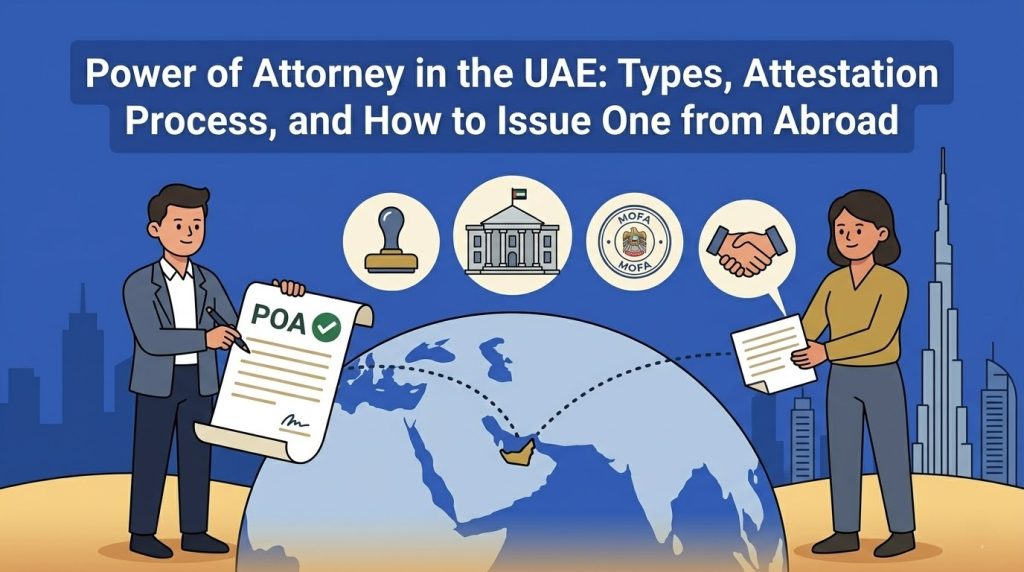
A Power of Attorney (POA) is the primary legal instrument for managing your UAE affairs — property, banking, business, visa, and legal matters — when you cannot be physically present. Governed by the agency chapter of the UAE Civil Transactions Law (Federal Decree-Law No. 25 of 2025, Articles 866 to 903, which replaced Articles 924 to 961 of the 1985 Civil Code on 1 June 2026) and administered through Dubai Courts Notary Public, Ministry of Justice notaries, and the DIFC/ADGM for their respective jurisdictions, a POA authorises a trusted person to act on your behalf for specified tasks. If you are outside the UAE and need to sell property, renew a trade licence, manage a tenancy, handle visa cancellation, or represent yourself in a legal dispute, a valid POA is not optional — it is the only way to proceed without returning in person. The article numbers for agency and mandate moved with the rest of the Code, and the full map is in our guide to what Federal Decree-Law 25/2025 changed.
This guide covers every type of POA used in the UAE, the step-by-step process for issuing one from abroad (including the attestation chain), the digital/remote notarisation options available in 2026, costs, common rejection reasons, and the specific requirements for property transactions under DLD Circular No. 29/R/2025. If you left the UAE quickly during the current regional crisis and need someone to manage your affairs, start here.
Types of Power of Attorney in the UAE
The type of POA you need depends on what you want the agent to do. Using the wrong type — particularly a general POA when a specific one is required — can result in rejection by banks, DLD, courts, or other government authorities.
| POA Type | Scope | Common Uses | Key Restrictions |
|---|---|---|---|
| Special (Specific) POA | One defined transaction or task | Selling a named property, signing a specific contract, completing one DLD transaction, court representation for a specific case | Expires upon completion of the specified task; most banks and DLD prefer this type for high-value transactions |
| Property Management POA | Ongoing property administration | Leasing, rent collection, Ejari registration, DEWA management, maintenance, owners’ association representation | Does not include authority to sell or mortgage unless explicitly stated |
| Business/Corporate POA | Company operations and governance | Trade licence renewal, signing commercial contracts, bank authorisations, shareholder resolutions, MOHRE/immigration submissions | Must reference the specific company trade licence and registration details |
| Litigation POA | Court and legal representation | Filing lawsuits, attending hearings, appointing lawyers, signing legal documents, RERA disputes, MOHRE complaints | Must expressly grant litigation rights; general wording like “represent me” is insufficient — courts reject vague POAs |
| General POA | Broad authority across multiple matters | Full financial, legal, and administrative management for an extended period | Highest risk; nominee should be an immediate family member; many banks and DLD reject general POAs for specific transactions in favour of special POAs |
2026 trend: Banks and the DLD increasingly require special (transaction-specific) POAs rather than accepting general ones for high-value operations. DLD Circular No. 29/R/2025 mandates specific wording for each transaction type (sale, purchase, mortgage, gift) — a POA that says “manage my property affairs” without the exact permitted terminology will be rejected. Draft your POA with the end-use authority in mind, not as a general-purpose document.
How to Issue a POA from Inside the UAE
If you are currently in the UAE, the process is straightforward:
- Draft the POA in Arabic or bilingual Arabic–English format. Use a qualified legal professional to ensure the wording meets the requirements of the intended authority (DLD, bank, court, MOHRE).
- Visit a Notary Public. Dubai Courts Notary Public or a licensed private notary authorised by Dubai Courts (for Dubai). Ministry of Justice notaries (for other emirates). Bring your original passport and Emirates ID, and the agent’s identification details.
- Sign in the presence of the notary. The principal (you) must be physically present. The agent does not need to be present at the time of signing.
- Pay the notarisation fee. Approximately AED 200–500 for simple POAs at Dubai Courts. Private notaries may charge AED 500–1,500 depending on complexity.
- Collect the notarised original. In 2026, you also receive a digital copy with a blockchain-verified QR code that government entities can use for instant verification.
How to Issue a POA from Outside the UAE
If you are already abroad, the process requires an international attestation chain. Each step must be completed in sequence — skipping any step renders the POA invalid in the UAE.
Option A: Traditional Embassy Attestation Route
- Draft the POA in Arabic or bilingual Arabic–English format with a qualified legal professional familiar with UAE requirements. Generic templates downloaded from the internet almost never meet DLD, bank, or court standards.
- Notarise in your current country through a local notary public, solicitor (UK), or equivalent authority. You must sign in the physical presence of the notary.
- Authenticate with your country’s foreign affairs ministry (or equivalent — e.g., the Foreign, Commonwealth & Development Office in the UK; the Ministry of External Affairs in India). This step confirms the local notary’s authority.
- Legalise at the UAE Embassy or Consulate in the country where you are located. The UAE Embassy attests that the document is authenticated and suitable for use in the UAE.
- Complete MOFA attestation in the UAE. The Ministry of Foreign Affairs and International Cooperation (MOFA) applies the final attestation. Your agent in the UAE can submit the document to MOFA on your behalf, or you can use MOFA’s digital attestation service via the MOFA website or app with UAE Pass authentication.
- Translate into Arabic (if not already bilingual) by a UAE Ministry of Justice-certified translator. The Arabic version is legally binding — in case of conflict between languages, the Arabic text prevails.
- Present the original to the relevant authority. DLD, bank, court, or government department. Scanned or electronic copies are not accepted for most transactions — the original physical document must be presented.
Timeline: The full embassy attestation process typically takes 1–3 weeks depending on embassy processing times in your country, courier logistics, and MOFA turnaround. Budget extra time if your country’s foreign ministry or the UAE Embassy has backlogs.
Cost breakdown:
| Step | Approximate Cost |
|---|---|
| Legal drafting | AED 500–3,000 (varies by complexity and law firm) |
| Local notarisation (your country) | Varies by jurisdiction (typically USD 50–200) |
| Home country foreign ministry authentication | Varies (typically USD 20–100) |
| UAE Embassy legalisation | AED 150–500 |
| MOFA attestation in UAE | AED 150 |
| Arabic translation (if needed) | AED 200–500 |
| Total (typical range) | AED 1,000–4,000+ |
Option B: Digital/Remote Notarisation
Both Dubai Courts and the UAE Ministry of Justice (MOJ) now offer remote notarisation (e-Notary) services that allow certain POAs to be issued without visiting an embassy or notary in person. The process uses video call verification and requires a verified UAE Pass (green/biometric verification level). The digitally notarised POA carries the same legal weight as a physically notarised document and is accepted by UAE authorities.
This option is faster and cheaper than the embassy route, but has limitations: not all document types are eligible, you need an active UAE Pass with biometric verification, and some authorities (particularly banks for high-value transactions) may still request a traditionally attested original. Check with the intended recipient authority before relying solely on a digital POA.
POA for Property Transactions: DLD-Specific Requirements
The Dubai Land Department applies stricter requirements for POAs used in real estate transactions than most other authorities. Under DLD Circular No. 29/R/2025, all POAs submitted for property dispositions must meet these conditions:
- Specific transaction wording required. The POA must contain the exact terminology prescribed by the circular for each transaction type: “sale of real estate” or “transfer for consideration” (for sales); “real estate mortgage” (for mortgages); “sale of the usufruct right” (for usufruct transactions). Generic phrases like “manage my property” are rejected.
- Electronic verification mandatory. The DLD Registrar must verify every POA through the issuing authority’s official electronic platform. QR code verification is prohibited.
- Foreign-issued POAs must be issued within two years. A POA older than two years from the date of submission will not be accepted.
- Original physical document required. Scanned or uncertified electronic copies are not accepted.
- Sale proceeds go to the owner’s bank account only. Under 2026 rules, the sale cheque must be issued in the name of the person on the title deed — not the POA holder. If selling from abroad, you must have an active UAE bank account in your own name.
POA for Banking: What Banks Accept and Reject
UAE banks are cautious about POAs due to fraud risk. Most banks strongly prefer special (transaction-specific) POAs over general ones. Common bank requirements include the POA being notarised and attested through the full chain (local notary → home country foreign ministry → UAE Embassy → MOFA), the document specifically naming the bank and account numbers where applicable, and the agent’s Emirates ID or passport matching the POA details exactly.
Banks frequently reject POAs that use overly broad language (“manage all my financial affairs”), that are more than one year old, that lack proper attestation, or where the principal’s identification details do not match the bank’s records. Some banks have internal POA verification departments that may take 5–10 working days to approve the document before the agent can transact. If you are opening a non-resident bank account remotely, the bank may require you to appear via video call rather than through a POA.
Revocation, Expiry, and Automatic Termination
A POA is not permanent. It terminates automatically in the following circumstances:
- Death of the principal. The POA becomes void immediately upon the principal’s death. Any transactions completed by the agent after the principal’s death are invalid.
- Completion of the specified task (for special POAs). Once the property is sold or the transaction is completed, the POA is exhausted.
- Expiry of the validity period stated in the document. Most POAs are issued with a one- or two-year validity.
- Revocation by the principal. You can cancel a POA at any time by issuing a written revocation through the notary and notifying all relevant parties (agent, DLD, bank, courts). Revocation should be notarised and communicated formally to prevent the agent from continuing to act.
- Loss of legal capacity of either the principal or the agent.
Common Rejection Reasons and How to Avoid Them
| Rejection Reason | How to Avoid |
|---|---|
| POA wording too vague or generic | Use the exact transaction-specific terminology required by the authority (DLD circular wording, bank-specific language, court requirements) |
| Missing attestation step in the chain | Complete every step: local notary → home country foreign ministry → UAE Embassy → MOFA → Arabic translation (if needed) |
| Passport or Emirates ID details do not match | Ensure all identification numbers in the POA match current documents exactly; if you renewed your passport, provide both old and new copies |
| POA older than two years (DLD) or one year (some banks) | Issue the POA close to the date of intended use; check the authority’s validity requirements in advance |
| Not in Arabic or lacking certified Arabic translation | Always draft bilingual (Arabic–English) or arrange certified translation by a UAE MOJ-accredited translator |
| Scanned or electronic copy submitted instead of original | Present the physical original; courier the attested original to your agent in the UAE |
Frequently Asked Questions
Can I issue a Power of Attorney while I am outside the UAE?
Yes. You can issue a POA from anywhere in the world through either the traditional embassy attestation route (local notary → home country foreign ministry → UAE Embassy → MOFA) or the digital e-Notary service offered by Dubai Courts and the Ministry of Justice (requires verified UAE Pass). Both routes produce legally valid documents accepted by UAE authorities.
How much does a POA from abroad cost?
The total cost typically ranges from AED 1,000 to AED 4,000+, covering legal drafting, local notarisation, home country foreign ministry authentication, UAE Embassy legalisation, MOFA attestation, and Arabic translation if needed. The exact amount depends on your country of residence and the complexity of the POA.
How long does the process take?
The full embassy attestation route typically takes 1–3 weeks. The digital e-Notary option can be completed in 1–3 business days if your UAE Pass is verified and the document type is eligible. Allow extra time for courier delivery of the physical original to your agent in the UAE.
Can my POA holder receive money from a property sale?
No — not since 2026. Under DLD Circular No. 29/R/2025, sale proceeds must be deposited into a UAE bank account in the name of the person listed on the title deed. The POA holder’s bank account cannot receive the funds. You must maintain an active UAE bank account in your own name if you plan to sell property remotely.
Does a POA expire?
Yes. Most POAs are issued with a validity period of one to two years. The DLD will not accept a POA that is more than two years old from the date of submission. Some banks apply a stricter one-year limit. A POA also terminates automatically upon the death of the principal, completion of the specified task (for special POAs), or formal revocation.
Can I revoke a POA after issuing it?
Yes, at any time. Issue a written revocation through a notary and notify all parties who have seen or relied on the POA — your agent, the bank, DLD, courts, or any other authority. Until formal revocation is communicated, the agent retains the authority granted. Revocation should be notarised for legal certainty.
Will banks accept a general POA?
Generally, no — not for high-value transactions. Most UAE banks require special (transaction-specific) POAs that name the bank, specify the account, and detail the authorised transactions. General POAs are increasingly rejected as a fraud prevention measure. Check with your specific bank before issuing the POA.
Do I need a POA for every government department separately?
Not necessarily. A well-drafted POA can cover multiple authorities if the wording is sufficiently comprehensive. However, some authorities (particularly DLD and courts) require very specific language. In practice, many expats find it more efficient to issue one broader management POA for day-to-day affairs and separate specific POAs for individual high-value transactions like property sales or litigation.
Can my POA holder apply for or renew my visa?
A POA holder can submit certain immigration applications on your behalf — such as visa renewal paperwork or sponsor-side applications — through authorised service centres or typing centres. However, some immigration procedures (particularly biometric data collection for Emirates ID) require your personal attendance and cannot be delegated. Confirm with GDRFA or ICP which steps require physical presence.
What if there is no UAE Embassy in my country?
Contact MOFA’s call centre or use the “Contact Us” function on the MOFA website to identify the nearest UAE mission that serves your country. Alternatively, use the digital e-Notary service through Dubai Courts or the Ministry of Justice if you have a verified UAE Pass — this bypasses the embassy route entirely.
What the 2025 Civil Transactions Law Changed for POAs
The agency rules were renumbered rather than rewritten when Federal Decree-Law No. 25 of 2025 replaced the 1985 Civil Code on 1 June 2026. Article 866 now carries the definition that was in Article 924: an agency is a contract by which the principal appoints an agent to perform a legal act in the principal’s name and for the principal’s account.
One rule is genuinely new and worth knowing if you have granted a POA that allows substitution. Article 903(2) provides that where the primary power of attorney is cancelled, every power of attorney derived from it is cancelled automatically. Under the 1985 Code the position had to be worked out from Article 961, which said only that a sub-agent is not removed by the removal or death of the agent who appointed them. If you revoke a POA, the substitute appointments made under it now fall away with it as a matter of law.
Article 903(1) keeps the older rule: a sub-agent is removed by the death or bankruptcy of the original principal and by removal by the principal, but not by the removal or death of the agent who appointed them.
Official Sources
- UAE Ministry of Foreign Affairs — Attestation of Official Documents and Certificates
- EGSH — Power of Attorney for Property Transactions in Dubai (DLD Circular No. 29/R/2025)
- BSA Law — Dubai’s New Standards for Powers of Attorney in Property Deals
- Dubai Land Department — Official Portal
- UAE Embassy London — Attestation Information (example of embassy-specific procedures)
POA requirements, attestation procedures, and authority-specific acceptance criteria are subject to change. Dubai Courts, MOJ, DLD, and banking requirements may differ — confirm with the intended recipient authority before finalising your POA. This guide is informational and does not constitute legal advice. For complex or high-value POA matters, consult a qualified UAE lawyer.