
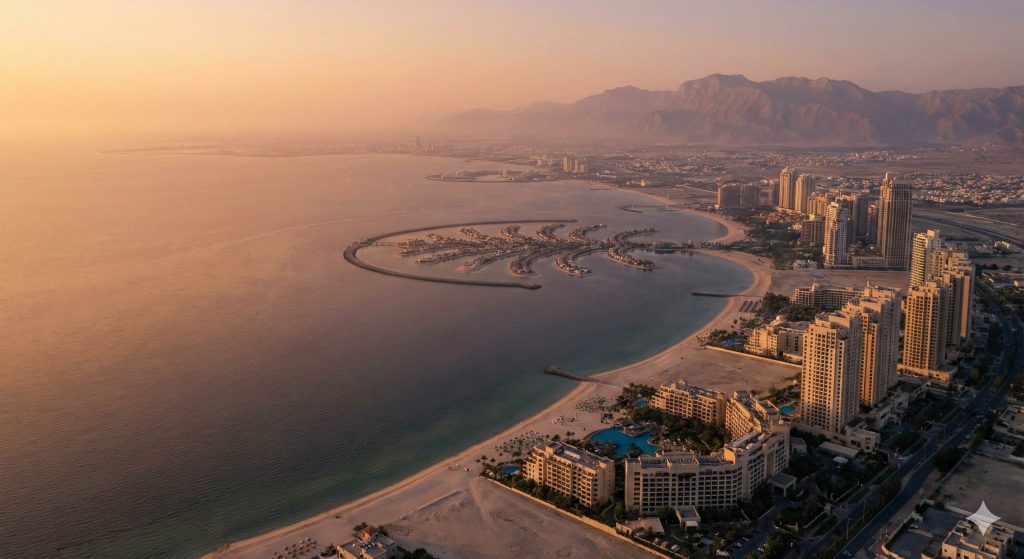
A data-driven guide to the UAE’s highest-growth property markets outside Dubai—covering Ras Al Khaimah, Abu Dhabi, Sharjah, and Ajman investment opportunities for 2026.
The UAE property market is no longer a one-emirate story. While Dubai continues to lead in transaction volume, Abu Dhabi recorded a 110% surge in transaction value in 2025, and Ras Al Khaimah posted 118% growth—making them impossible for serious investors to ignore. With Dubai facing potential 10-15% corrections in oversupplied segments by 2026-2027, diversification across emirates has shifted from optional strategy to portfolio necessity. Foreign investors now account for over 70% of transactions in key freehold zones outside Dubai, drawn by rental yields reaching 8-10% and entry prices 40-60% below comparable Dubai properties.
This guide analyzes five emerging areas beyond Dubai that offer the strongest investment fundamentals for 2026: Al Marjan Island in Ras Al Khaimah (benefiting from the transformative Wynn Resort project), Yas Island in Abu Dhabi (anchored by Disney and entertainment infrastructure), Aljada in Sharjah (the emirate’s flagship freehold community), Al Shamkha in Abu Dhabi (an affordable growth corridor), and Al Zorah in Ajman (premium waterfront at accessible prices). Each area is evaluated on capital appreciation potential, rental yields, infrastructure catalysts, and practical considerations for foreign buyers.
Understanding the UAE’s Shifting Investment Landscape
The UAE property market in 2025-2026 presents a fundamentally different opportunity set than previous cycles. According to data from the Abu Dhabi Real Estate Centre (ADREC), the capital recorded AED 96.2 billion in transactions in 2024—a 24% increase year-over-year—while foreign direct investment in Abu Dhabi property rose 35% to AED 6.2 billion in the first nine months of 2025. Simultaneously, Marjan reports that Ras Al Khaimah transaction values reached AED 15.08 billion in 2024, representing a 118% surge from AED 6.94 billion in 2023.
These figures reflect structural shifts rather than temporary anomalies. Dubai’s residential supply pipeline includes 120,000-150,000 units scheduled for delivery between 2025-2027, creating potential oversupply in certain segments. By contrast, Abu Dhabi faces a supply shortage—only 10% of expected 2025 residential units were delivered by Q3—while Ras Al Khaimah projects a housing deficit of 45,000 homes by 2030. For investors, this supply-demand imbalance outside Dubai creates favorable conditions for both capital appreciation and rental income.
The regulatory environment has also evolved significantly. Sharjah’s Law No. 2 of 2022 expanded freehold ownership to all nationalities in designated zones, while Abu Dhabi continues expanding freehold areas in Shamkha, Yas Island, and emerging communities. Combined with the UAE’s Golden Visa program (AED 2 million minimum property investment for 10-year residency), these reforms have removed previous barriers that concentrated foreign investment in Dubai.
1. Al Marjan Island, Ras Al Khaimah: The Wynn Resort Catalyst
Al Marjan Island represents the most significant transformation story in UAE real estate outside Dubai. This man-made archipelago comprising four coral-shaped islands has become the focal point of Ras Al Khaimah’s emergence as a global investment destination, driven primarily by the USD 5.1 billion Wynn Al Marjan Island integrated resort—the UAE’s first licensed gaming establishment, scheduled to open in early 2027.
The Wynn effect on property values has been extraordinary. According to data from Bayut and Property Finder, apartment prices on Al Marjan Island have jumped from AED 2,499 per square foot in 2023 to AED 3,073 in late 2025—a 23% increase that now exceeds prices in Dubai’s Downtown (AED 2,700/sq ft) and Palm Jumeirah (AED 2,600/sq ft). Off-plan apartment rates have nearly tripled since the Wynn announcement in January 2022, rising from AED 950 to AED 2,838 per square foot.
Investment Metrics and Projections
Current pricing on Al Marjan Island ranges from AED 1,400-2,000 per square foot for standard apartments to AED 2,500+ for branded residences. Rental yields average 7-9%, with waterfront and branded properties achieving 8-11%. Capital appreciation forecasts suggest 10-15% growth in the 12-18 months surrounding the Wynn opening, with Colliers projecting sustained demand through 2030 as the emirate targets 5.5 million annual visitors.
| Metric | Al Marjan Island | Comparison (Dubai Marina) |
|---|---|---|
| Average Price/sq ft | AED 2,500-3,073 | AED 2,200-2,800 |
| Gross Rental Yield | 7-11% | 5-6.5% |
| 2024-2025 Price Growth | 17-21% | 8-12% |
| Off-Plan Share | 85% | 62% |
| Foreign Buyer Share | 77% | 65% |
Key Developments and Infrastructure
Beyond Wynn, Al Marjan Island is attracting significant branded residential development. Approximately 40% of RAK’s 14,000-unit pipeline for 2026-2029 will be branded residences, including JW Marriott Residences and Manta Bay developments. The Wynn tower itself reached its 70th floor by late 2025, with construction 64% complete and on track for the 2027 opening.
Infrastructure enhancements include planned Etihad Rail integration by 2026 connecting RAK to all seven emirates, expansion of RAK International Airport, and proposed air taxi routes that could reduce Dubai travel time to under 15 minutes by 2027. These connectivity improvements address the primary historical limitation of northern emirate investments.
Risk Considerations
Al Marjan Island carries higher speculative risk than more established markets. The investment case depends heavily on Wynn’s successful opening and tourism projections materializing. Additionally, limited secondary market liquidity—a common challenge in emerging areas—means exit timing requires careful planning. That said, with 80-90% absorption rates on projects launched between 2022-2024 within 12-18 months, current demand fundamentals remain strong.
2. Yas Island, Abu Dhabi: Entertainment-Anchored Growth
Yas Island has evolved from a single-attraction destination into Abu Dhabi’s premier entertainment and lifestyle hub, with the upcoming Disney theme park (announced 2025) serving as the next major catalyst. The island already hosts Ferrari World, Warner Bros. World, Yas Waterworld, and the Yas Marina Circuit (home to the Formula 1 Abu Dhabi Grand Prix), creating a unique combination of tourism infrastructure and residential demand.
According to Aldar Properties, Abu Dhabi’s largest developer, Yas Island leads the emirate’s development pipeline with over 8,000 residential units planned. The median property price currently stands at AED 2.3 million, with values up 5.1% compared to Q2 2024. Apartment prices average AED 1,300-1,900 per square foot, while townhouses range from AED 3-5 million.
Investment Profile and Returns
Yas Island offers a balanced investment profile combining capital appreciation with rental income. Gross rental yields average 5.5-6.5%, with studios outperforming at 7%+ due to strong short-term rental demand from tourists and F1 visitors. The Disney announcement effect—similar to the Wynn effect in RAK—is expected to drive 10-12% price appreciation in waterfront and premium segments by 2026.
Key residential communities include Yas Acres (gated villas with golf views), Ansam (affordable apartments near Yas Links), Mayan (high-end beachfront apartments), and Water’s Edge (mid-range canal-view units). Each serves distinct investor profiles, from family-oriented long-term rentals to tourism-focused short-stay strategies.
| Property Type | Price Range | Gross Yield |
|---|---|---|
| Studio Apartment | AED 650,000-900,000 | 6.5-7.5% |
| 1-Bedroom Apartment | AED 1.0-1.5 million | 5.5-6.5% |
| 2-Bedroom Apartment | AED 1.5-2.2 million | 5-6% |
| 3-Bedroom Townhouse | AED 3.0-4.5 million | 4.5-5.5% |
| 4-Bedroom Villa | AED 5.0-8.0 million | 4-5% |
Infrastructure and Connectivity
Yas Island benefits from established infrastructure including direct highway access to Abu Dhabi city center (20 minutes) and Dubai (60 minutes), Yas Bay waterfront development with Etihad Arena (capacity 18,000), and expanded Yas Mall attracting international brands. Planned metro connectivity to downtown Abu Dhabi and new bridge links will further enhance accessibility.
The Disney development, while details remain limited, is expected to create 8,000-10,000 direct jobs and attract millions of additional visitors annually. Historical precedent from Dubai’s theme park developments suggests 20-30% property value increases in adjacent areas within 24 months of opening announcements.
Abu Dhabi Market Fundamentals
Yas Island benefits from Abu Dhabi’s broader market strength. The emirate’s population exceeded 4 million in 2024, with real estate contributing AED 21.9 billion to non-oil GDP in H1 2025—a 9% increase year-over-year. Foreign investment grew 66% to AED 35 billion, with investment zones attracting 74% of foreign capital. Unlike Dubai’s potential oversupply concerns, Abu Dhabi’s limited delivery pipeline (approximately 6,500 units expected in 2026) supports continued price growth.
3. Aljada, Sharjah: The Emirate’s Flagship Freehold Community
Aljada represents Sharjah’s transformation from affordable Dubai alternative to standalone investment destination. Developed by Arada, this 2.2 square kilometer master-planned community is the emirate’s largest mixed-use development, offering freehold ownership to all nationalities with entry prices 30-40% below comparable Dubai communities.
Sharjah’s property market recorded AED 40 billion in transactions during 2024, with foreign investors accounting for 30.1% of total transaction value (AED 8.1 billion) in H1 2025—a 40.6% increase from the previous year. Aljada specifically has achieved 8-12% annual price appreciation since launch, with most phases reaching 80-90% absorption within 12 months.
Pricing and Returns
Aljada apartments range from AED 800-1,400 per square foot, with one-bedroom units priced between AED 650,000-1.1 million. Rental yields consistently achieve 6-8%, outperforming the UAE average of 4.87% and matching or exceeding Dubai’s 6.5% average. Studios and one-bedroom units offer the highest yields (7-9%) due to strong demand from young professionals and Dubai commuters.
| Unit Type | Purchase Price | Annual Rent | Net Yield |
|---|---|---|---|
| Studio | AED 450,000-600,000 | AED 35,000-45,000 | 6.5-8% |
| 1-Bedroom | AED 650,000-900,000 | AED 50,000-65,000 | 6-7.5% |
| 2-Bedroom | AED 900,000-1,300,000 | AED 65,000-85,000 | 5.5-7% |
| 3-Bedroom Villa | AED 1,900,000-2,500,000 | AED 109,000-130,000 | 5-6% |
Community Features and Amenities
Aljada functions as a self-contained city, incorporating SABIS schools, healthcare facilities, the Madar entertainment district (opened 2020) with skate park and cultural hub, retail boulevards, and extensive green spaces. This integrated approach addresses the primary limitation of many Dubai satellite communities—lack of amenities during early development phases.
Location provides direct Dubai access via E88/E311 highways (30-minute drive to Dubai business districts), proximity to Sharjah Airport, and connectivity to University City. Multiple handovers are scheduled through 2025-2026, including new residential towers, hotels, and expanded retail components.
Transaction Costs and Ownership
Sharjah offers competitive transaction costs: 2% registration fee (versus Dubai’s 4%), agency commission around 2% on secondary market, and service charges of AED 12-16 per square foot annually for newer buildings. Freehold ownership is available in Aljada and other designated zones including Maryam Island, Masaar, Hayyan, and Tilal City.
4. Al Shamkha, Abu Dhabi: Affordable Growth Corridor
Al Shamkha has emerged as Abu Dhabi’s primary affordable growth market, transforming from a quiet suburban area into a self-sufficient urban center with significant infrastructure investment. The district benefits from Aldar’s strategic focus on properties priced between AED 500,000-3 million—a segment previously underserved in the capital.
According to dubizzle’s H1 2025 report, Al Shamkha ranks among Abu Dhabi’s top-performing affordable areas, with off-plan apartments at Al Reeman 1 averaging AED 804,000. Villa prices range from AED 1.01-4.7 million in developments like Al Reeman 2. Annual rental growth has reached 6-10%, supported by limited supply and strong family demand.
Investment Rationale
Al Shamkha offers the capital appreciation potential of an emerging market combined with Abu Dhabi’s stability advantages. Key investment drivers include planned Etihad Rail connectivity (enhancing access to Dubai and other emirates), proximity to Khalifa Port industrial zone, ongoing AED 3.4 billion housing project investment, and development of schools, hospitals, and retail clusters.
Current pricing reflects significant discount to established areas: apartments average AED 800,000-1.2 million versus AED 1.5-2.5 million on Al Reem Island; villas range from AED 1.5-3.5 million versus AED 5-10 million on Saadiyat Island. This price gap, combined with infrastructure improvements, supports forecasts of 8-10% annual appreciation through 2026-2027.
| Development | Property Type | Price Range | Expected ROI |
|---|---|---|---|
| Al Reeman 1 | Apartments | AED 700,000-1,100,000 | 6-7% |
| Al Reeman 2 | Villas | AED 1,200,000-2,500,000 | 5.5-6.5% |
| Fay Al Reeman | Villas/Townhouses | AED 1,500,000-3,000,000 | 5-6% |
Target Demographics and Demand Drivers
Al Shamkha primarily attracts UAE nationals seeking affordable, spacious homes and expatriate families working in Abu Dhabi’s industrial and government sectors. The Fay Al Reeman project, with Q4 2025 handover, represents Aldar’s flagship offering in the area. Demand is predominantly end-user rather than speculative, providing more stable price support than tourism-dependent markets.
The district’s position within Abu Dhabi’s Plan 2030 urban framework ensures continued infrastructure investment. Planned developments include additional schools, healthcare facilities, community retail centers, and enhanced road connectivity. This government-backed development trajectory reduces the execution risk common in emerging areas.
5. Al Zorah, Ajman: Premium Waterfront at Accessible Prices
Al Zorah represents Ajman’s strategic play for premium market positioning, offering waterfront living at prices 50-60% below comparable Dubai and Abu Dhabi developments. Developed by Solidere International in partnership with the Government of Ajman, this master-planned community spans the emirate’s coastline with direct beach access, a protected mangrove nature reserve, and an 18-hole Jack Nicklaus-designed golf course.
Ajman’s real estate market recorded AED 1.9 billion in transaction value by mid-2025—a 62.5% increase from 2024—with Al Zorah commanding the emirate’s premium segment. Average property prices range from AED 300,000-1.5 million depending on property type, with rental yields of 7-10% (the highest among UAE emirates).
Pricing Structure and Returns
Al Zorah offers Ajman’s only premium freehold waterfront properties. One-bedroom apartments start around AED 1.1 million, while villas range from AED 3.5-9 million for 3-5 bedroom configurations. These prices represent significant value relative to similar offerings in RAK’s Al Marjan Island or Abu Dhabi’s Saadiyat Island, while offering comparable beachfront amenities and lifestyle infrastructure.
Rental yields in Al Zorah typically achieve 6-8% for apartments and 5-6% for villas—strong performance for a premium segment. Capital appreciation projections suggest 10-15% growth by 2027, driven by limited waterfront supply in the northern emirates and continued infrastructure development.
| Property Type | Al Zorah (Ajman) | Al Marjan (RAK) | Saadiyat (Abu Dhabi) |
|---|---|---|---|
| 1-Bed Apartment | AED 1.1-1.5M | AED 1.5-2.2M | AED 2.5-4.0M |
| 3-Bed Villa | AED 3.5-6.0M | AED 4.5-7.0M | AED 8-15M |
| Gross Yield | 6-8% | 7-9% | 4-5.5% |
Development Status and Catalysts
Al Zorah’s development includes completed phases with ready-to-move units, ongoing construction on new residential towers and villas (multiple Q4 2025 and 2026 handovers), and planned marina, spa, and expanded retail components. The community’s nature reserve setting provides differentiation from urban waterfront developments, attracting buyers seeking escape from Dubai’s density.
Location provides 25-30 minute access to Dubai via Sheikh Mohammed Bin Zayed Road, proximity to Sharjah Airport, and connection to Sharjah’s Al Khan and Al Mamzar areas. For Dubai-based professionals seeking waterfront lifestyle at lower prices, Al Zorah offers compelling value—particularly for families willing to accept the trade-off of a 40-50 minute commute.
Ajman Market Fundamentals
Ajman attracts residents priced out of Dubai and Sharjah, with transaction volumes increasing 20%+ year-over-year and rental yields reaching 9-10% in high-demand segments like Downtown Ajman. The emirate’s 2% transfer fee (lowest in the UAE alongside Sharjah), freehold availability since 2004, and metro connectivity expected by 2026 support continued growth. Al Zorah represents the premium tier of this market, offering quality-conscious buyers an alternative to the emirate’s more budget-focused developments.
Comparative Investment Framework
Selecting among these five areas requires matching investment objectives with each market’s characteristics. The following framework summarizes key differentiators:
| Area | Entry Price (1-Bed) | Yield Range | Growth Catalyst | Risk Profile |
|---|---|---|---|---|
| Al Marjan Island, RAK | AED 1.5-2.2M | 7-11% | Wynn Resort 2027 | Higher (speculative) |
| Yas Island, Abu Dhabi | AED 1.0-1.5M | 5.5-7% | Disney + F1 | Moderate (established) |
| Aljada, Sharjah | AED 650K-900K | 6-8% | Freehold + value | Moderate (developer track record) |
| Al Shamkha, Abu Dhabi | AED 700K-1.1M | 5.5-7% | Infrastructure + Etihad Rail | Lower (government-backed) |
| Al Zorah, Ajman | AED 1.1-1.5M | 6-8% | Waterfront scarcity | Moderate (limited liquidity) |
Investment Strategy Recommendations
For yield-focused investors seeking immediate rental income, Aljada offers the strongest combination of affordable entry prices (AED 650,000+), established tenant demand, and 6-8% yields with lower holding costs than Dubai equivalents. Al Shamkha provides similar yield characteristics with Abu Dhabi’s regulatory stability.
For capital appreciation seekers with higher risk tolerance, Al Marjan Island offers the greatest upside potential tied to Wynn’s 2027 opening—but requires accepting speculative pricing and limited liquidity. Yas Island provides a middle ground: meaningful appreciation catalysts (Disney) within Abu Dhabi’s stable market framework.
For lifestyle-oriented investors seeking personal use combined with rental income, Al Zorah delivers premium waterfront living at accessible prices, with yields supporting carrying costs during non-use periods.
Transaction Costs Across Emirates
Understanding fee structures is essential for accurate return calculations. The following table summarizes key transaction costs by emirate:
| Fee Type | Abu Dhabi | Ras Al Khaimah | Sharjah | Ajman |
|---|---|---|---|---|
| Transfer/Registration Fee | 2% | 2% | 2% | 2% |
| Agency Commission | 2% | 2% | 2% | 2% |
| NOC/Admin Fees | AED 1,000-5,000 | AED 1,000-3,000 | AED 1,000-5,000 | AED 1,000-3,000 |
| Mortgage Registration | 0.25% + fees | 0.25% + fees | 0.25% + fees | 0.25% + fees |
| Service Charges (annual) | AED 12-25/sq ft | AED 10-20/sq ft | AED 12-22/sq ft | AED 8-16/sq ft |
| Total Acquisition Cost | 5-6% | 5-6% | 5-6% | 5-6% |
All four emirates offer the 2% registration fee (versus Dubai’s 4%), representing immediate savings on acquisition costs. This differential becomes significant at higher price points—on a AED 2 million property, the 2% saving equals AED 40,000.
Risk Assessment and Due Diligence
Investing outside Dubai introduces specific risks that require mitigation through thorough due diligence:
Liquidity Risk: Secondary markets in emerging areas are less active than Dubai’s. Resale may take longer, and price discovery can be challenging. Mitigate by focusing on projects from established developers (Aldar, Arada, Eagle Hills) with demonstrated absorption rates.
Developer Risk: Off-plan investments carry completion and quality risks. Verify developer track record, escrow compliance, and construction progress. In RAK and Ajman, focus on master developers with government backing.
Infrastructure Timing Risk: Projected catalysts (Wynn Resort, Disney, Etihad Rail) face potential delays. Build contingency into return projections and avoid overweighting single-catalyst investments.
Regulatory Risk: While freehold ownership is now available across emirates, regulations can change. Verify current ownership rules for specific projects and zones before committing.
FAQ
Can Foreigners Buy Freehold Property in All UAE Emirates?
Yes, but only in designated freehold zones. Abu Dhabi permits freehold ownership on Yas Island, Saadiyat Island, Al Reem Island, Al Shamkha, and other investment zones. Ras Al Khaimah allows freehold in Al Marjan Island, Al Hamra Village, and Mina Al Arab. Sharjah expanded freehold access through Law No. 2 of 2022 to communities including Aljada, Maryam Island, and Tilal City. Ajman has permitted foreign freehold ownership since 2004 in designated areas including Al Zorah and Downtown Ajman. Always confirm the specific project’s ownership structure before purchasing.
What Are the Minimum Investment Amounts for Golden Visa Eligibility?
The UAE Golden Visa requires a minimum property investment of AED 2 million for the 10-year residency visa. This threshold applies across all emirates. The property must be fully paid (no mortgage balance) for Golden Visa qualification, though some emirates accept multiple properties totaling AED 2 million. Properties in any freehold zone across Abu Dhabi, RAK, Sharjah, or Ajman qualify, providing flexibility to meet the threshold through emerging area investments at lower per-unit prices than Dubai equivalents.
How Do Rental Yields in These Areas Compare to Dubai?
All five emerging areas offer yields exceeding Dubai’s current 6-6.5% average. Al Marjan Island achieves 7-11% (highest among waterfront developments), Aljada delivers 6-8% with lower entry costs, and Al Zorah reaches 6-8% for premium waterfront. Abu Dhabi’s Yas Island and Al Shamkha average 5.5-7%—comparable to Dubai mid-tier areas but with stronger capital appreciation potential. These yield premiums reflect the value gap between Dubai and other emirates, though they may compress as prices appreciate.
What Is the Wynn Resort Effect on RAK Property Prices?
Since the Wynn Al Marjan Island announcement in January 2022, off-plan apartment prices have nearly tripled from AED 950 to AED 2,838 per square foot. Ready property prices have increased 17-21% annually, and villa prices have risen 92% to AED 2,058 per square foot. Colliers projects RAK will welcome 5.5 million annual visitors by 2030 (versus current ~1 million), creating sustained demand for residential and short-term rental properties. The resort’s 2027 opening is expected to trigger an additional 10-15% appreciation in adjacent areas.
What Are the Risks of Investing in Emerging UAE Areas?
Primary risks include limited secondary market liquidity (longer resale periods), dependency on infrastructure completion (Wynn, Disney, Etihad Rail), developer execution quality for off-plan purchases, and potential oversupply in specific segments. Mitigation strategies include focusing on established developers, diversifying across emirates, maintaining cash reserves for extended holding periods, and avoiding over-leverage. Abu Dhabi generally carries lower risk due to government-backed development, while RAK carries higher speculative risk with greater upside potential.
How Does Abu Dhabi Compare to Dubai for Property Investment?
Abu Dhabi offers more stable fundamentals with limited supply (6,500 units expected in 2026 versus Dubai’s 120,000+), stronger end-user demand (fewer speculators), and 2% transfer fees (versus 4%). However, Dubai provides greater liquidity, faster appreciation in prime segments, and more established rental markets. For 2026, Abu Dhabi’s supply-demand balance suggests 5-8% stable growth versus Dubai’s potential 10-15% corrections in oversupplied segments. Portfolio diversification across both emirates provides risk-adjusted returns superior to single-market exposure.
What Is the Best Emerging Area for First-Time UAE Investors?
Aljada in Sharjah offers the most accessible entry point: one-bedroom apartments from AED 650,000, 6-8% rental yields, established developer (Arada), completed amenities, and 30-minute Dubai access. The lower entry cost reduces exposure while the active rental market provides income during the holding period. For investors with larger capital seeking appreciation, Yas Island provides Abu Dhabi’s stability with Disney-driven growth catalysts. Al Marjan Island suits aggressive investors accepting higher risk for potential 15%+ returns.
When Is the Best Time to Buy Property in These Emerging Areas?
For Al Marjan Island, the optimal window is before Wynn’s 2027 opening—prices historically spike at project completion. For Yas Island, pre-Disney announcement pricing still exists in some developments, though windows are closing. Aljada and Al Shamkha offer consistent value without specific timing pressure, though off-plan phases typically offer 10-15% discounts to ready prices. Generally, Q2-Q3 provides better negotiating leverage due to lower transaction volumes during summer months. Off-plan launches often offer “early bird” pricing 5-10% below subsequent phases.