
What actually works, what’s blocked, and how to make legal calls in Dubai and across the UAE
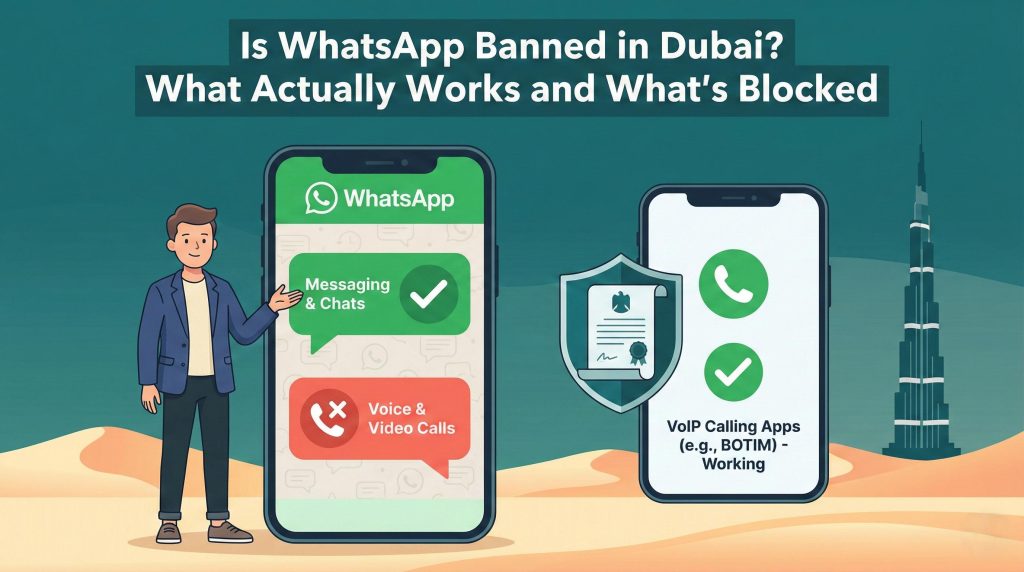
WhatsApp is not banned in Dubai — but its voice and video calling features are blocked across the entire UAE under federal VoIP regulations enforced by the Telecommunications and Digital Government Regulatory Authority (TDRA). Text messaging, photo sharing, voice notes, and file transfers all work without restriction. The calling block applies equally to residents, expats, and tourists, on both Wi-Fi and mobile data networks.
This guide covers the exact scope of WhatsApp restrictions in Dubai, the legal framework behind VoIP regulation, which calling features work and which do not, TDRA-approved alternatives for voice and video calls, the legal risks of using VPNs to bypass restrictions, and practical setup steps so you can stay connected from day one.
What Exactly Is Blocked and What Still Works
The distinction is straightforward: WhatsApp’s text-based features function normally throughout the UAE, while anything involving real-time voice or video transmission is blocked at the network level by licensed telecom operators Etisalat (e&) and du. You will not receive an error message or a warning — calls simply fail to connect or display a generic “Call Failed” notification.
| WhatsApp Feature | Status in the UAE | Notes |
|---|---|---|
| Text messages | ✅ Works normally | Individual and group chats |
| Photos and videos (sending/receiving) | ✅ Works normally | All media types |
| Voice notes | ✅ Works normally | Recorded audio, not live |
| Document/file sharing | ✅ Works normally | PDFs, spreadsheets, etc. |
| Status updates | ✅ Works normally | Text, photo, and video statuses |
| WhatsApp Web / Desktop | ✅ Messaging works | Calling features blocked |
| Voice calls | ❌ Blocked | VoIP protocol blocked by ISPs |
| Video calls | ❌ Blocked | VoIP protocol blocked by ISPs |
| Group calls | ❌ Blocked | Same VoIP restriction applies |
This restriction is not limited to WhatsApp. FaceTime, Viber, and the consumer version of Skype face identical blocks. The restriction applies to the VoIP protocol itself, not to specific apps — any unlicensed application that attempts real-time voice or video transmission over the internet will fail to connect on UAE networks.
Why WhatsApp Calls Are Restricted in the UAE
The UAE’s VoIP restrictions stem from a combination of telecommunications regulation, economic policy, and national security considerations. Understanding the reasoning helps residents and visitors navigate the rules rather than simply being frustrated by them.
Telecommunications Licensing Framework
Under the UAE Telecommunications Law (Federal Law by Decree No. 3 of 2003), all voice communication services require a licence from the TDRA. The authority’s VoIP Regulatory Policy (version 2.0, issued December 2009) classifies voice and video calls over the internet as regulated services. Only licensed providers — primarily Etisalat (e&) and du — or applications explicitly approved by the TDRA may legally offer VoIP services within the UAE.
The TDRA states directly on its official FAQ page that using VoIP software not provided by or in collaboration with a licensee constitutes a potential criminal offence. Licensed operators are obliged to block non-compliant VoIP traffic as part of their content filtering responsibilities.
National Security and Encryption Concerns
WhatsApp uses end-to-end encryption for all calls, which prevents even service providers and government agencies from monitoring call content. The UAE government requires the ability to conduct lawful interception of communications under its national security framework. Applications that cannot accommodate this requirement face continued restriction.
Telecom Revenue Protection
Etisalat and du are the UAE’s two licensed public telecommunications operators, with significant government ownership. Free VoIP calling through apps like WhatsApp directly competes with their international and domestic calling revenue. The regulatory framework channels voice traffic through licensed operators, maintaining the commercial viability of the UAE’s telecommunications infrastructure.
The Legal Framework: Laws and Penalties
Two primary pieces of legislation govern VoIP usage and related digital conduct in the UAE. Anyone living in or visiting Dubai should understand these provisions, as penalties can be severe.
Federal Law by Decree No. 3 of 2003 (Telecommunications Law)
This foundational law establishes the TDRA’s authority and requires licensing for all telecommunications services. Providing or using unlicensed VoIP services falls under prohibited activities. The TDRA’s Internet Guidelines explicitly categorise unlicensed voice services under prohibited content, requiring ISPs to block such traffic.
Federal Decree-Law No. 34 of 2021 (Cybercrime Law)
This law, which replaced the earlier Cybercrime Law (No. 5 of 2012) and took effect on 2 January 2022, contains provisions directly relevant to VoIP circumvention. Article 10 addresses IP address manipulation: using any technology to alter or disguise your IP address with the intent to commit a crime or conceal evidence carries penalties of provisional imprisonment and fines ranging from AED 500,000 to AED 2,000,000.
The law does not explicitly ban VPN technology itself. However, using a VPN to bypass government-imposed content restrictions — including VoIP blocks — can be classified as a violation. The distinction matters: VPN use for accessing corporate resources, securing personal data, or general privacy is permitted. VPN use to access blocked services may trigger enforcement.
| Provision | Offence | Potential Penalty |
|---|---|---|
| Article 10, Decree-Law 34/2021 | Manipulating IP address to commit or conceal a crime | Imprisonment + fine of AED 500,000–2,000,000 |
| VoIP Regulatory Policy 2.0 / Telecom Law | Using unlicensed VoIP services | Potential criminal offence; ISP traffic blocking |
In practice, individual users who simply attempt a WhatsApp call are unlikely to face prosecution — the call will just fail. Enforcement focuses on deliberate circumvention methods and larger-scale violations. However, the legal provisions exist, and relying on a VPN to bypass calling restrictions carries real — if rarely enforced — legal risk.
TDRA-Approved Calling Apps That Work in Dubai
The TDRA maintains an official list of approved VoIP applications that are legally permitted for voice and video calls within the UAE. This list is updated periodically, so always check the current version on the TDRA website before relying on any specific app.
Personal Calling Apps
BOTIM is the most widely used approved calling app among UAE residents and visitors. It supports voice calls, video calls, and messaging, and works on both iOS and Android. BOTIM is free to download, though you typically need to activate an Internet Calling Plan (ICP) through your telecom provider for full functionality. To activate this plan with Etisalat, text “ICP” to 1012; du subscribers can activate through their account settings or by contacting customer support.
Other approved personal calling apps include C’Me (supported primarily on Etisalat), Voico (available on both networks), and HiU Messenger (supported by du). Call quality and reliability vary — BOTIM generally receives the most consistent reviews, while C’Me has been criticised for dropped calls and lower audio quality.
Business and Enterprise Apps
Several business-grade platforms are approved for use in the UAE, particularly since restrictions were relaxed during the COVID-19 pandemic to support remote work and distance learning. These include Zoom, Microsoft Teams, Google Meet, Cisco Webex, Avaya Spaces, BlueJeans, and Slack. These platforms function for both personal and professional use, though some may require specific calling features to be enabled through your provider.
| App | Type | Key Features | Notes |
|---|---|---|---|
| BOTIM | Personal | Voice, video, messaging, group calls (up to 21) | Most popular; requires ICP activation |
| C’Me | Personal | Voice, video calls | Etisalat-supported; mixed reviews on quality |
| Voico | Personal | Voice, video, messaging | End-to-end encryption; works in low bandwidth |
| HiU Messenger | Personal | Voice, video calls, messaging | du-supported |
| Zoom | Business/Personal | Video conferencing, up to 100 participants | 40-minute limit on free plan |
| Microsoft Teams | Business/Personal | Calls, video, file sharing, collaboration | Integrates with Microsoft 365 |
| Google Meet | Business/Personal | Video calls, up to 100 participants | Requires Gmail account |
How to Set Up Legal Internet Calling in Dubai
Getting internet calling working legally in the UAE requires two steps: subscribing to an Internet Calling Plan through your telecom provider and installing an approved VoIP application. Neither step alone is sufficient — you need both.
Step 1: Activate an Internet Calling Plan
Both Etisalat and du offer Internet Calling Plans (ICPs) that unlock VoIP functionality on approved apps. For Etisalat prepaid customers, text “ICP” to 1012 to activate the plan. Postpaid customers can activate through the My Etisalat UAE app or by calling 101. Du subscribers can activate through the du app or customer care. Pricing and inclusions vary by plan type — check current rates directly with your provider, as these change periodically.
Step 2: Install a TDRA-Approved App
Download BOTIM, C’Me, Voico, or another approved app from your device’s app store. Register with your UAE phone number. Once your ICP is active and the app is set up, voice and video calling should function normally over both Wi-Fi and mobile data. If calls still fail after ICP activation, restart your device or contact your telecom provider to confirm the plan is properly linked to your line.
For Tourists and Short-Term Visitors
Purchase a tourist SIM card from Etisalat or du upon arrival (available at airports, malls, and retail outlets). Activate an Internet Calling Plan on the SIM, then install an approved app. Alternatively, business platforms like Zoom and Google Meet generally work without an ICP subscription and require no UAE phone number — just a data connection and an account.
VPNs and WhatsApp Calling: Legal Risks Explained
Many online guides suggest using a VPN to bypass WhatsApp calling restrictions. While this is technically possible — a VPN routes your internet traffic through a server outside the UAE, making it appear you are calling from a different country — it carries legal risk under UAE cybercrime legislation.
VPN technology is not banned outright in the UAE. Businesses, banks, and institutions routinely use VPNs for secure access to internal networks, and this is explicitly permitted. The TDRA has issued an official statement clarifying that VPN use by companies and institutions to access their own networks is allowed. The legal problem arises specifically when a VPN is used to bypass government-imposed content restrictions or access blocked services.
Under Article 10 of Federal Decree-Law No. 34 of 2021, manipulating your IP address to commit an offence or conceal evidence of one carries fines between AED 500,000 and AED 2,000,000 plus potential imprisonment. Whether using a VPN for WhatsApp calls constitutes “committing an offence” is subject to interpretation, and enforcement against individual users for personal VoIP calls has been rare. However, the legal framework exists, the penalties are substantial, and UAE authorities have the technical capability to detect VPN usage patterns.
What About Using a VPN in Dubai?
VPN services such as Planet VPN can encrypt internet traffic and provide additional privacy on public or local networks. Planet VPN offers both free and premium options and includes its proprietary StarGuard protocol, designed to maintain stable connections on restrictive networks. However, using a VPN does not change UAE rules governing WhatsApp calling or other restricted VoIP services. Users should ensure that their use of a VPN and online communication services complies with applicable UAE laws and regulations.
The practical advice for residents and visitors: use TDRA-approved apps for calling. The risk-benefit calculation does not favour using a VPN for something as routine as a phone call when legal alternatives exist.
Common Misconceptions About WhatsApp in Dubai
Misconception: WhatsApp Is Completely Banned in Dubai
Reality: WhatsApp messaging is fully functional. Only the voice and video calling features are blocked. You can send and receive text messages, photos, videos, documents, voice notes, and status updates without any restriction. WhatsApp remains one of the most widely used communication tools in the UAE.
Misconception: The Ban Will Be Lifted Soon
Reality: There is no official indication from the UAE government or TDRA that WhatsApp calling restrictions will be removed. The VoIP regulatory framework has been in place since 2009 and has been consistently enforced. While some business platforms gained approval during COVID-19, WhatsApp’s consumer calling features remain outside the approved list.
Misconception: Hotel Wi-Fi Bypasses the Restriction
Reality: Hotel Wi-Fi networks operate under the same TDRA regulations as all other UAE networks. WhatsApp calls will not work on hotel Wi-Fi any more than on your personal mobile data. Some travellers report occasional success due to inconsistent filtering, but this is unreliable and still technically non-compliant.
Misconception: You Can Be Fined for Attempting a WhatsApp Call
Reality: Simply pressing the call button on WhatsApp will not result in a fine. The call will fail to connect, and that is the extent of the consequence. Legal risk applies only to deliberate circumvention methods such as using VPNs to bypass the restriction.
How This Restriction Applies Across the UAE
WhatsApp calling restrictions are federal, not Dubai-specific. They apply uniformly across all seven emirates — Dubai, Abu Dhabi, Sharjah, Ajman, Umm Al Quwain, Ras Al Khaimah, and Fujairah. The TDRA operates at the federal level, and both licensed telecom operators (Etisalat and du) implement the same VoIP blocking nationwide. Free zones, including DIFC and ADGM, do not have separate telecommunications regulations that exempt them from these restrictions.
The restriction also applies regardless of your residency status. UAE citizens, residents on employment or family visas, investors, tourists on visit visas, and transit passengers using airport Wi-Fi all face the same VoIP limitations. Your nationality, visa type, and length of stay do not create exceptions.
Practical Tips for Staying Connected
- Before arriving in Dubai: Install BOTIM, Zoom, or Google Meet on your phone. Inform your regular contacts that WhatsApp calls will not work and share your alternative app details.
- For regular calls home: BOTIM with an active Internet Calling Plan offers the closest experience to WhatsApp calling. It supports both individual and group video calls.
- For business communication: Microsoft Teams, Zoom, and Google Meet function without needing an ICP subscription in most cases. These are widely accepted in UAE corporate environments.
- For quick voice communication: WhatsApp voice notes (recorded audio) work perfectly. While not real-time, they serve as an effective workaround for brief messages that are easier to speak than type.
- For international roaming: If you are visiting Dubai on an active international roaming plan (not a local UAE SIM), your data routes through your home country’s network. WhatsApp calls may work in this scenario, as the VoIP filtering applies to UAE-based networks. This is not guaranteed, however, and data roaming costs are typically high.
FAQ
Is WhatsApp Banned in Dubai?
WhatsApp itself is not banned. The app is widely installed and used for messaging throughout Dubai. Only the voice and video calling features are blocked under TDRA’s VoIP regulations, which restrict all unlicensed internet-based calling services. Text, photos, files, and voice notes all function normally.
Can I Use WhatsApp to Send Messages in Dubai?
Yes, without any restriction. Individual chats, group chats, document sharing, photo and video sharing, voice notes, location sharing, and status updates all work on WhatsApp in Dubai. Only real-time voice and video calling is blocked.
Why Are WhatsApp Calls Blocked in the UAE?
Three factors drive the restriction: UAE telecommunications law requires all voice services to be licensed by the TDRA; WhatsApp’s end-to-end encryption prevents government monitoring required under national security provisions; and free VoIP calls compete with revenue streams of state-linked telecom operators Etisalat and du.
What Calling Apps Work in Dubai Without a VPN?
TDRA-approved apps include BOTIM, C’Me, Voico, and HiU Messenger for personal use, plus Zoom, Microsoft Teams, Google Meet, and Cisco Webex for business communication. Most personal apps require activation of an Internet Calling Plan through Etisalat or du. Check the TDRA’s current approved list before relying on any specific app.
Is It Illegal to Use a VPN in Dubai?
VPN technology is not banned outright. Using a VPN for business purposes, corporate network access, or general privacy is legal. Using a VPN to bypass government-imposed restrictions on blocked services — including WhatsApp calling — may violate Federal Decree-Law No. 34 of 2021, with potential fines of AED 500,000 to AED 2,000,000 under Article 10.
Will I Be Fined for Trying to Make a WhatsApp Call?
No. Attempting a WhatsApp call results in a “Call Failed” message, not a fine or legal consequence. The network-level block prevents the call from connecting. Penalties apply only if you use deliberate circumvention methods (such as VPNs) to bypass the restriction, and even then enforcement against individual personal use has been uncommon.
Do WhatsApp Calls Work on International Roaming in Dubai?
They may work if your phone is using an active international data roaming connection from a non-UAE carrier, because your traffic routes through your home country’s servers. Results are inconsistent and depend on your carrier’s routing configuration. Roaming data costs are typically much higher than using a local SIM with an approved calling app.
Does WhatsApp Work in Dubai Hotels?
WhatsApp messaging works on hotel Wi-Fi, but voice and video calls remain blocked. Hotel networks in the UAE follow the same TDRA filtering rules as all other internet connections. For calls, use BOTIM or another approved app, or rely on a business platform like Zoom or Google Meet.
Is FaceTime Also Blocked in Dubai?
Yes. FaceTime, Viber, the consumer version of Skype, and all other unlicensed VoIP services are blocked under the same TDRA regulations. Apple devices sold in the UAE historically had FaceTime removed entirely, though more recent models may include the app while the service remains non-functional on UAE networks.
How Do I Activate BOTIM for Calling in Dubai?
Download BOTIM from the App Store or Google Play, then activate an Internet Calling Plan with your telecom provider. For Etisalat, text “ICP” to 1012. For du, activate through the du app or customer care. Once both the app and the calling plan are active, register with your UAE mobile number and start making calls.
Official Sources
This guide references information from the following UAE authorities and official resources:
- TDRA — VoIP Frequently Asked Questions
- TDRA — Internet Guidelines and Approved VoIP Applications
- TDRA — Telecommunications Regulations and Ruling
- UAE Legislation — Federal Decree-Law No. 34 of 2021 on Countering Rumours and Cybercrimes
- Etisalat (e&) — Prepaid Plans and Internet Calling
TDRA regulations, approved app lists, and telecom pricing are subject to change. Always verify current requirements directly with the TDRA or your telecom provider before proceeding.
This guide is for informational purposes only. UAE regulations and fees are subject to change. Always verify current requirements with the relevant official authority before proceeding with any application or transaction.