

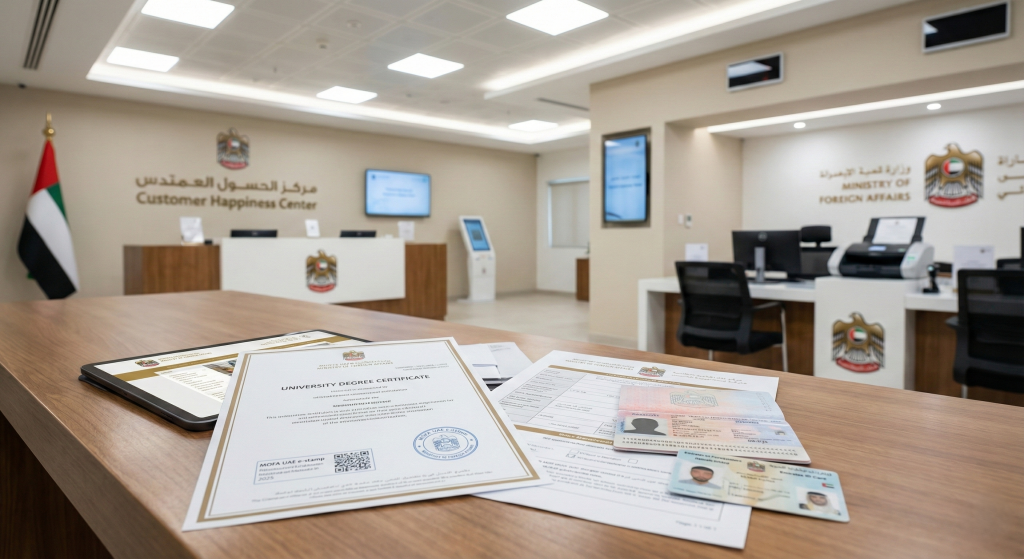
Understanding when educational certificate attestation is mandatory for UAE employment and university admission, navigating the three-tier attestation chain from home country Foreign Ministry through UAE Embassy to final MOFA validation, utilizing digital attestation services introduced in 2025, preparing required documentation including originals and translations, avoiding common rejection reasons, and distinguishing between MOFA attestation and Ministry of Education equivalency certification requirements for different professional contexts.
Educational certificate attestation represents a legally mandatory validation process for foreign-issued degrees, diplomas, and academic credentials intended for use in the UAE, whether for employment visa processing, university enrollment, professional licensing, or Golden Visa applications. The attestation follows a strict three-step sequence beginning with notarization and Foreign Ministry authentication in the certificate’s country of origin, proceeding through UAE Embassy or Consulate attestation in that same country, and concluding with final Ministry of Foreign Affairs and International Cooperation (MOFA) stamping within the UAE—only after which authorities recognize the credentials as legally valid across all seven emirates.
This guide examines the complete attestation framework under UAE regulations governing document authentication, explains when educational certificate attestation is required versus optional for various purposes, details each step of the home country attestation process including notary publics, state departments, and Foreign Ministry procedures, outlines UAE Embassy attestation requirements and procedures in major countries, describes the final MOFA attestation process through digital portals and physical service centers introduced in 2025, clarifies fees (AED 150 per educational document), timelines (2-4 weeks complete chain, 1-3 days MOFA stage), required documentation, common rejection reasons, and distinguishes MOFA attestation from Ministry of Education equivalency certification needed for certain regulated professions.
What is Educational Certificate Attestation and When is it Required?
Educational certificate attestation is the official verification process confirming that academic credentials issued by educational institutions in foreign countries are genuine, properly authorized by relevant government authorities, and legally valid for use in the UAE. The process establishes an unbroken authentication chain from the originating institution through multiple government levels in the issuing country, verification by UAE diplomatic missions, and final validation by UAE Ministry of Foreign Affairs.
Without proper attestation, UAE employers cannot process employment visas for foreign professionals, universities cannot enroll international students or recognize transfer credits, professional licensing bodies cannot issue practice permits for doctors, engineers, teachers, and other regulated professions, and immigration authorities cannot approve Golden Visa applications based on academic qualifications. Attestation serves dual purposes: proving the document’s authenticity to prevent fraud, and ensuring the issuing institution meets recognized educational standards acceptable to UAE authorities.
Mandatory Attestation Scenarios
Educational certificate attestation is legally required for employment visa processing when UAE employers sponsor foreign professionals for residence visas—the Ministry of Human Resources and Emiratisation (MOHRE) and immigration authorities mandate attested educational certificates proving qualifications match the sponsored position’s requirements. Professional positions requiring university degrees, technical diplomas, or specialized certifications all require attested credentials before visa approval. Even if you hold a valid UAE residence visa through other means (family sponsorship, property investment), switching to employment requires presenting attested educational documents to the new employer for work permit processing.
University enrollment in UAE higher education institutions requires attested degrees, diplomas, and transcripts for admission consideration. Both undergraduate and postgraduate programs mandate attestation, with universities unable to process enrollment without validated credentials. Transfer students bringing credits from foreign institutions require attestation of all relevant academic records. Professional licensing for regulated professions including medicine, nursing, engineering, teaching, law, architecture, and other fields governed by specific regulatory bodies requires attested educational certificates before authorities issue practice licenses or registration permits. Healthcare professionals must attest medical degrees through the Ministry of Health and Prevention’s equivalency process, engineers through Dubai Society of Engineers or Abu Dhabi equivalents, teachers through Ministry of Education, and lawyers through UAE legal authorities.
Golden Visa applications based on academic excellence (doctorate holders, outstanding students) or professional categories requiring specific educational qualifications mandate attested degrees proving eligibility. Immigration authorities verify educational credentials as part of Golden Visa assessment. Ministry of Education equivalency certification—required for certain educational roles and licensed professions—cannot commence without MOFA-attested certificates serving as prerequisite documentation. The equivalency process evaluates whether foreign degrees meet UAE educational standards, but this evaluation only begins after MOFA attestation confirms document authenticity.
When Attestation May Not Be Required
Attestation is not necessary for employment in companies within certain free zones that process visas internally without MOHRE involvement, though many free zones still require attestation depending on the profession and zone regulations. General labor positions not requiring specific educational qualifications may not mandate attested certificates, though employers increasingly request attestation regardless of position level. Dependent visa sponsorship (spouse, children) typically does not require the sponsor’s educational credentials to be attested unless the sponsor’s employment visa itself required attestation. Tourist visits, short business trips, and temporary stays do not require educational attestation as these visa categories do not involve employment or long-term residence based on professional qualifications.
The Three-Step Attestation Chain: Complete Framework
Educational certificate attestation follows a mandatory three-tier process, with each step building upon the previous authentication to create an unbroken verification chain from the original institution through government authorities in both the issuing country and the UAE.
Step 1: Home Country Attestation (Origin Country)
The attestation process begins in the country where the educational certificate was issued, requiring validation through multiple government levels before the document can proceed to UAE diplomatic missions.
Notarization (If Required by Country)
Some countries require notary public verification as the initial step, confirming the document is a true copy of the original certificate and the signatures are genuine. Notaries examine original certificates, verify issuer signatures, and apply notarial seals. Not all countries mandate this step—some proceed directly to higher authentication levels. India, Pakistan, and many Western countries typically require notarization; GCC countries and some others skip directly to ministry-level attestation.
State/Provincial/Regional Authentication
Federal countries with state or provincial governments often require intermediate authentication at the regional level before national Foreign Ministry attestation. In the United States, certificates typically require authentication by the Secretary of State in the state where the educational institution is located—this confirms the institution’s registration and the document’s validity within that state. In India, certificates require attestation by the Human Resource Development (HRD) department, Sub-Divisional Magistrate (SDM), or Mantralaya (state secretariat) depending on the state of issue. In Canada, documents require provincial authentication before proceeding to Global Affairs Canada. This regional step confirms the certificate’s validity within the specific state or province where it originated.
National Foreign Ministry Authentication
The highest level of home country attestation occurs at the national Foreign Ministry (or equivalent external affairs department), which verifies all previous attestations and applies the official government seal authorizing the document for international use. In the United States, this involves the Department of State’s Office of Authentications in Washington, D.C. In the United Kingdom, the Foreign, Commonwealth & Development Office (FCDO) handles legalization. In India, the Ministry of External Affairs (MEA) provides attestation services through its offices in New Delhi and regional centers. In Australia, the Department of Foreign Affairs and Trade (DFAT) processes document authentication. In Canada, Global Affairs Canada performs this function.
The Foreign Ministry verification confirms that all previous attestations (notarization, state-level authentication) were performed by legitimate authorities with proper authorization, validates the document chain’s integrity, and authorizes the document for use in foreign countries including the UAE. This step typically requires physically submitting documents to Foreign Ministry offices or authorized service centers, paying government fees (varying by country, typically USD 8-50 per document in most jurisdictions), and waiting 3-10 business days for processing depending on the country and current workload.
Step 2: UAE Embassy or Consulate Attestation (in Origin Country)
After completing all home country attestation steps, the certificate must be authenticated by the UAE Embassy or Consulate located in the issuing country. This represents the UAE government’s first verification, confirming that the document has been properly attested by the origin country’s authorities and is ready for use in the UAE.
Locating the Appropriate UAE Mission
Submit documents to the UAE Embassy or Consulate in the country where the certificate was issued—not your current location or country of citizenship if different. For example, if you hold an Indian degree but currently reside in the UK, the certificate requires attestation by the UAE Embassy in India (where the degree originated), not the UAE Embassy in the UK. If the UAE maintains no diplomatic mission in the certificate’s country of origin, alternative arrangements may be possible through designated authentication services, UAE missions in neighboring countries with jurisdiction over the originating country, or specialized attestation service providers with authority to represent UAE interests. Contact MOFA UAE’s helpline or check the Ministry of Foreign Affairs website for guidance on countries without UAE diplomatic presence.
UAE Embassy Attestation Procedures
Each UAE Embassy or Consulate maintains its own specific procedures, office hours, appointment requirements, and fee structures, though general principles remain consistent. Typical requirements include original educational certificates with all home country attestations visibly present and intact—missing any step in the home country chain results in rejection; passport copy of the certificate holder; application forms specific to the UAE mission (downloadable from embassy websites or available at the embassy); and fees varying by country and document type, typically USD 50-150 per educational certificate.
Application procedures vary: some UAE Embassies accept walk-in submissions during designated hours, others require advance appointments booked online or by phone, and some utilize third-party attestation service centers as authorized collection and submission points. Processing times range from same-day service in certain embassies to 3-7 business days in others depending on volume and staffing. Major UAE Embassies in countries with large expatriate populations (India, Pakistan, Philippines, Egypt) often experience high volumes requiring longer processing times.
The UAE Embassy verifies that all previous attestations are genuine and properly executed, applies the UAE diplomatic mission stamp or seal to the document, and records the attestation in embassy systems. From June 2025, many UAE Embassies participate in digital attestation systems where the embassy stamp is applied electronically with a QR code linking to verification systems, though physical stamps remain in use at many missions during the transition period.
Step 3: MOFA UAE Final Attestation (Within the UAE)
After UAE Embassy attestation, the final step occurs within the UAE where the Ministry of Foreign Affairs and International Cooperation (MOFA UAE) provides conclusive validation making the certificate legally acceptable across all seven emirates for employment, education, and official purposes. For a visual walkthrough of every stamp in order, from your home country to this final step, follow our step-by-step certificate attestation hub.
Understanding MOFA’s Role
MOFA attestation represents the UAE government’s definitive confirmation that the document has been properly authenticated through the complete chain, the UAE Embassy attestation is genuine and was performed by an authorized diplomatic mission, and the certificate is approved for legal use throughout the UAE. Only after MOFA attestation can UAE authorities including MOHRE, immigration departments, universities, professional licensing bodies, and government entities accept the educational certificate as valid documentation. The reverse direction, a UAE-issued certificate needed in another country, runs a different chain and is covered in our guide to attesting UAE documents for use abroad.
Digital Attestation Reforms (2025)
MOFA UAE implemented significant digital transformation in 2025, introducing electronic attestation services that streamline processing while maintaining security. The new system features online submission portals accessible through the MOFA website (www.mofa.gov.ae) and MOFA UAE mobile application, eliminating physical queue requirements at service centers. Applicants upload digital copies of documents, track application status in real-time, and receive electronic notifications when processing completes. The 2025 reforms introduced blue e-stamps with QR codes replacing traditional physical stamps—these digital seals carry identical legal validity as physical endorsements and enable instant verification by scanning the QR code, which links to MOFA databases confirming the attestation’s authenticity.
Physical document submission remains mandatory despite digital application procedures. After online application and payment, applicants send original documents via courier services integrated with MOFA systems (Zajel, Empost) or drop documents at designated service centers. MOFA examines physical documents to verify they match uploaded digital copies and contain proper UAE Embassy attestations, applies the blue e-stamp with QR code directly to the original certificate, and returns attested documents through selected courier service or pickup at service centers. This hybrid model combines digital convenience with physical verification ensuring document integrity.
Step-by-Step MOFA Attestation Process (UAE Stage)
The MOFA attestation procedure within the UAE follows a structured sequence accessible through digital and physical channels.
Method 1: Online Application via MOFA Website or App
Access the MOFA website at www.mofa.gov.ae or download the MOFA UAE mobile application (UAE MOFA) from app stores. Create an account or log in using UAE Pass—the UAE’s unified digital identity platform providing secure access to government services. If you don’t have UAE Pass, register at uaepass.ae using your Emirates ID (for UAE residents) or create a SmartPass account for non-residents.
Navigate to “Attestation of Official Documents” service within the portal or app. Select document type: “Educational Certificates” from the categories including degrees, diplomas, transcripts, school certificates, and professional certifications. Specify document origin: “Issued Outside UAE” for foreign certificates requiring UAE Embassy attestation completion before MOFA processing, or “Issued Inside UAE” for certificates from UAE educational institutions requiring only MOFA attestation.
Upload clear, high-resolution scans or photographs of your educational certificate showing all attestations—the image must clearly display the document text, institutional seals, home country attestation stamps, and UAE Embassy stamp. The system rejects poor-quality images where text is illegible, stamps are unclear, or portions are cut off. Upload your passport copy (photo page and UAE visa page if applicable). Complete the application form providing your personal information, contact details (mobile number and email for notifications), delivery address for document return, and preferred courier service.
Review application details carefully ensuring all information matches the certificate exactly—name spelling, dates, institution names must be identical. Pay the attestation fee of AED 150 per educational certificate via online payment (credit/debit card, Apple Pay, or other integrated payment methods accepted by UAE government portals). Select courier service for physical document submission and return: Standard delivery (3 working days, AED 40), Express delivery (1 working day, AED 150), or prepaid courier packages for multiple documents.
Submit the application electronically. The system generates a confirmation number and sends SMS and email notifications confirming successful submission. Within 24 hours, the selected courier service contacts you to arrange physical document pickup from your specified address. Place original documents inside an envelope (documents must not be laminated) and hand over to the courier representative when they collect.
Track application status through the MOFA portal or app using your confirmation number—the system displays current stage (document received, under review, attested, dispatched). MOFA processes the attestation upon receiving physical documents, typically within 1-3 working days. After attestation, documents are couriered back to your delivery address with the blue e-stamp and QR code applied.
Method 2: Physical Submission at MOFA Service Centers
For applicants preferring in-person submission or experiencing issues with online systems, MOFA operates customer happiness centers accepting walk-in applications. Book an appointment online through the MOFA website before visiting to avoid wait times—walk-ins without appointments may experience delays depending on center occupancy. Prepare original educational certificate with all visible attestations (home country Foreign Ministry, UAE Embassy), passport original and copy, completed application form (downloadable from MOFA website or available at centers), and payment (cash, card, or digital payment accepted at centers).
Visit the MOFA service center at your scheduled appointment time. Centers operate in Abu Dhabi, Dubai, and other emirates with specific locations and operating hours listed on the MOFA website. Present documents at the designated counter where MOFA staff verify completeness, examine attestation chain integrity, confirm the document is not laminated (laminated documents cannot be attested and are rejected), and check that names match exactly across certificate and passport.
Pay AED 150 attestation fee at the center’s payment counter. Choose document return method: collect in person from the same center after attestation (typically 1-3 working days), or arrange courier delivery to specified address (additional courier fees apply). Receive a collection receipt with reference number for tracking and document pickup. Return to the center on the specified date with the collection receipt to retrieve your attested certificate, or await courier delivery if you selected that option.
Required Documentation and Preparation
Proper document preparation prevents rejection and delays during the attestation process.
Original Educational Certificate
Submit the original certificate issued by the educational institution—MOFA does not attest photocopies, scanned copies, or certified copies. The certificate must be clean, legible, and free from damage including tears, water damage, excessive wear, or fading that makes text unreadable. All institutional seals, signatures, and official markings must be clearly visible. Certificates must not be laminated—lamination prevents MOFA from applying stamps and results in automatic rejection. If your certificate is currently laminated, have a professional document service carefully remove the lamination before beginning the attestation process, though this risks document damage and may affect the certificate’s appearance.
The certificate must display all previous attestation stamps: home country Foreign Ministry (or equivalent) stamp clearly visible, UAE Embassy or Consulate stamp from the country of issuance, and all intermediate attestations (state-level, notarization) if required by the origin country. Missing any attestation in the chain results in MOFA rejection with instructions to complete the missing steps before resubmission.
Passport Copy
Provide a clear copy of the passport biographical page showing photo, name, passport number, nationality, date of birth, and passport expiry. If you currently hold UAE residence, include a copy of the UAE visa page showing valid residence permit. The name on your passport must match the name on the educational certificate exactly—discrepancies (different spelling, middle names missing, maiden names vs married names) trigger rejection. If names differ due to marriage, legal name changes, or transliteration variations, provide additional supporting documents including marriage certificates (attested) for name changes due to marriage, legal name change orders from courts (attested), or affidavits explaining transliteration differences between languages (notarized and attested).
Translation Requirements
Certificates issued in languages other than English or Arabic require certified translation before attestation. Use UAE Ministry of Justice-approved legal translation offices—only translations from authorized providers are accepted by MOFA. Unofficial translations, online translation services, or translations from non-approved offices result in rejection. Find approved translators through the Ministry of Justice website or by visiting MOJ-certified translation offices in major UAE cities.
The translation process involves submitting the original certificate to an approved translation office, specifying Arabic or English as the target language (Arabic preferred for UAE use, though English is widely accepted), paying translation fees (typically AED 50-150 per page depending on language and translator), and receiving certified translated copy bearing the translator’s official stamp and MOJ authorization seal. The certified translation must accompany the original certificate throughout the attestation process—MOFA requires both documents for verification. After MOFA attestation, both the original certificate and its certified translation receive MOFA stamps, with the translation carrying the same legal validity as the original for UAE purposes.
Fees and Processing Timeline
Understanding costs and timelines enables effective planning for employment start dates, university enrollment deadlines, or visa application schedules.
MOFA Attestation Fees
MOFA charges AED 150 per educational document as the standard attestation fee effective 2025. This applies uniformly to all educational certificates including bachelor’s degrees, master’s degrees, doctoral degrees, diplomas, school leaving certificates, transcripts, and professional certifications. Fees are non-refundable—if MOFA rejects the application due to missing attestations, name discrepancies, or document issues, the AED 150 is not returned and you must pay again upon resubmission after correcting the problems.
Additional costs include courier service fees if using online application: standard delivery within UAE (3 working days, AED 40), express delivery (1 working day, AED 150), or prepaid corporate packages for businesses processing multiple employees’ documents. Translation fees from MOJ-approved translators: AED 50-150 per page depending on language pair and document length. Service center fees: none—physical submission at MOFA centers incurs no additional fees beyond the AED 150 attestation charge.
Commercial document attestation carries substantially higher fees—AED 2,000 per document for business contracts, company registrations, powers of attorney for commercial matters, and other corporate documents—but educational certificates qualify for the lower AED 150 personal document rate regardless of whether used for employment or other purposes.
Processing Timelines
The complete attestation chain from home country through MOFA typically requires 2-4 weeks depending on several variables. Home country attestation (Step 1) varies significantly by country: United States (Department of State apostille) typically 2-3 weeks, India (HRD + MEA attestation) typically 1-2 weeks depending on state, United Kingdom (FCDO legalization) typically 1-2 weeks, Canada (provincial + Global Affairs) typically 2-3 weeks, and Australia (DFAT) typically 1-2 weeks. Timelines extend during peak periods, government holidays, or backlogs.
UAE Embassy attestation (Step 2) in the certificate’s origin country ranges from same-day service at certain UAE missions to 5-7 business days at busy embassies processing high volumes. Large UAE missions in India, Pakistan, Philippines, and Egypt often require 3-7 days due to volume, while smaller missions in countries with fewer applicants may process within 1-2 days.
MOFA UAE final attestation (Step 3) within the UAE completes relatively quickly—1-3 working days from the date MOFA receives physical documents. Online applicants experience slightly longer total timelines due to courier pickup and delivery: 1-2 days for courier to collect documents from applicant, 1-3 days for MOFA processing after receipt, 1-3 days for courier return delivery, totaling approximately 3-8 days from online application submission to receiving attested documents. Physical service center submissions eliminate courier delays—submit documents directly and collect 1-3 days later.
Express MOFA services may be available for urgent cases, though availability varies and requires confirmation at time of application. Some attestation service providers offer expedited processing through dedicated channels with MOFA, completing attestation within same day or next day for premium fees (typically AED 500-1,000 additional beyond standard AED 150 MOFA fee).
Common Rejection Reasons and How to Avoid Them
MOFA rejects attestation applications for specific, identifiable reasons, all of which are preventable through careful preparation.
Missing Attestation Steps
The most frequent rejection cause is incomplete attestation chains—documents reaching MOFA without proper home country Foreign Ministry stamps or UAE Embassy attestation. Every certificate must display visible stamps from the origin country’s Foreign Ministry (or equivalent) showing that country’s government validated the document, the UAE Embassy or Consulate in the origin country, and all intermediate attestations required by the origin country (state-level, notarization if applicable). Missing even one step in the chain results in automatic rejection with instructions to complete the missing attestation before resubmitting to MOFA.
To avoid this, carefully verify your certificate has all required attestations before sending to MOFA. If uncertain which attestations are required for your country, consult the UAE Embassy in your certificate’s country of origin before beginning the process, contact professional attestation service providers familiar with requirements for your specific country, or check MOFA’s website and help center for country-specific attestation requirements.
Name Discrepancies
Name mismatches between the educational certificate and passport rank as the second most common rejection reason. MOFA requires exact name matches—every letter, space, and hyphen must be identical. Common discrepancies include spelling variations (Mohammad vs Mohammed, Mahmood vs Mahmud), middle names present on certificates but absent from passports or vice versa, maiden names on certificates but married names on passports without accompanying marriage certificates, transliteration differences between languages where names contain non-English characters, and extra spaces or hyphens positioned differently.
To address name discrepancies, obtain attested supporting documents explaining the variation: marriage certificate (attested) explaining name changes from marriage, legal name change orders from courts (attested) documenting official name modifications, or affidavits from notaries public (attested) confirming that two name spellings refer to the same person due to transliteration. Alternatively, if possible, obtain a new passport matching the certificate name exactly, or request the educational institution issue a revised certificate matching the current passport name (though this may be difficult or impossible years after graduation).
Laminated Certificates
MOFA cannot attest laminated documents because the lamination prevents applying stamps and seals directly to the certificate surface. Laminated documents receive immediate rejection. If your certificate is laminated, have it carefully de-laminated by professional document services—though this risks damaging the certificate and may result in visible marks, tears, or adhesive residue. Alternatively, request a duplicate original certificate from the issuing institution, which will be unlaminated and suitable for attestation, though obtaining duplicate certificates may require weeks or months depending on the institution’s processes and fees.
Poor Quality or Damaged Documents
Certificates with significant wear, water damage, tears, fading ink, or illegible text are rejected because MOFA cannot verify the document’s authenticity when key information is unreadable. To prevent this, store original certificates carefully in protective folders or sleeves away from moisture, direct sunlight, and physical damage. If your certificate has deteriorated, request a duplicate original from the issuing institution before attempting attestation. Some universities charge fees (USD 50-200) for duplicate certificates and require 4-8 weeks processing, so plan accordingly.
Incorrect Translation or Untranslated Documents
Certificates in languages other than English or Arabic submitted without certified translation are rejected. Similarly, translations from unauthorized translators or poorly executed translations with errors are rejected. Only use UAE Ministry of Justice-approved legal translation offices—their translations carry official recognition by UAE government authorities including MOFA. Verify translator authorization before engaging their services by checking the MOJ website listing approved translators or confirming the translator displays valid MOJ authorization certificates in their office.
MOFA Attestation vs Ministry of Education Equivalency: Understanding the Difference
Many individuals confuse MOFA attestation with Ministry of Education (MOE) equivalency certification, though these represent distinct processes serving different purposes.
MOFA Attestation: Document Authentication
MOFA attestation verifies that your educational certificate is genuine—it confirms the document was issued by a legitimate institution, properly attested by relevant government authorities in the origin country, authenticated by the UAE diplomatic mission, and approved for legal use in the UAE. MOFA attestation does NOT evaluate the academic level or quality of your qualification, determine whether your degree equals a UAE degree, assess whether your university is accredited or recognized, or authorize you to practice professions requiring regulatory approval. MOFA simply confirms: “This document is real and properly authenticated.”
MOFA attestation suffices for most employment visa processing where employers assess qualifications independently, university enrollment when the institution evaluates credentials through their own admission standards, general professional positions not governed by specific regulatory bodies, and personal documentation requirements for various UAE procedures.
Ministry of Education Equivalency: Academic Recognition
MOE equivalency certification evaluates whether your foreign degree meets UAE educational standards, determines the academic level of your qualification relative to UAE degree levels (bachelor’s, master’s, doctoral), confirms whether the issuing institution is recognized and accredited, and issues an equivalency certificate stating “Your [degree] from [university] is equivalent to a UAE [degree] in [field].” This process involves academic review by MOE specialists who assess curricula, accreditation, institutional reputation, and other factors determining whether the qualification aligns with UAE standards.
MOE equivalency is mandatory for certain regulated professions including teaching positions in UAE schools (all levels), healthcare professions requiring UAE practice licenses (physicians, nurses, pharmacists, etc.), engineering practice requiring professional registration with UAE engineering societies, legal practice and admission to UAE legal authorities, and academic positions at UAE universities or educational institutions. Golden Visa applications based on educational qualifications often require equivalency certificates proving the degree meets UAE standards.
The Sequential Relationship
MOFA attestation is a prerequisite for MOE equivalency—you cannot apply for equivalency without first obtaining MOFA-attested certificates. The sequence follows: complete home country attestation, obtain UAE Embassy attestation, secure MOFA attestation in UAE, then submit MOFA-attested certificates to Ministry of Education for equivalency evaluation. MOE equivalency application requires MOFA-attested original certificates, MOFA-attested transcript showing courses and grades, additional documents depending on the profession (experience letters, licensing from origin country, etc.), and payment of MOE equivalency fees (AED 100 for bachelor’s, AED 150 for master’s, AED 200 for doctoral degrees).
MOE equivalency processing takes 2-4 weeks after submission, involves academic review by specialized committees, and results in either equivalency certificate issuance confirming recognition, equivalency with conditions (additional requirements specified), or rejection if the degree doesn’t meet UAE standards. For most employment scenarios not involving regulated professions, MOFA attestation alone suffices without requiring MOE equivalency—the employer’s judgment of qualifications and MOHRE’s approval of the work permit application provide sufficient validation. However, when regulatory bodies govern the profession (medical councils, engineering societies, teaching authorities), they mandate MOE equivalency as part of professional licensing requirements.
Using Professional Attestation Services
While individuals can complete the entire attestation process independently, professional attestation service providers offer comprehensive handling for fees typically ranging AED 500-1,500 beyond government charges, depending on document type, country of origin, and service level.
Services Provided
Attestation companies manage the complete process including home country attestation coordination—they maintain networks of agents in major countries who handle notarization, state-level authentication, and Foreign Ministry attestation without requiring you to travel to your home country or manage these steps directly. UAE Embassy attestation management where service providers liaise with UAE missions, submit documents on your behalf, track progress, and collect attested documents. MOFA UAE attestation processing through established relationships with MOFA service centers or digital platforms, ensuring proper documentation and expedited handling. Document collection from your location and delivery of attested certificates to your specified address within UAE, international courier arrangements for applicants outside UAE, and translation services connecting you with MOJ-approved translators or providing in-house certified translation.
Advantages of Professional Services
Time savings are substantial—attestation companies handle all steps while you focus on work, relocation preparation, or other priorities without dedicating hours to government offices, courier services, and application procedures. Expertise in country-specific requirements ensures proper attestation chain completion—companies familiar with requirements for 50+ countries guide you through jurisdiction-specific procedures avoiding common mistakes. Error prevention through experienced staff who review documents before submission, identify potential rejection risks, and correct issues proactively rather than discovering problems after MOFA rejection. Expedited processing leveraging established relationships with UAE Embassies and MOFA service centers, accessing priority processing lanes, and minimizing delays.
Selecting Attestation Service Providers
Choose companies with established UAE presence—verify physical offices in UAE, not just online operations—and years of operational history demonstrating reliability. Check reviews and testimonials from previous clients through Google reviews, social media feedback, and personal references from colleagues or friends. Confirm transparent pricing with itemized quotes showing government fees separately from service charges, ensuring no hidden costs emerge during processing. Verify country coverage ensuring the company has experience and networks in your certificate’s country of origin—some companies specialize in specific regions (India, Philippines, Egypt) while others offer global coverage. Request timeline commitments with specific processing duration estimates and guarantees, understanding that government processing times vary but service provider coordination should be efficient.
FAQ
What is the difference between MOFA attestation and Embassy attestation?
These represent different stages in the sequential attestation chain, not alternative options. Embassy attestation occurs first—after completing home country attestation steps, you submit documents to the UAE Embassy or Consulate in the country where the certificate was issued, and the embassy applies their diplomatic mission stamp confirming they verified the home country attestations. MOFA attestation occurs second—after UAE Embassy attestation, you submit documents to the Ministry of Foreign Affairs and International Cooperation within the UAE itself, and MOFA applies the final stamp confirming UAE government acceptance. Both are mandatory in that sequence: first UAE Embassy in the certificate’s origin country, then MOFA within the UAE. You cannot skip UAE Embassy and go directly to MOFA, nor can you stop after Embassy attestation without completing MOFA—both steps are required for the certificate to be legally valid in the UAE. Think of Embassy attestation as the UAE’s external verification (confirming proper home country attestation) and MOFA attestation as the UAE’s internal approval (authorizing use throughout the Emirates).
How long does the complete attestation process take from start to finish?
Total timeline from beginning home country attestation to receiving MOFA-attested certificates typically spans 2-4 weeks, though this varies based on several factors. Home country attestation (notarization, state-level, Foreign Ministry) requires 1-3 weeks depending on your country—United States typically 2-3 weeks, India 1-2 weeks, UK 1-2 weeks, but timelines extend during peak periods or government holidays. UAE Embassy attestation in the certificate’s origin country adds 1-7 days depending on the specific embassy—small missions process quickly (1-2 days), large busy missions require longer (3-7 days). Courier time sending documents from origin country Embassy to you in UAE (if you manage the process yourself) or to professional services adds 3-7 days depending on international shipping methods. MOFA UAE processing within the Emirates takes 1-3 working days from when they physically receive documents, plus courier pickup and delivery time if using online applications (total 3-8 days from application submission to receiving attested documents). If you use professional attestation services managing the entire chain, they typically complete the process in 2-3 weeks through established networks and expedited handling. For urgent employment start dates or university enrollment deadlines, begin attestation immediately upon receiving admission or job offers—starting late risks missing deadlines due to inevitable delays from incomplete attestations, name discrepancies, or processing backlogs.
Can I attest my certificate if I’m currently outside the UAE?
Yes, the attestation process accommodates applicants located outside the UAE, though logistics differ from in-country applicants. Complete Steps 1 and 2 (home country attestation and UAE Embassy attestation) while abroad or through agents in the certificate’s origin country if you’re in a third location. For Step 3 (MOFA UAE attestation), authorize someone in the UAE to submit documents on your behalf—family members, friends, colleagues, or professional attestation service providers can apply for MOFA attestation with your authorization letter and documents. Alternatively, use professional attestation services offering door-to-door service—mail your Embassy-attested certificate to the attestation company in UAE, they handle MOFA submission and processing, and they courier the MOFA-attested certificate back to your international address. International courier services (DHL, FedEx, UPS) facilitate document transfer, though secure shipping for valuable documents costs USD 50-150 depending on origin and service level. Some companies offer remote processing where you never physically come to UAE—you mail documents to them, they complete MOFA attestation, and mail attested certificates to your location anywhere in the world. This is particularly useful for individuals securing UAE employment while still in home countries or abroad, as you can complete attestation before traveling to UAE, arriving with fully attested documents ready for immediate visa processing. Just ensure professional services you engage have legitimate UAE presence and positive track records—verify through reviews and recommendations before sending valuable original certificates internationally.
My certificate has spelling errors compared to my passport. What should I do?
Name discrepancies between certificates and passports represent one of the most common rejection reasons, but several solutions exist depending on the nature of the discrepancy. For minor spelling variations where the names are obviously the same person but spelled slightly differently (Mohammad vs Mohammed, Fatima vs Fatema), obtain an affidavit from a notary public in your home country stating that both name spellings refer to the same individual, attest the affidavit through the complete chain (home country Foreign Ministry, UAE Embassy, MOFA), and submit it alongside your certificate during MOFA attestation—MOFA often accepts affidavits explaining transliteration differences or minor variations. For name changes due to marriage where the certificate shows maiden name but passport shows married name, obtain your marriage certificate, attest it through the complete chain (home country plus UAE Embassy plus MOFA), and submit it with your educational certificate as supporting documentation proving the name change. For significant name differences that cannot be explained through affidavits or marriage certificates, consider requesting a new passport from your country’s passport authority that exactly matches your certificate name if the certificate name is your legal name and the passport was issued with errors; or requesting the educational institution issue a corrected certificate matching your current legal name shown in passport—though universities often resist issuing corrected certificates years after graduation, some will do so upon receiving legal documentation (court orders, official name change records) and payment of administrative fees. The most reliable approach when facing stubborn name discrepancies: engage professional attestation consultants who have experience resolving similar issues, as they often know country-specific solutions, MOFA procedures for handling discrepancies, and diplomatic channels for requesting exceptions in legitimate cases.
What if the UAE has no embassy in my certificate’s country of origin?
If the UAE maintains no diplomatic mission in the country where your certificate was issued, alternative authentication routes exist though procedures become more complex. First, check if a neighboring country’s UAE Embassy has jurisdiction over your certificate’s origin country—some UAE missions serve multiple countries in their region and can attest documents from countries without direct UAE presence. Contact the nearest UAE Embassy or MOFA UAE helpline to confirm jurisdictional coverage. Second, use that origin country’s embassy located in the UAE for attestation—some countries allow their diplomatic missions in the UAE to attest documents issued by their home governments, which MOFA UAE then accepts as equivalent to UAE Embassy attestation. This reverses the usual sequence: complete home country attestation, bring documents to UAE, visit the origin country’s embassy in UAE for attestation, then submit to MOFA UAE. Third, utilize international authentication systems like the Apostille Convention (Hague Convention) if both the certificate’s origin country and UAE are signatories—though UAE is not currently a party to the Apostille Convention as of 2025, some countries’ apostilled documents may be accepted with additional authentication steps. Fourth, engage specialized attestation service providers with experience in such scenarios—professional companies often have established procedures and relationships with UAE authorities enabling document authentication through alternative channels for countries without UAE missions. The specific procedure depends on the country involved, type of document, and current UAE policies, so contact MOFA’s customer service or use professional services familiar with your specific situation for definitive guidance. The key principle: MOFA requires some form of UAE government verification before final attestation, whether from UAE Embassy abroad, alternative diplomatic channels, or special procedures established for specific countries, so the solution exists but requires identifying the correct pathway for your situation.
Do I need to attest transcripts as well as the degree certificate?
Requirements depend on the purpose for which you’re using the documents. For most employment visa processing, only the degree certificate requires attestation—employers and MOHRE primarily verify that you hold the required educational level (bachelor’s, master’s, etc.) and the degree certificate proves this. Transcripts showing individual course grades are typically not required for standard employment visas. However, some scenarios mandate transcript attestation: Ministry of Education equivalency applications require MOFA-attested transcripts showing all courses, grades, and credit hours—MOE evaluates your complete academic record to determine equivalency, not just the degree certificate. University enrollment especially for postgraduate programs often requires attested transcripts so the admitting institution can evaluate your previous coursework, calculate GPA, and assess transfer credit possibilities. Professional licensing in fields like medicine or engineering may require transcripts as part of comprehensive credential evaluation by regulatory bodies verifying you completed required coursework for the profession. Golden Visa applications based on academic qualifications sometimes request transcripts as supporting documentation demonstrating educational achievements. As a practical approach, if you’re attesting your degree certificate, consider attesting transcripts simultaneously even if not immediately required—the additional cost (AED 150 per transcript set) is modest, and having attested transcripts available prevents delays if circumstances later require them (job changes, further education, professional licensing). This is particularly advisable for individuals in fields with regulatory licensing requirements or those who may pursue postgraduate education in UAE. If budget or time constraints are tight, start with the degree certificate for immediate employment needs, then attest transcripts later if specific situations require them—though this means repeating the entire attestation chain (home country, Embassy, MOFA) for the transcripts at that later date.
How much does the complete attestation process cost including all stages?
Total costs vary significantly based on the certificate’s country of origin, whether you handle the process independently or use professional services, and specific requirements for your document. For individuals managing attestation themselves, expect the following cost ranges: Home country attestation fees vary widely by country—notarization USD 10-50 in most countries, state-level authentication USD 10-30, Foreign Ministry authentication USD 8-50, totaling approximately USD 30-150 for the complete home country chain. UAE Embassy attestation in origin country typically costs USD 50-150 per document depending on the specific embassy. International courier shipping from origin country to UAE (if needed) costs USD 50-150 for secure express services. MOFA UAE attestation fees are AED 150 per document. UAE courier services for MOFA processing add AED 40-150 depending on standard versus express delivery. Translation fees (if required) cost AED 50-150 per page from MOJ-approved translators. Total for self-managed attestation: approximately AED 800-1,500 (USD 220-400) covering all stages and couriers, though this excludes your time investment and assumes no rejections requiring resubmission fees. For individuals using professional attestation services, total costs increase to AED 1,500-3,000 (USD 400-800) or more depending on the country and service level—this includes all government fees plus service provider charges for managing the process, coordination, document handling, and delivery. Premium express services completing attestation in 7-10 days rather than standard 2-4 weeks may charge AED 2,500-4,000. These costs are per document—if you need to attest a degree certificate plus transcripts plus additional certificates, multiply accordingly. Budget conservatively at the higher end of ranges to accommodate unexpected fees, potential rejections requiring resubmissions, or processing delays necessitating express services to meet deadlines. Many find professional services worth the additional AED 500-1,000 cost to ensure proper handling, avoid mistakes, and eliminate the time burden of managing multiple government agencies across countries.
Can I use the attested certificate for employment in other GCC countries like Saudi Arabia or Qatar?
UAE MOFA attestation makes certificates valid specifically for use in the United Arab Emirates—it does not automatically authorize use in other GCC countries including Saudi Arabia, Qatar, Kuwait, Bahrain, or Oman. Each country requires separate attestation by their own Foreign Ministry, creating distinct attestation chains for each Gulf nation. If you plan to work in Saudi Arabia, your certificate needs attestation by the Saudi Arabian Embassy (after home country attestation) followed by Saudi Ministry of Foreign Affairs within Saudi Arabia. Similarly, Qatar requires Qatar Embassy attestation and Qatar MOFA attestation, Kuwait requires their embassy and ministry, and so forth. There is no unified GCC attestation—despite the GCC Unified Customs Tariff and other integration efforts, educational certificate attestation remains country-specific with no reciprocal recognition. The practical implication: if you might work in multiple GCC countries during your career, you would need to attest your certificates separately for each country as opportunities arise. However, the home country attestation stage (Step 1) doesn’t need repeating—once you’ve completed notarization, state-level authentication, and Foreign Ministry attestation in your certificate’s origin country, those attestations remain valid. You can take the same home-country-attested certificate to different GCC embassies for their attestations without redoing the origin country steps. So the strategy for individuals considering opportunities across the GCC: complete home country attestation once, keep multiple original copies of certificates or obtain official duplicates if possible (some institutions issue multiple originals for fees), and attest different copies through different GCC embassy chains as opportunities in specific countries materialize—this allows maintaining separately attested certificates for UAE, Saudi Arabia, and other nations simultaneously. If your employer might transfer you between GCC locations, inform them early about attestation requirements so they can facilitate the necessary authentications before transfers, as completing attestation from within one GCC country for use in another (when you no longer have easy access to your home country) becomes more complex though still possible through courier services and agents.
Is MOFA attestation valid forever or does it expire?
MOFA attestation does not have an official expiration date—once attested, the stamp and authentication remain valid indefinitely from MOFA’s perspective. The attested certificate maintains its legal authenticity for as long as the physical document remains intact and the stamps remain clearly visible. However, practical limitations arise in certain scenarios. Employers, universities, or regulatory bodies may implement their own policies regarding document age—some organizations prefer recently issued or recently attested certificates (within past 1-2 years) to ensure currency and reduce fraud risk, especially if years or decades have passed since the degree was earned. Professional licensing authorities may request fresh attestation or additional documentation if significant time has elapsed since your original qualification, particularly in fields where knowledge becomes outdated quickly. UAE visa regulations occasionally change, potentially introducing new documentation requirements that weren’t mandatory when you initially attested your certificates years prior—though the attestation itself remains valid, supplementary documentation might be required. The physical condition of documents deteriorates over time—repeated handling, storage conditions, and age can fade stamps, create wear and tear, or damage certificates, potentially requiring fresh attestation if the original becomes illegible. As a best practice, maintain attested certificates carefully in protective folders, store in dry, cool environments away from direct sunlight and moisture, make high-quality color scans of attested certificates storing digitally as backup, and avoid unnecessary handling or repeatedly submitting originals when certified copies suffice. If your attested certificate was completed years ago and you’re now applying for new employment, university admission, or licensing, confirm with the receiving authority whether they accept older attestations or require recent attestation—most accept attestations regardless of age if the document remains clearly legible and undamaged, but clarifying beforehand prevents surprises. In situations where you need fresh attestation of a certificate originally attested years ago, you must repeat the entire process including home country Foreign Ministry re-attestation and UAE Embassy re-attestation before MOFA will attest again—MOFA doesn’t simply re-stamp previously attested certificates, they require the complete authentication chain to be current.
What happens if MOFA rejects my attestation application?
MOFA rejection occurs when documents fail to meet attestation requirements, and understanding the rejection process helps you correct issues and resubmit successfully. When MOFA rejects an application, you receive notification via SMS and email (for online applications) or at the service center (for in-person submissions) explaining the rejection reason—common reasons include missing attestation from UAE Embassy, name discrepancies between certificate and passport, laminated documents, poor document quality or illegibility, incorrect translation or missing certified translation for non-English/Arabic documents, or documents from unrecognized institutions. The rejection notification specifies what must be corrected before resubmission. The AED 150 attestation fee is non-refundable—rejected applications forfeit the fee, and you must pay again when resubmitting after corrections. Your original documents are returned via your selected courier service or available for pickup at service centers without the MOFA attestation stamp. To proceed after rejection, carefully read the rejection reason, address the specific issue—obtain missing UAE Embassy attestation, resolve name discrepancies through supporting documents, de-laminate certificates or obtain unlaminated duplicates, secure proper certified translation, etc.—and reapply following the same application procedures including paying another AED 150 fee. There is no limit to resubmission attempts, but each attempt requires new payment. To avoid rejections, thoroughly review requirements before initial submission, verify document completeness including all attestation stamps clearly visible, confirm names match exactly between certificate and passport, ensure documents are unlaminated, in good condition, and properly translated if needed, and consider using professional attestation services who review documents before submission and identify potential rejection risks proactively—the additional service fee (typically AED 500-1,000) may save the cost and delay of rejected applications and resubmissions.
This information is current as of December 2025 and represents general guidance on MOFA attestation procedures for educational certificates in the UAE. Attestation requirements, fees, processing timelines, and procedures are subject to change by the Ministry of Foreign Affairs and International Cooperation, UAE diplomatic missions abroad, and foreign ministries in certificate-issuing countries. Digital attestation system features, online portal functions, and blue e-stamp implementation continue evolving as part of UAE government digital transformation initiatives. Specific requirements for notarization, state-level authentication, and Foreign Ministry attestation vary by country and may change based on diplomatic agreements, bilateral relations, and individual country policies. UAE Embassy procedures, fees, and processing times differ between diplomatic missions depending on location, staffing, and local regulations. Professional attestation service provider availability, pricing, and service quality vary between companies, and selection should be based on thorough research, references, and verification of company legitimacy. Ministry of Education equivalency requirements, fees, and procedures constitute separate processes beyond MOFA attestation with their own application procedures and evaluation criteria. For the most current information specific to your situation, consult the MOFA UAE official website at www.mofa.gov.ae, contact MOFA customer service at 800 44444, visit the UAE Embassy or Consulate in your certificate’s country of origin for country-specific requirements, or engage licensed attestation service providers with established track records in your specific country and document type. This guide provides educational information and does not constitute legal advice for specific attestation circumstances.